In astronomy, when learning about the rotation of the galaxy and stellar motion, the concept of the Local Standard of Rest comes up.
Although galaxy rotation and stellar motion can be explained by gravity and the Doppler effect in physics, making them not too difficult to understand, the concept of the Local Standard of Rest (LSR) is as unfamiliar as when first learning about the celestial sphere, making it somewhat tricky to grasp.
Therefore, I will explain how to understand this concept through analogy.
Before reading this article, make sure to study the spatial motion of stars and galaxy rotation.
1. What is the Local Standard of Rest (LSR)?
The Local Standard of Rest is a coordinate system that momentarily centers on the position of the Sun while revolving around the galactic center.
Let's take a closer look at this.
Local Standard of Rest (LSR)
1) Basis of the coordinate system: Sun's position
2) Basis of velocity: Perfect circular motion at the Sun's position
3) Expression method: Relative motion against perfect circular motion
The LSR assumes a celestial body in perfect circular motion at the Sun's position and depicts how it moves 'relatively' to this.
Even the Sun, which serves as the reference point, does not engage in perfect circular motion around our galaxy, so it appears to move relative to the LSR.
The Sun is moving at 19.5 km/s towards the direction of Hercules.
2. Understanding the Local Standard of Rest
Assume there are celestial bodies revolving around the Sun in A, B, and C orbits and compare the speeds relative to the LSR.
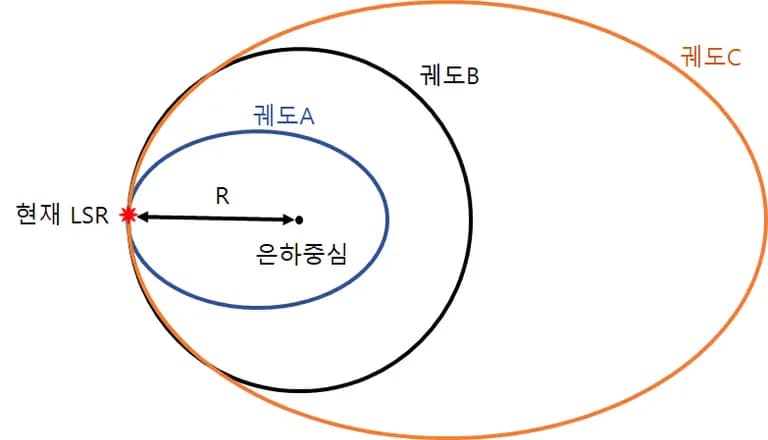
Let's compare the speeds relative to the LSR by assuming three orbits.
1) Orbit A has an aphelion at the LSR position and a perihelion near the galactic center. In this case, it will move slower than a celestial body in perfect circular orbit.
2) Orbit B is a perfect circular orbit passing through the LSR. This is the speed by which the LSR is defined.
3) Orbit C has a perihelion at the LSR position and an aphelion toward the galactic center. In this case, it will move faster than a celestial body in perfect circular orbit.
Therefore, a celestial body in Orbit B appears completely stationary relative to the LSR, while celestial bodies in Orbits A and B appear to move in opposite directions relative to the LSR.
Let's consider another example.
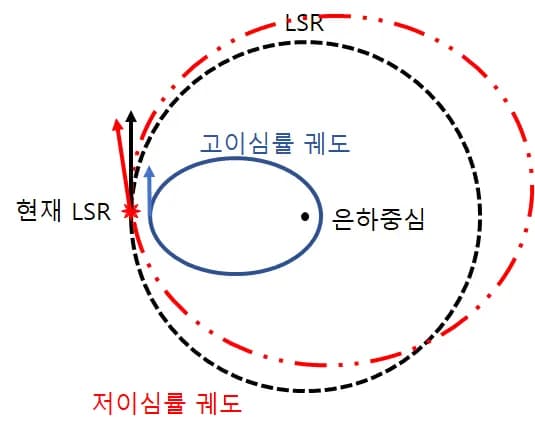
Each arrow indicates the speed and direction of a celestial body in its orbit.
How would celestial bodies orbiting around the LSR appear?
It's like the difference of vectors.
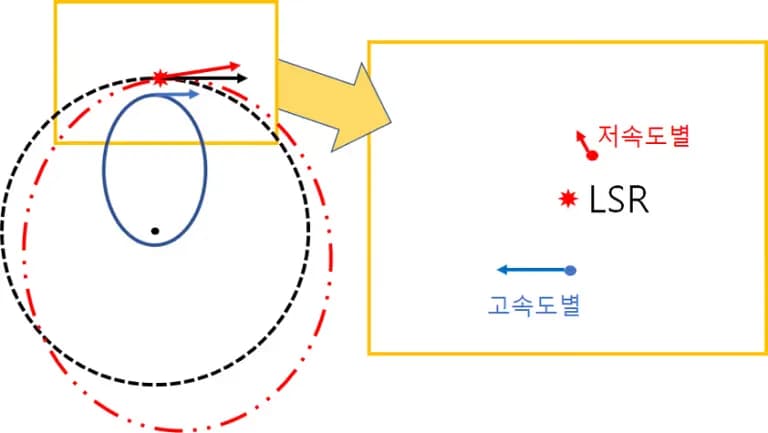
The speed of the two celestial bodies as seen from the LSR differs from their actual speed.
A celestial body in a high-eccentricity orbit appears to move rapidly due to a large speed difference with the LSR, even though its actual speed is slow.
A celestial body in a low-eccentricity orbit, which is faster in actual speed, appears to move slowly as the speed difference with the LSR is slight.
The important thing is that the speed observed from the LSR is not the actual speed but illustrates how it moves relative to a perfect circular orbit.
When examining the actual movement of our galaxy, celestial bodies appear to move in three different axial directions relative to the LSR.
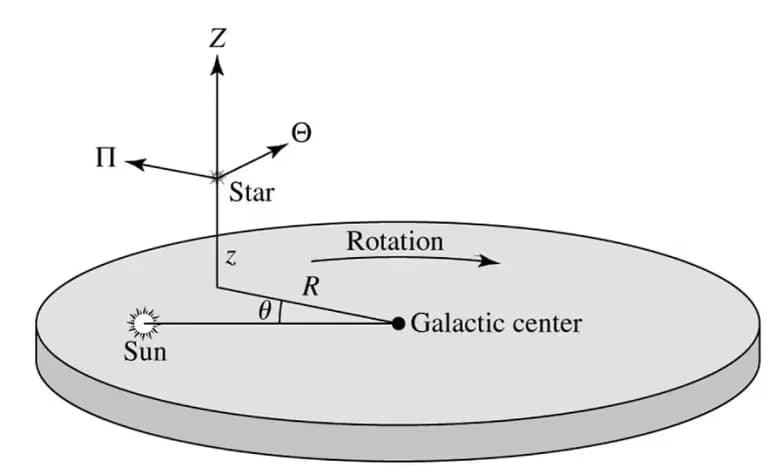
3. Conclusion
1) The LSR assumes the Sun's position and the speed of a celestial body in a perfect circular orbit.
2) It shows how other celestial bodies move relative to this.
3) Observing celestial motion through the LSR demonstrates how our galaxy rotates concerning actual circular motion.
4) Depending on where a celestial body was born, it will show a different position on the LSR. Look these characteristics up as needed to memorize them.




댓글을 불러오는 중...