This time, it’s the last stop in our tour of Earth Science.
We’re going to look at Unit 3.
1. Content structure
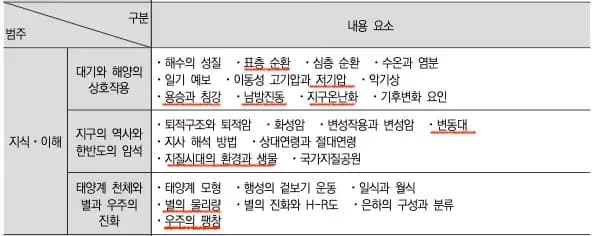
In the content structure of Unit 3, the topics of exoplanets and the search for life, which used to be in the celestial bodies unit of Earth Science I, have been removed, and the solar system model and solar and lunar eclipses that were in Earth Science II have been newly added.
Compared to other units, the content feels considerably reduced.
2. Achievement standards for Unit 3
[12지구03-01] Understand eclipse phenomena in the Sun–Earth–Moon system and be able to explain the apparent motion of planets in the solar system using models.
[12지구03-02] Understand the process of determining stellar spectral types and classifying stars, and be able to infer stellar physical quantities using the blackbody radiation law.
[12지구03-03] Be able to plot and interpret the evolutionary paths of stars with various masses on the H–R diagram.
[12지구03-04] Compare the characteristics of galaxies according to Hubble’s classification scheme and, using data on external galaxies, infer observational characteristics of peculiar galaxies.
[12지구03-05] Understand the expansion of the universe via the Hubble–Lemaître law and, from the perspective of modern cosmology, compare the significance of various explanatory frameworks for the evolution of the universe.
3. Looking into the content
1) Sun–Earth–Moon system and eclipse phenomena, apparent motion of planets in the solar system [12지구-03-01]
For this content, it’s good to refer to Earth Science I in the 2009 revised curriculum and Earth Science II in the 2015 revised curriculum.
First, for questions about the Sun–Earth–Moon system and eclipse phenomena, read the question below.
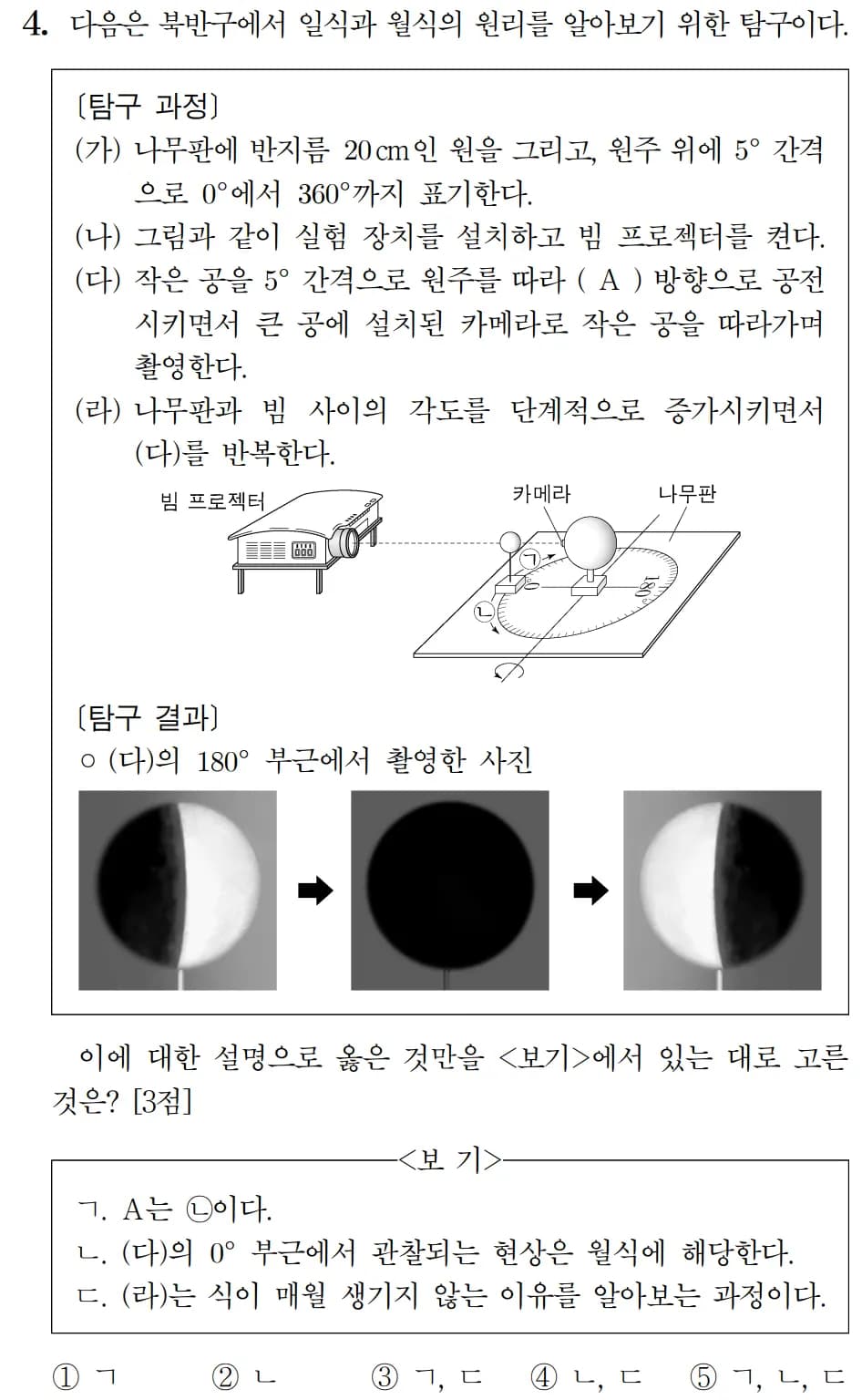
This is a question from the September 2019 mock exam for 12th‑grade Earth Science I.
It’s a question that investigates the change in the Moon’s phases in the form of an experiment.
Since it’s about the change in lunar phases seen from the Northern Hemisphere, the direction of rotation must be counterclockwise when viewed from the Northern Hemisphere.
Also, near 0 degrees a solar eclipse will occur, and as the angle between the wooden board and the beam increases, Earth’s shadow can no longer reach the Moon, so a lunar eclipse may not occur.
Therefore, the answer is choice 3.
The next question is about the apparent motion of planets.
You can think of it as an easier version of the content on celestial coordinate systems from Earth Science II in the 2015 revised curriculum, with the coordinate system part removed.
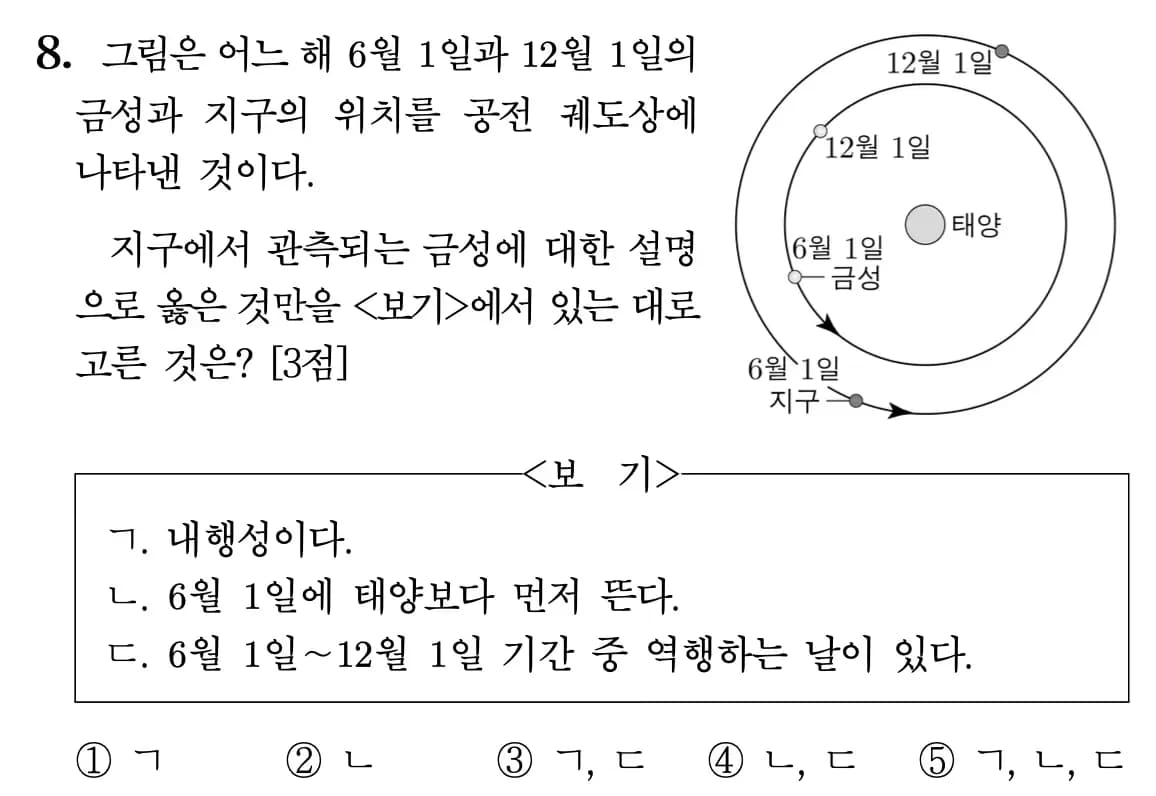
Even though it’s a question from the September mock exam, the difficulty isn’t that high.
All you need is the fact that Venus is an inferior planet and therefore has a faster orbital speed, and you solve the problem by considering the relative positions of Earth and the planet.
2) Stellar classification and various physical quantities [12지구-03-02]
Over roughly the last three years, many problems have been asked in the following format.
It’s not easy to calculate the numbers directly, and you have to solve them through inference, so each statement in the choices demanded a lot of time.
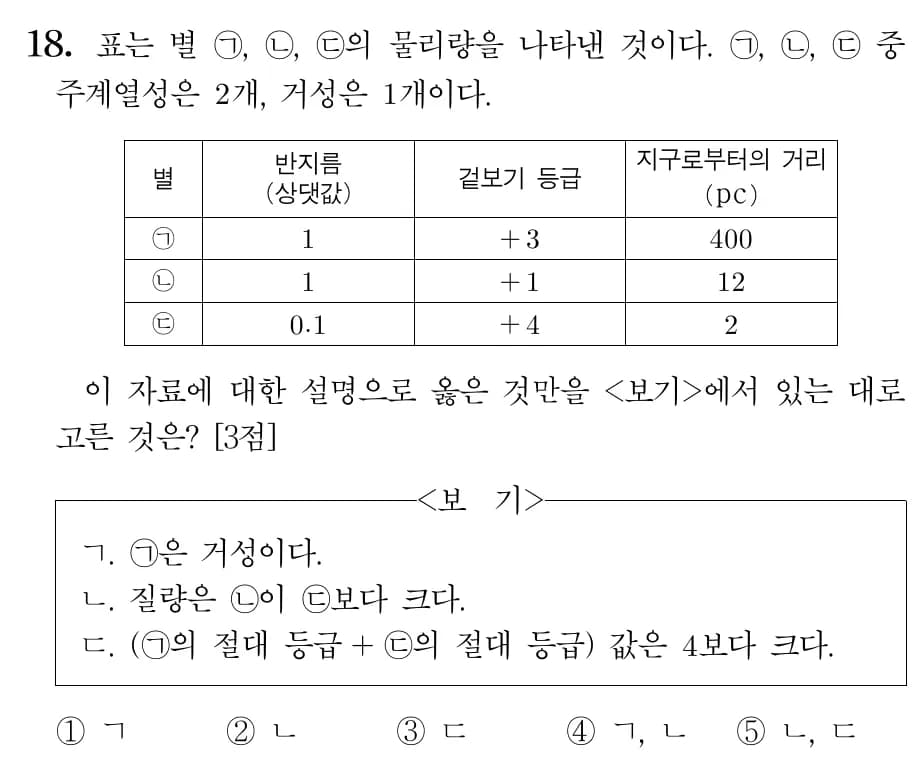
Let’s look at choice ㄷ as an example.
Since the distance to star ㉠ is 400 pc, it must be brighter than magnitude 3 by a factor of (10×4)², and since the distance to star ㉢ is 2 pc, it must be 5 times fainter than magnitude 4.
The brightness difference of one magnitude is a factor of 2.5, for two magnitudes it’s 6.25 times, and for a difference of five magnitudes it’s 100 times.
Based on this and reasoning it out, the absolute magnitude of star ㉠ is roughly brighter than magnitude −5 (3rd magnitude − 5 magnitudes − 2 magnitudes or more = ≤ −5), and the absolute magnitude of ㄷ is about 1–2 magnitudes fainter than 4th magnitude, so the sum of the two values is less than 4.
Because you have to solve it like this, it takes a long time.
3) H–R diagram and characteristics of stars, stellar evolution and energy generation [12지구-03-03]
Questions that use only the H–R diagram itself are low in difficulty, so they haven’t been asked very often.
Usually, questions combine the H–R diagram with other concepts, as in the example below.
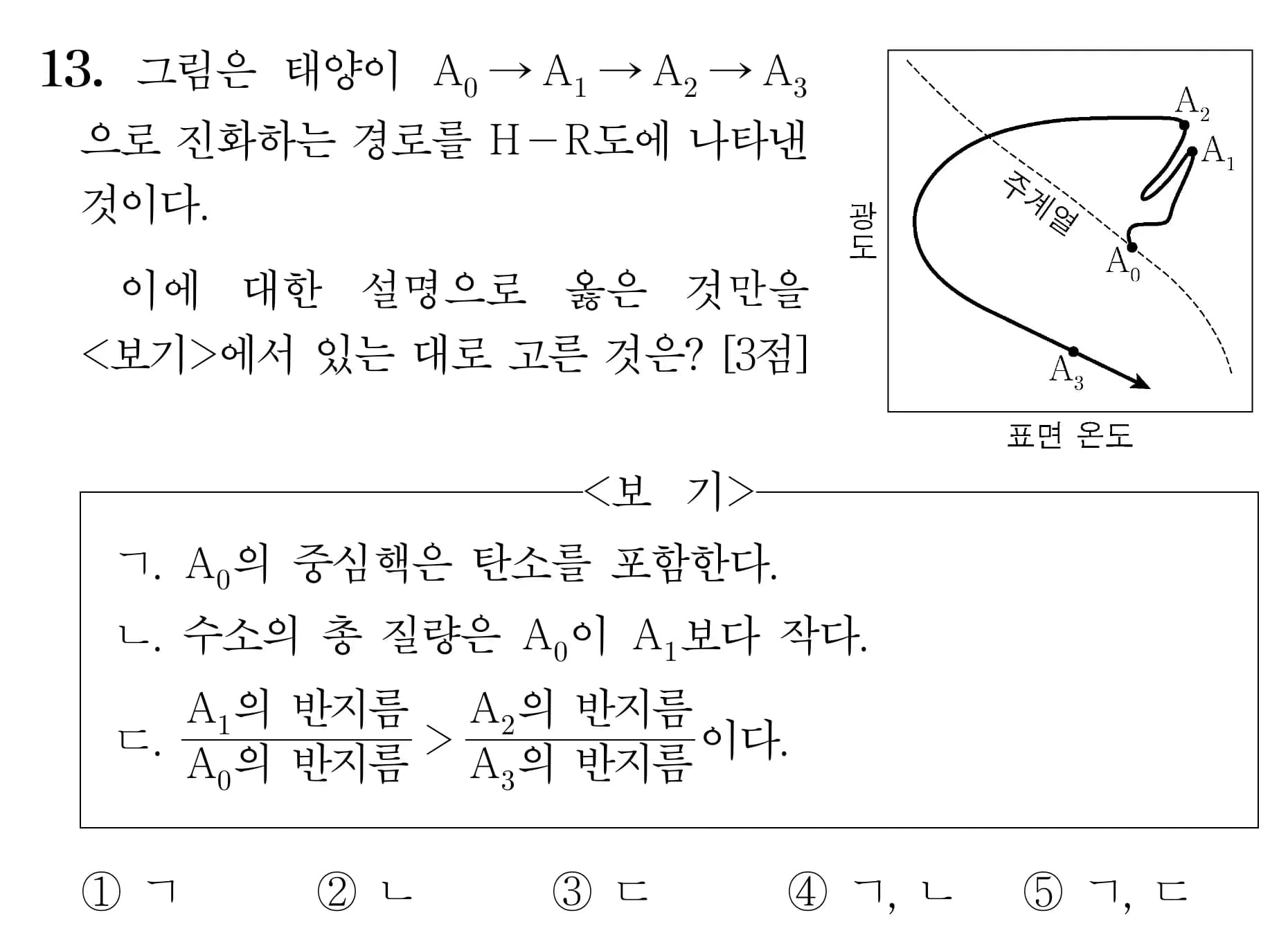
The question combines several concepts: plotting the evolutionary path of a star on the H–R diagram, the elements that can be produced in each evolutionary stage, stellar size, and the energy sources during stellar evolution.
If you use only the topics of stellar energy sources and internal structure, you can also get questions like the one below.
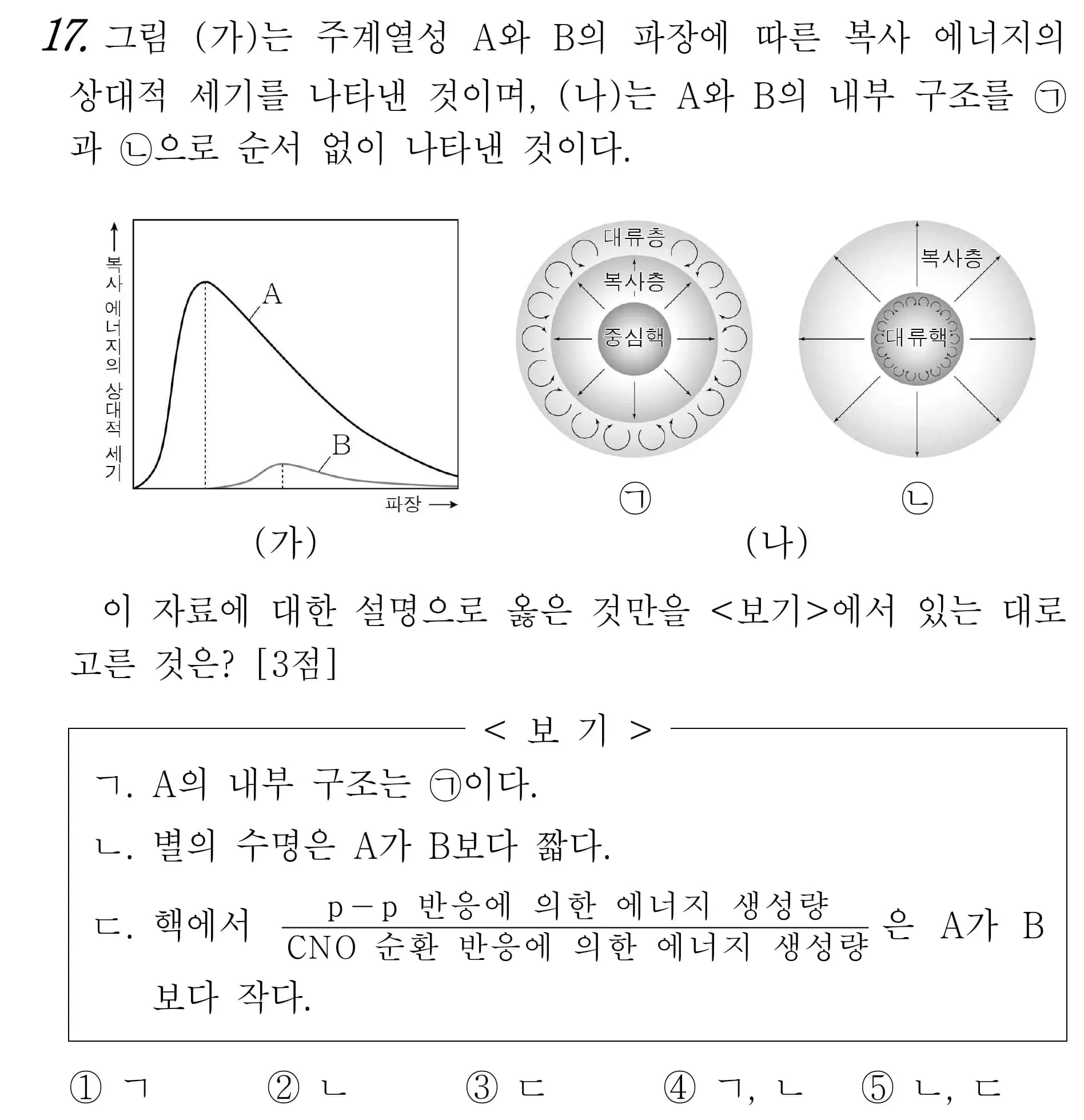
Since it’s a question from the March 2025 exam for 12th‑graders, the difficulty is not that high, though it’s worth 3 points.
It may look difficult, but once you study it, you’ll find it easy.
4) Galaxy classification and peculiar galaxies [12지구-03-04]
This is about Hubble’s tuning fork diagram and peculiar galaxies.
If you take galaxy classification too lightly, you might be caught off guard.
Even as an Earth Science teacher with 10 years of experience, every time I see these questions I wonder where they keep finding such unfamiliar graphs.
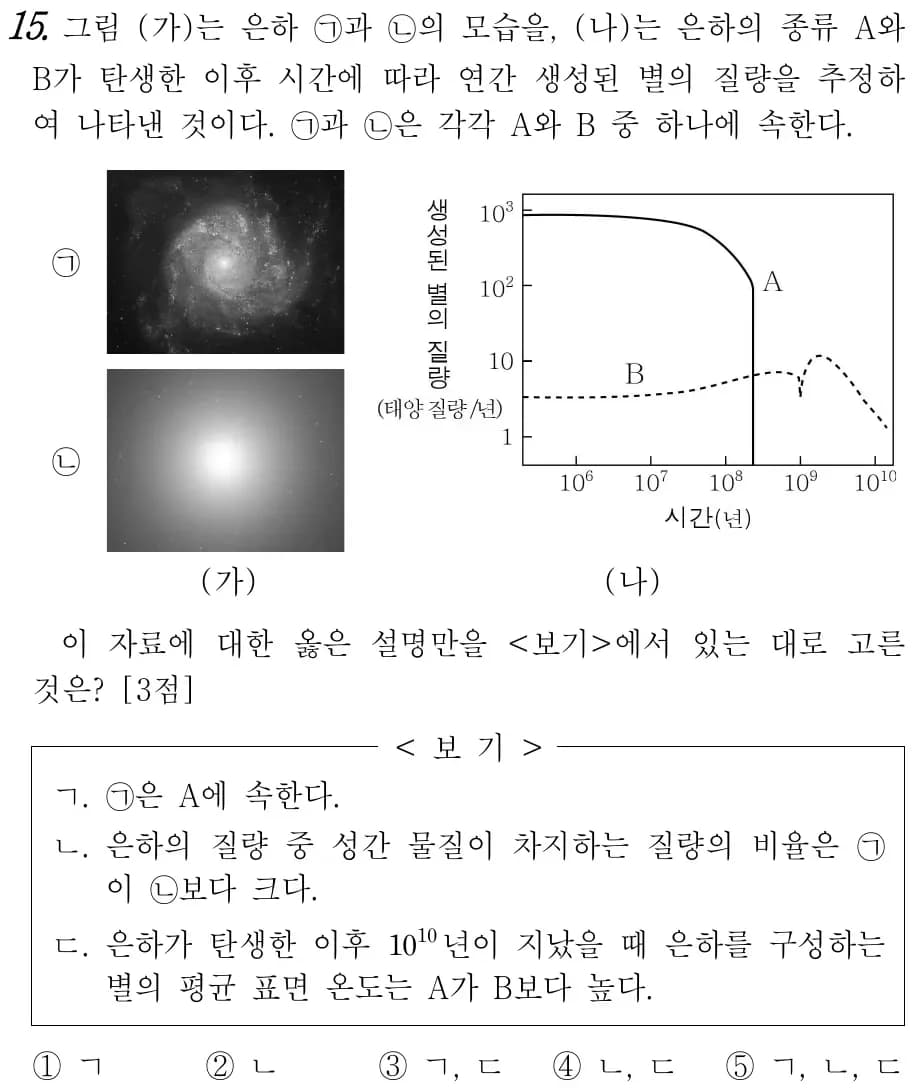
The key concepts here are that in spiral galaxies, star formation is active in the spiral arms, whereas in elliptical galaxies, there is almost no star formation.
Let’s also look at a question on peculiar galaxies.
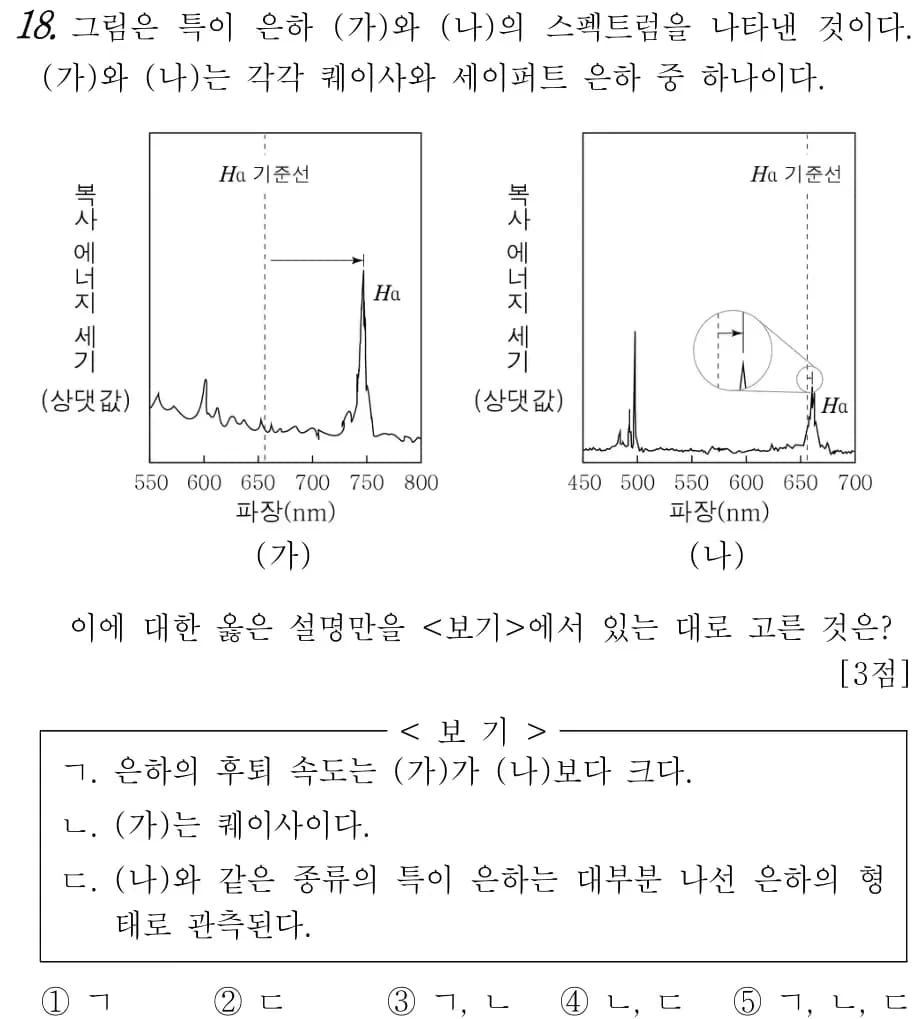
For the spectra of peculiar galaxies, once you memorize the figure above, that’s basically all you need.
True to the name “peculiar galaxy,” there aren’t that many types of spectra that can realistically be used in exam questions.
5) Expansion of the universe and the establishment of cosmology [12지구-03-05]
You can think of this as a somewhat milder version of the content in Earth Science I of the 2015 revised curriculum, with concepts such as dark energy, dark matter, and ordinary matter removed.
There seem to be many different styles of questions that could be used as examples.
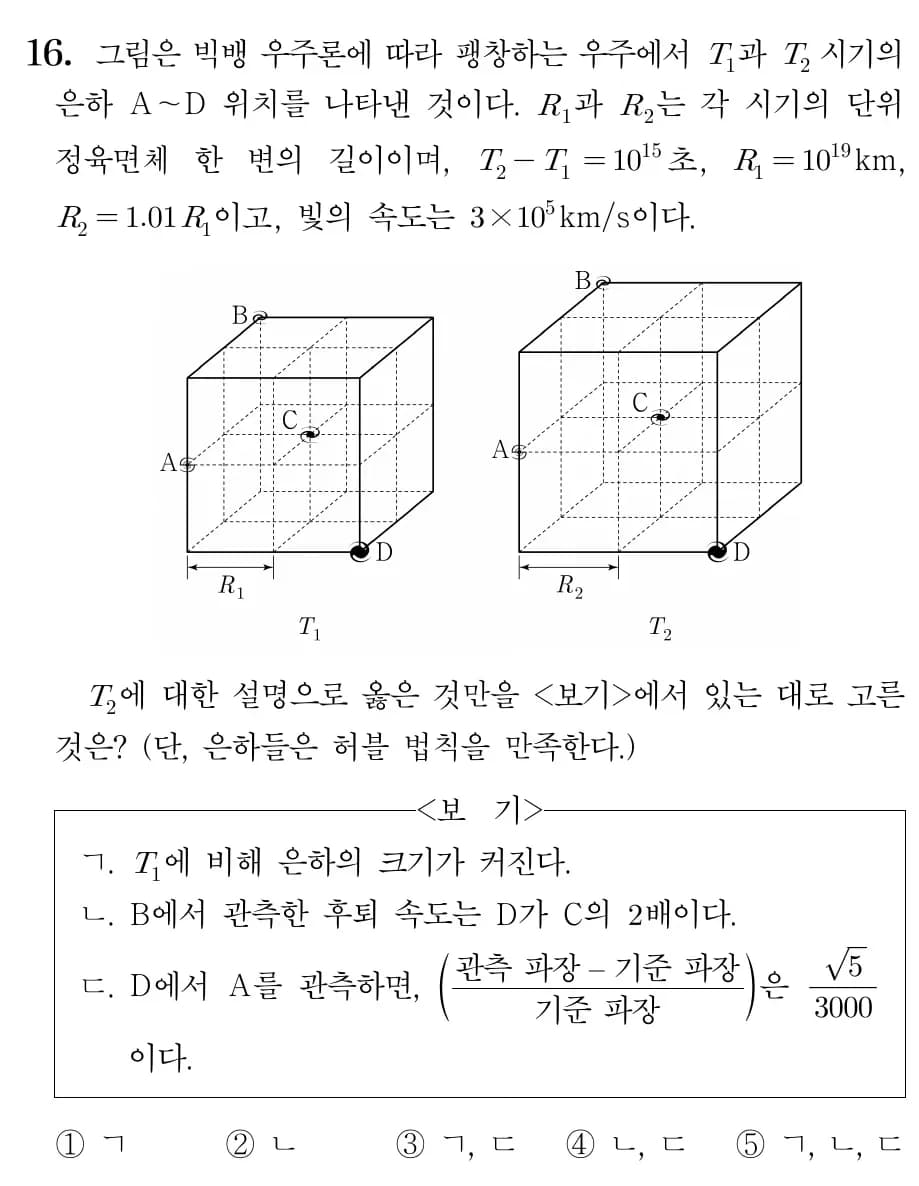
The question that appeared in September 2025 used Hubble’s law to ask a question like the one above.
You can figure out how to solve it, but it takes a lot of time and you don’t really feel like doing it.
4. Summary
There aren’t many concepts that overlap with Integrated Science.
Concepts learned in Integrated Science
 - Types of spectra, evidence for the Big Bang cosmology, history of the universe, etc.
New concepts
 - Everything else
5. Closing remarks
In this way, we’ve taken a look at the curriculum using example questions.
Anyone familiar with the existing Earth Science curriculum will know that it hasn’t changed all that much.
From the perspective of the students taking this subject, they have to spend more than half a semester studying a subject they won’t even take on the CSAT, so I really hope they choose it carefully.
If possible, look at your intended career path and the recommended high school subjects listed by the universities, and choose accordingly.
Below is “Recommended High School Courses for Natural Science Fields for the 2028 University Entrance Cohort” announced by Kyung Hee University.
I hope everyone reading this will do well.






댓글을 불러오는 중...