In the previous post, we looked at the contents of Unit 1 along with some questions.
This time as well, let’s continue with that post and take a look at the contents of Unit 2.

1. Content structure
Let’s look at the content structure of Unit 2.
At first glance, it feels like there is quite a lot to memorize.
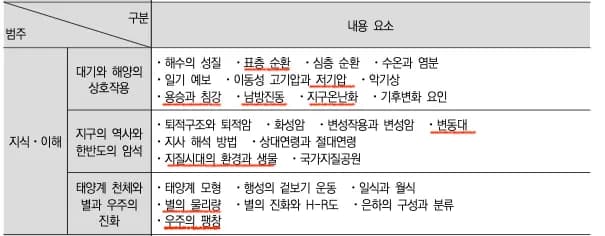
Unlike the 2015 revised curriculum, sedimentary rocks, metamorphic rocks, and igneous rocks are all included.
Also, the content element of “national geopark” has been newly added.
The specific details will differ from textbook to textbook, but it seems they will introduce Korea’s geoparks using the rocks learned earlier and geological analysis methods.
2. Achievement standards for Unit 2
As before, let’s look at the achievement standards with a bit of explanation and some questions.
[12지구02-01] 지층 형성의 선후 관계를 결정짓는 법칙들을 활용하여 상대 연령을 비교하고, 방사성 동위 원소를 이용한 광물의 절대 연령 자료로 암석의 절대 연령을 구할 수 있다.
[12지구02-02] 지질시대를 기(紀) 수준에서 구분하고, 지층과 화석을 통해 지질시대의 생물과 환경 변화를 해석할 수 있다.
[12지구02-03] 변동대에서 마그마가 생성되고, 그 조성에 따라 다양한 화성암이 생성됨을 설명할 수 있다.
[12지구02-04] 변성작용의 종류와 지각 변동에 따른 구조를 변동대와 관련지어 설명하고, 지구시스템에서 암석이 순환함을 추론할 수 있다.
[12지구02-05] 우리나라의 대표적인 지질공원의 지질학적 형성 과정을 추론하고, 지역사회와 함께하는 지질공원의 지속가능한 발전방안을 제안할 수 있다.
3. Looking at the content
1) Sequence of strata and the age of rocks (12지구02-01)
[12지구02-01] 지층 형성의 선후 관계를 결정짓는 법칙들을 활용하여 상대 연령을 비교하고, 방사성 동위 원소를 이용한 광물의 절대 연령 자료로 암석의 절대 연령을 구할 수 있다.You learn methods for comparing the ages of rocks.
This covers the five major principles of historical geology, correlation based on the order of formation of strata, and absolute age.
Typical questions are as follows.
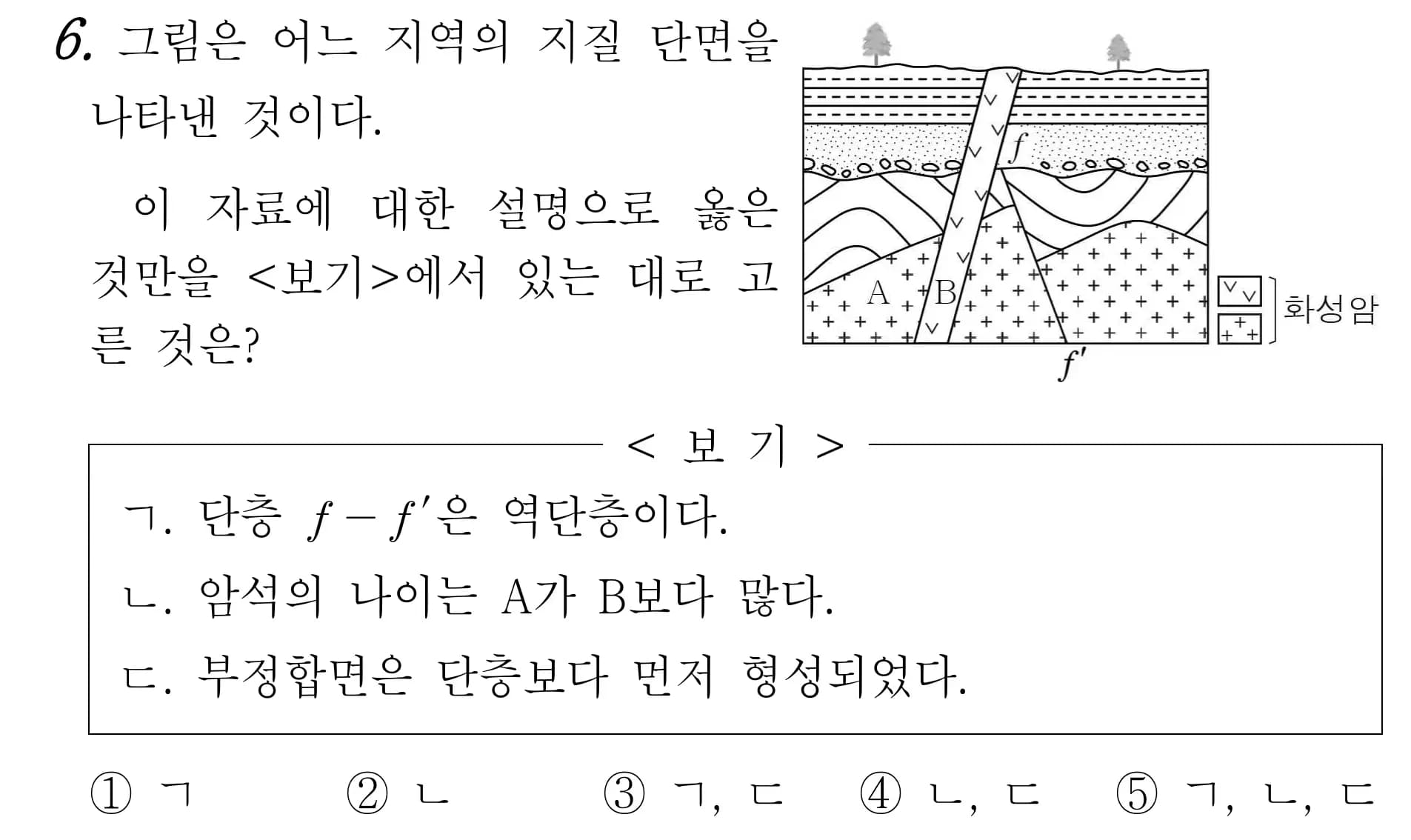
Since the 2022 revised Earth Science curriculum deals with metamorphic, igneous, and sedimentary rocks all together, questions on historical geology are likely to become even more complex.
The content itself is not particularly difficult, but recent Earth Science questions have been shifting toward consuming a lot of time.
Take a look at the question below as well.
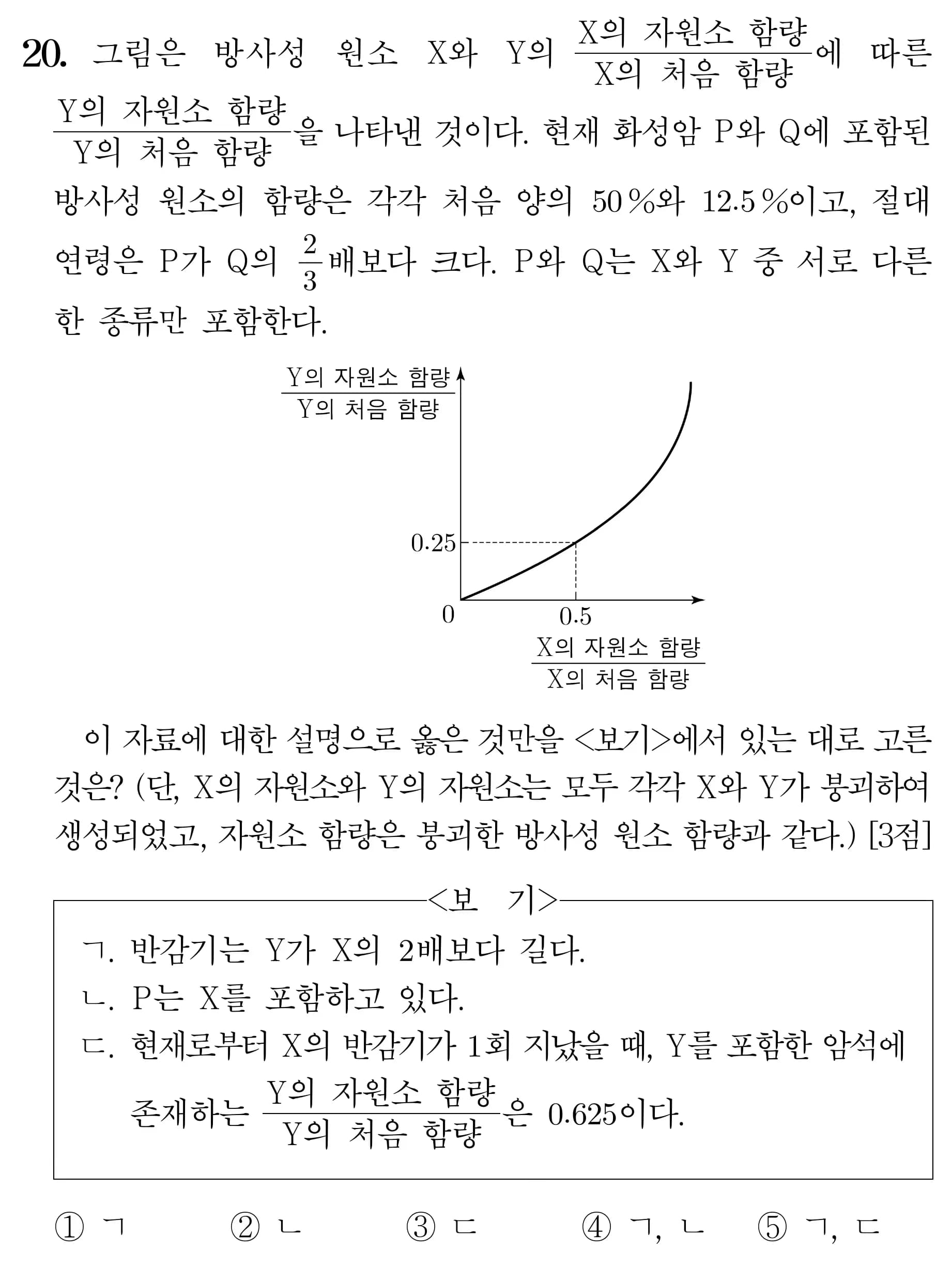
Whether you’ll even choose Earth Science or not is uncertain, so the content itself isn’t the crucial part.
The key is that you have to choose which mineral contained in the igneous rock has which half‑life and what it includes.
The questions are designed to make you spend a lot of time and induce mistakes even if you know the concept.
2) Sedimentary strata and the environments of geologic time (12지구02-02)
[12지구02-02] 지질시대를 기(紀) 수준에서 구분하고, 지층과 화석을 통해 지질시대의 생물과 환경 변화를 해석할 수 있다.This part was covered once in Integrated Science.
But it would be a mistake to think it has the same depth as Integrated Science.
In Integrated Science you memorized Precambrian, Paleozoic, Mesozoic, and Cenozoic eras, but here you memorize at the period level, which is smaller than an era.
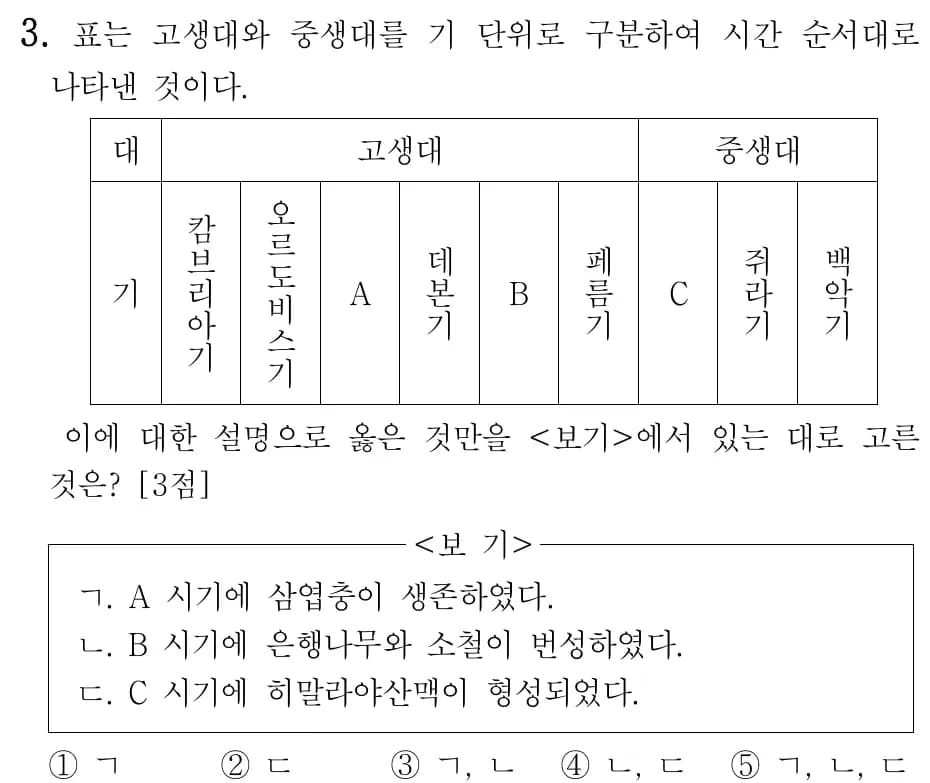
Just think of it as memorizing what appeared when, across the board.
For this unit, memorization is basically the only way to survive.
Hopefully you can take comfort in the fact that it’s related to what you learned in Integrated Science.
And perhaps because the latter part of the achievement standard says to interpret changes in organisms and environments of geologic time through strata and fossils, this section also includes sedimentary rocks and sedimentary structures, as well as paleoclimate research using fossils.
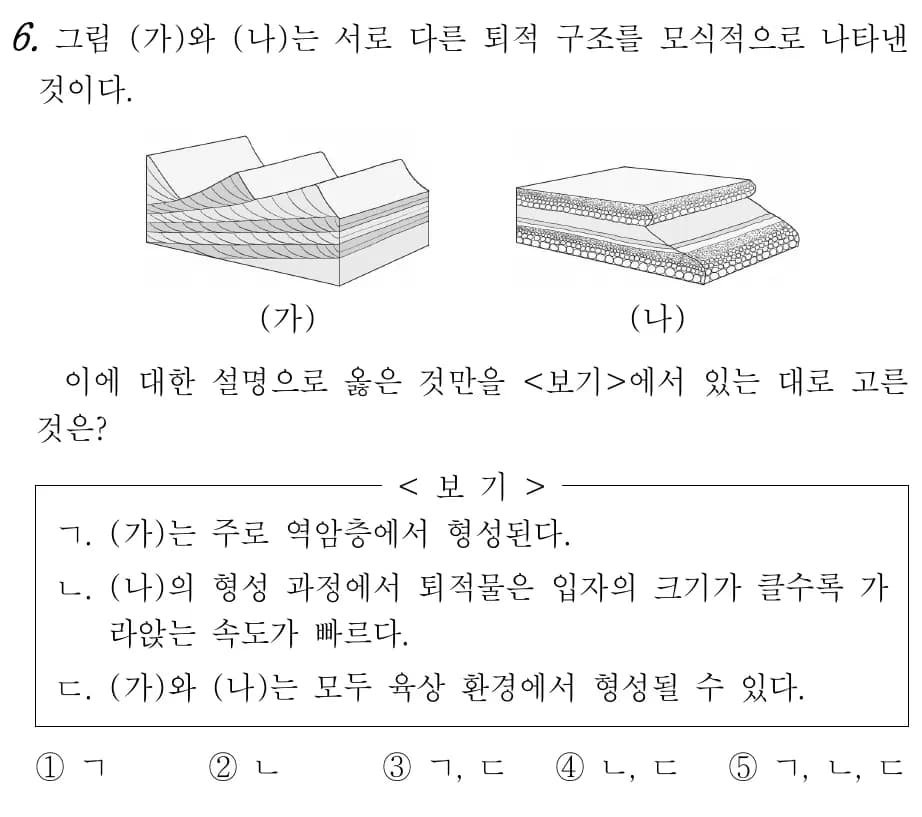
The type of question above is a common type of sedimentary structure question.
Sedimentary structures are just mud cracks, cross‑bedding, graded bedding, and ripple marks, so they’re not particularly difficult.
Paleoclimate research appears in Unit 4 in the 2015 revision, but it seems they’ve mixed things together in a rough yet workable way.
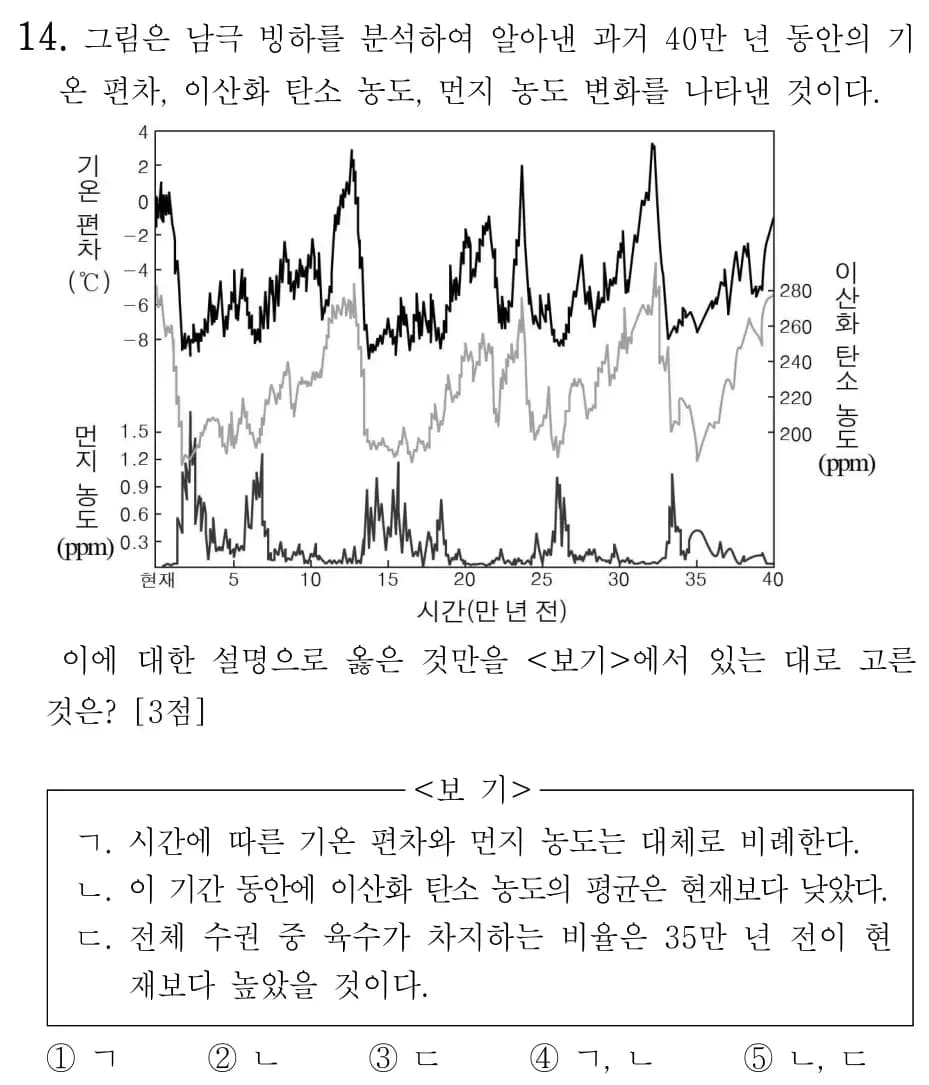
The difficulty level of previously asked questions on these topics isn’t very high.
In most cases, you can solve them using only the information provided in the question.
3) Magma generation and igneous rocks (12지구02-03)
[12지구02-03] 변동대에서 마그마가 생성되고, 그 조성에 따라 다양한 화성암이 생성됨을 설명할 수 있다.This unit will probably feel somewhat unfamiliar.
It deals with mechanisms of magma generation, types of igneous rocks, xenoliths and intrusion, joints, and igneous rock landforms in Korea.
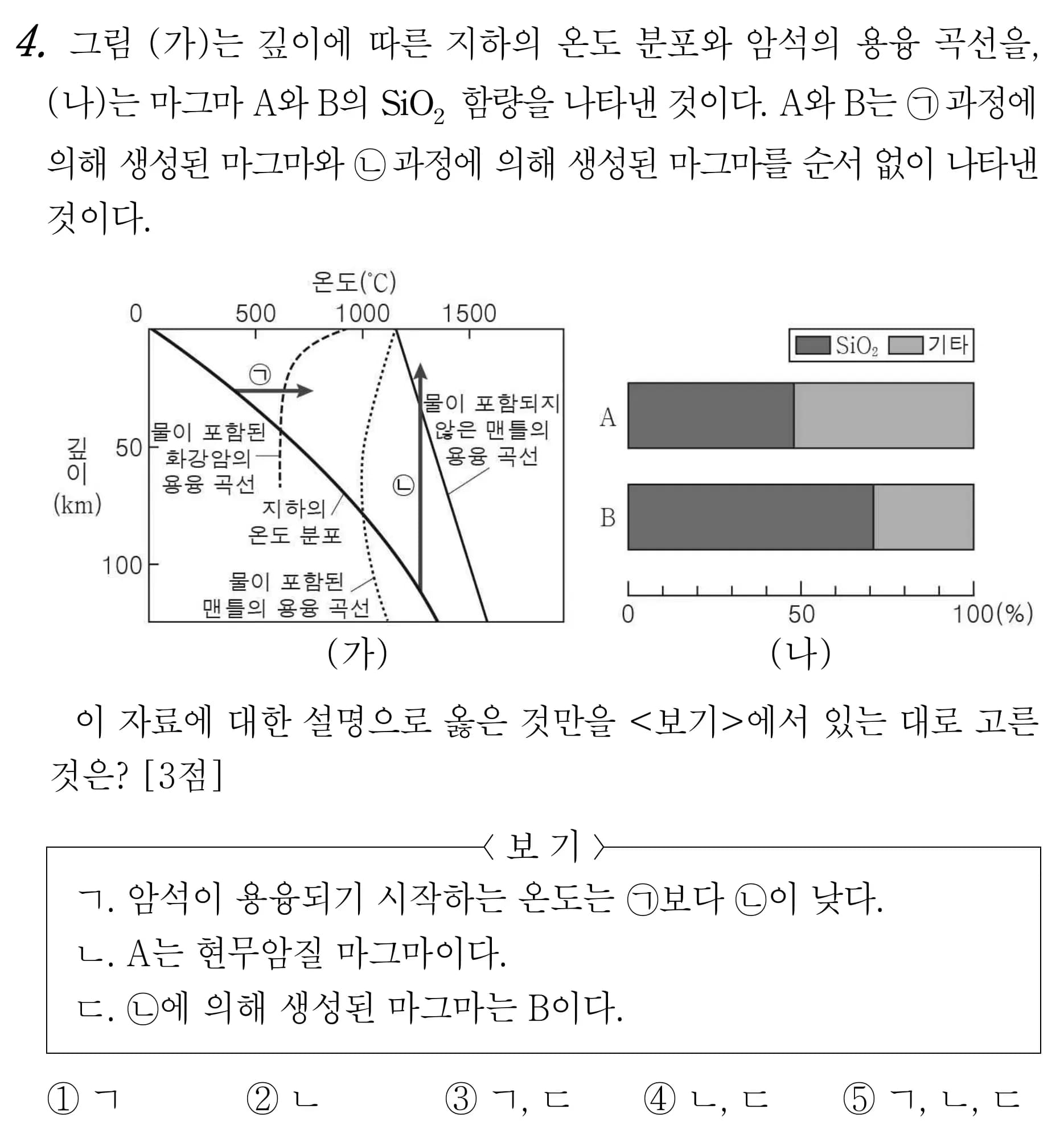
The question above is about mechanisms of magma generation.
Figure (a) is the most important figure in this section.
It only feels difficult because you’re encountering it for the first time; once you understand it, it’s not that hard.
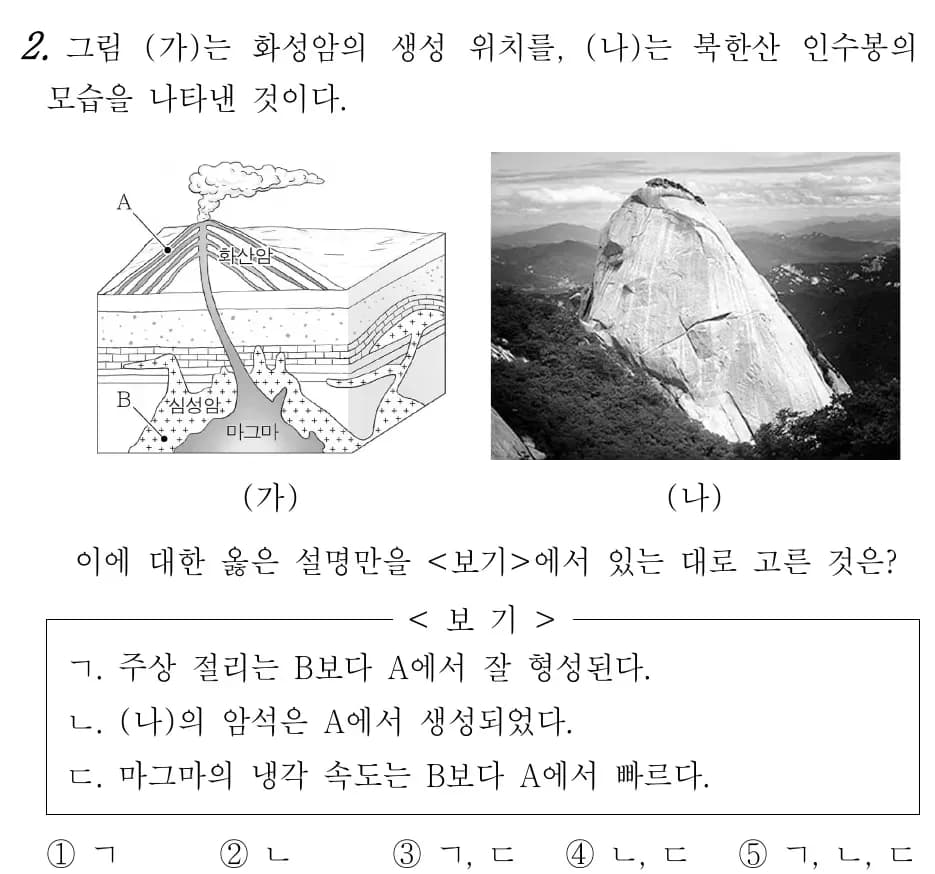
This kind of question also belongs to this unit.
It covers classification of igneous rocks, joints, and even igneous rock landforms all together.
4) Metamorphism and the rock cycle (12지구02-04)
[12지구02-04] 변성작용의 종류와 지각 변동에 따른 구조를 변동대와 관련지어 설명하고, 지구시스템에서 암석이 순환함을 추론할 수 있다.In the 2015 revised curriculum, metamorphic rocks were covered in Earth Science II, but they have now been moved down into Earth Science.
Here, you study the metamorphic process and metamorphic rocks, folding and faults, simple plate boundaries, and notable geological sites.
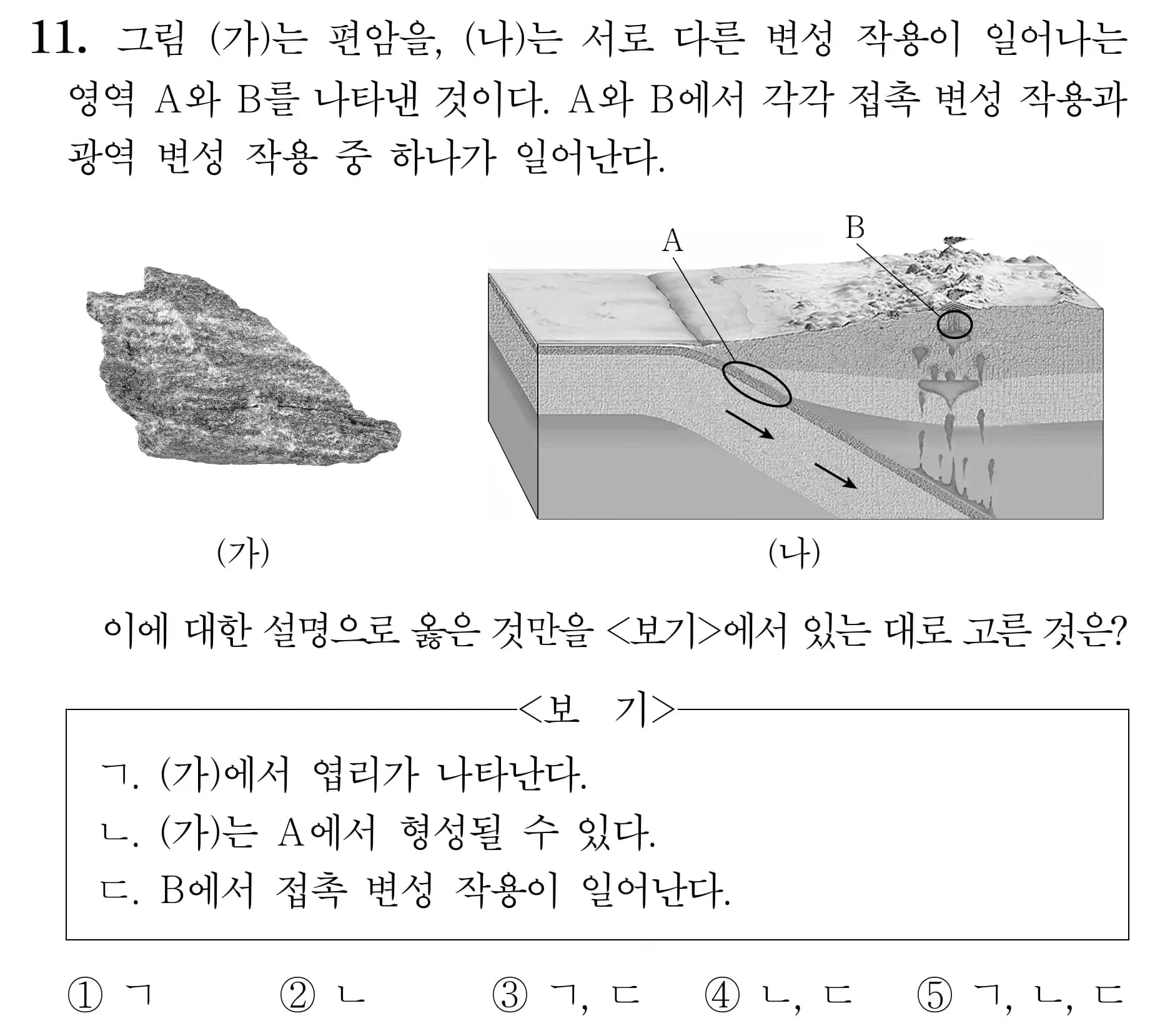
The question above deals with metamorphic rocks, mobile belts, foliation in rocks, and metamorphism together.
It includes a lot of content, so it could be considered a representative question for this unit.
5) Geological attractions of the Korean Peninsula and national geoparks (12지구02-05)
[12지구02-05] 우리나라의 대표적인 지질공원의 지질학적 형성 과정을 추론하고, 지역사회와 함께하는 지질공원의 지속가능한 발전방안을 제안할 수 있다.This unit was briefly removed in a previous curriculum but has been included again.
If it appears on exams, you’ll probably have to memorize all the Earth‑science‑related travel attractions in Korea, similar to “travel geography.”
You’ll need to know the names, locations, time of formation, and formation processes of landforms such as Danyang, the Gogunsan Archipelago, Ulleungdo, Gumosso, and so on.
The question below is from 2017, and my guess is that questions in this style will return.
4. Summary
Once again, I looked for concepts that overlap with Integrated Science.
Concepts learned in Integrated Science
 - Mobile belts (plate boundaries), environments and organisms of geologic time
New concepts
 - Everything else
The further you go toward the end of the unit, the fewer overlaps there are with what you learned in Integrated Science.
This makes me think they might have considered the hierarchy of learning.
5. Closing remarks
Since Integrated Science is now included in the CSAT, I’m planning to reconstruct the entire Earth Science curriculum and teach only the parts that overlap with Integrated Science.
That’s why I feel it’s more meaningful to take this kind of overview.
I should probably put together a summary for Chapter 3 as well.


댓글을 불러오는 중...