The 2022 revised curriculum has to be taught starting this March.
Even I hadn’t properly looked at what appears in the revised curriculum, so I decided to go through it carefully.
Since uploading the textbook itself to the blog would cause copyright issues, let’s instead deal with the officially announced revised curriculum content and some example questions.
1. Content Structure
The content structure is basically a difficult way of saying, “This is the kind of stuff that appears here.”
If you look at the “content elements” in the middle, you can see the important concepts.
Most Earth science teachers can get a rough idea of the unit just by looking at the content elements.

I underlined only those parts of the Earth science content that are related to Integrated Science.
Now that Integrated Science is a CSAT subject, if you study a bit harder on the underlined units when learning Earth science, you’ll likely get good results on the CSAT as well.

Today, I’d like to deal with Unit 1: Interaction Between the Atmosphere and the Ocean.
Let’s tackle the remaining units one by one in separate posts.
For reference, the unit names are based on the Cheonjae textbook.
2. Achievement Standards for Unit 1
The achievement standards for this unit are as follows.
Let’s go through the content one by one along with the achievement standards.
[12지구01-01] 해수의 물리적, 화학적 성질을 이해하고, 실측 자료를 활용하여 해수의 온도, 염분, 밀도, 용존 산소량 등의 분포를 분석⋅해석할 수 있다.
[12지구01-02] 심층 순환의 발생 원리와 분포를 알고, 표층 순환 및 기후변화의 관련성을 추론할 수 있다.
[12지구01-03] 중위도 저기압과 고기압이 통과할 때 날씨의 변화를 일기도, 위상 영상, 레이더 영상을 종합하여 예측할 수 있다.
[12지구01-04] 태풍의 발생, 이동, 소멸 과정 및 태풍 영향권에서 날씨를 예측하고, 뇌우, 집중호우, 폭설, 강풍, 황사 등 주요 악기상의 생성 메커니즘과 대처 방안을 제시할 수 있다.
[12지구01-05] 대기와 해양의 상호작용의 사례로서 해수의 용승과 침강, 엘니뇨-남방진동(ENSO)의 현상의 진행 과정 및 관련 현상을 설명할 수 있다.
[12지구01-06] 기후변화의 원인을 자연적 요인과 인위적 요인으로 구분하여 설명하고, 인간 활동에 의한 기후변화 문제를 과학적으로 해결하는 방법을 탐색할 수 있다.
3. Looking at the Content
1) Various Properties of Seawater (12지구01-01)
[12지구01-01] 해수의 물리적, 화학적 성질을 이해하고, 실측 자료를 활용하여 해수의 온도, 염분, 밀도, 용존 산소량 등의 분포를 분석⋅해석할 수 있다.This part might feel a bit unfamiliar.
Among the physical quantities of seawater, this deals with water temperature, salinity, density, and dissolved gases (amount of oxygen).
There is something called a temperature–salinity diagram (T–S diagram), which can be used to represent how these physical quantities vary with depth.
For example, you might see a question like the one below.
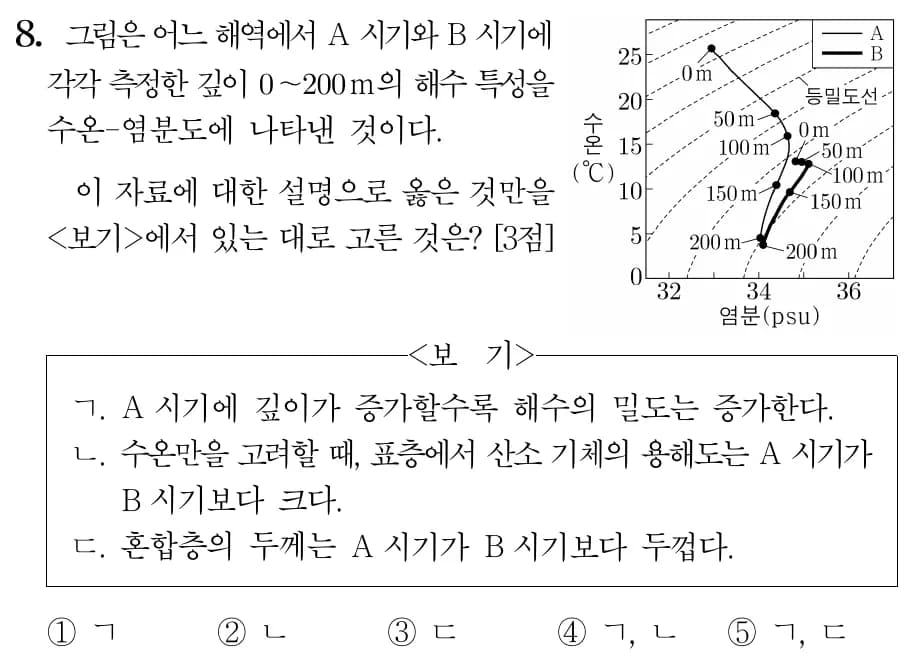
Setting everything else aside, you probably at least know the concept of the mixed layer in ⑶.
The mixed layer is the layer in which the seawater temperature does not change and remains constant.
So between period A and period B above, you can tell that the mixed layer is thicker in period B.
This is because from 0 m to 100 m, the temperature does not change and the points line up in a straight line.
In this unit, you learn about the physical quantities of seawater and about ways of representing those quantities.
2) Circulation of Seawater and Climate Change (12지구01-02)
[12지구01-02] 심층 순환의 발생 원리와 분포를 알고, 표층 순환 및 기후변화의 관련성을 추론할 수 있다.This section deals with the overall circulation of seawater.
The content on surface circulation should feel familiar, since you’ve encountered it in Integrated Science.
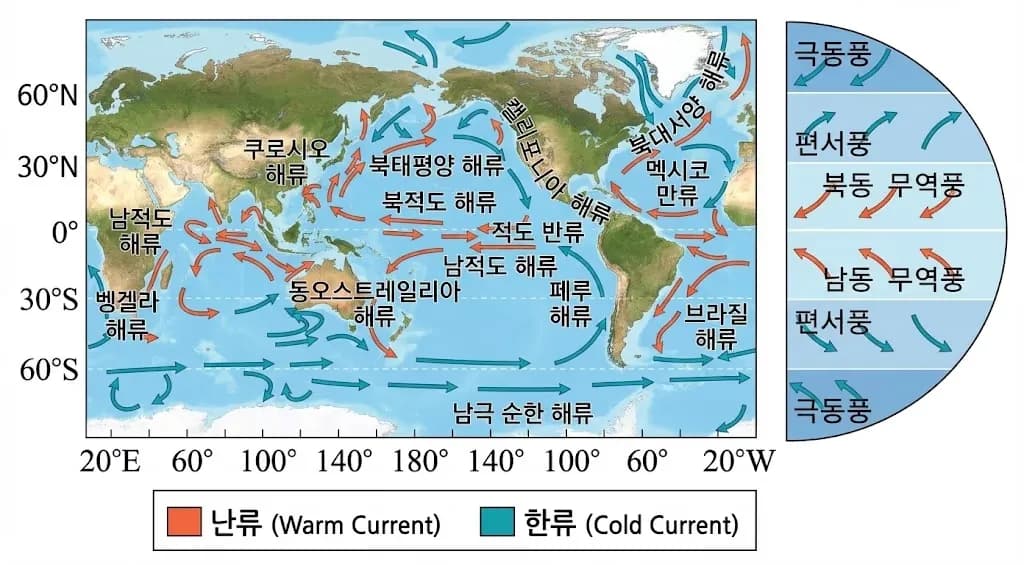
You don’t need to memorize the names of all the currents shown above.
The important point is that ocean currents generally flow in directions similar to the wind.
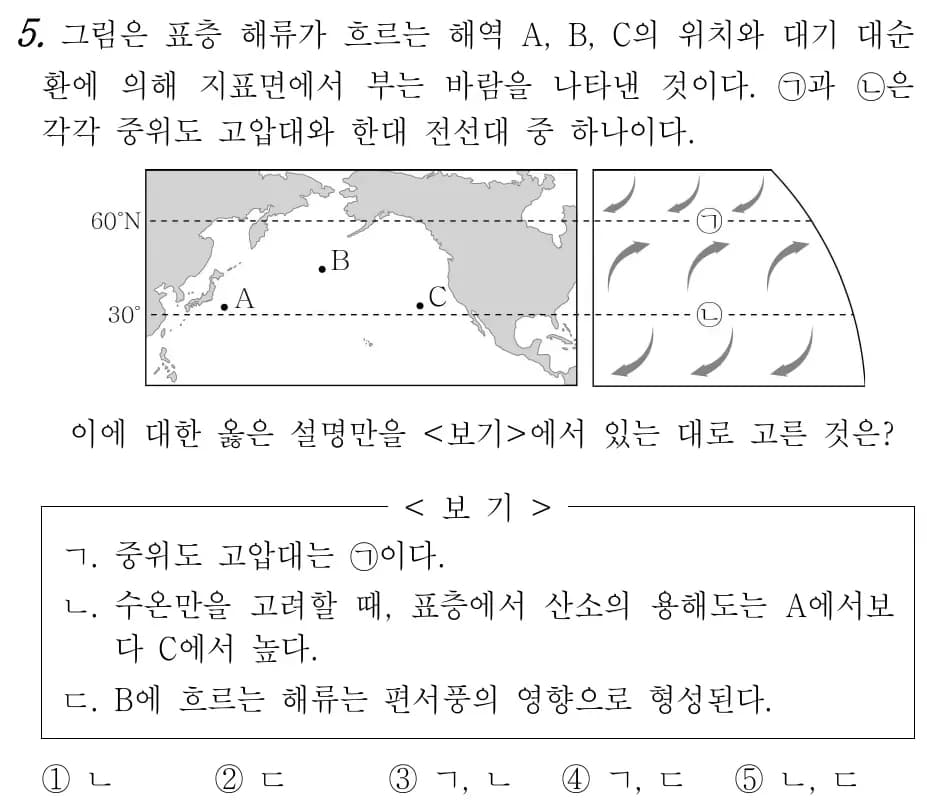
In the North Pacific, the Kuroshio Current and the California Current flow in the latitudinal direction after currents driven by wind are blocked by the continents.
An example question related to this is shown below.
The deep circulation of seawater will probably be your first encounter with this topic in Earth science.
In places like the sea off Greenland, when the seawater temperature drops, its density increases and the water sinks.
The water that has sunk in this way eventually rises back to the surface somewhere on Earth.
This process is called deep-ocean circulation, or thermohaline circulation, or sometimes density currents.
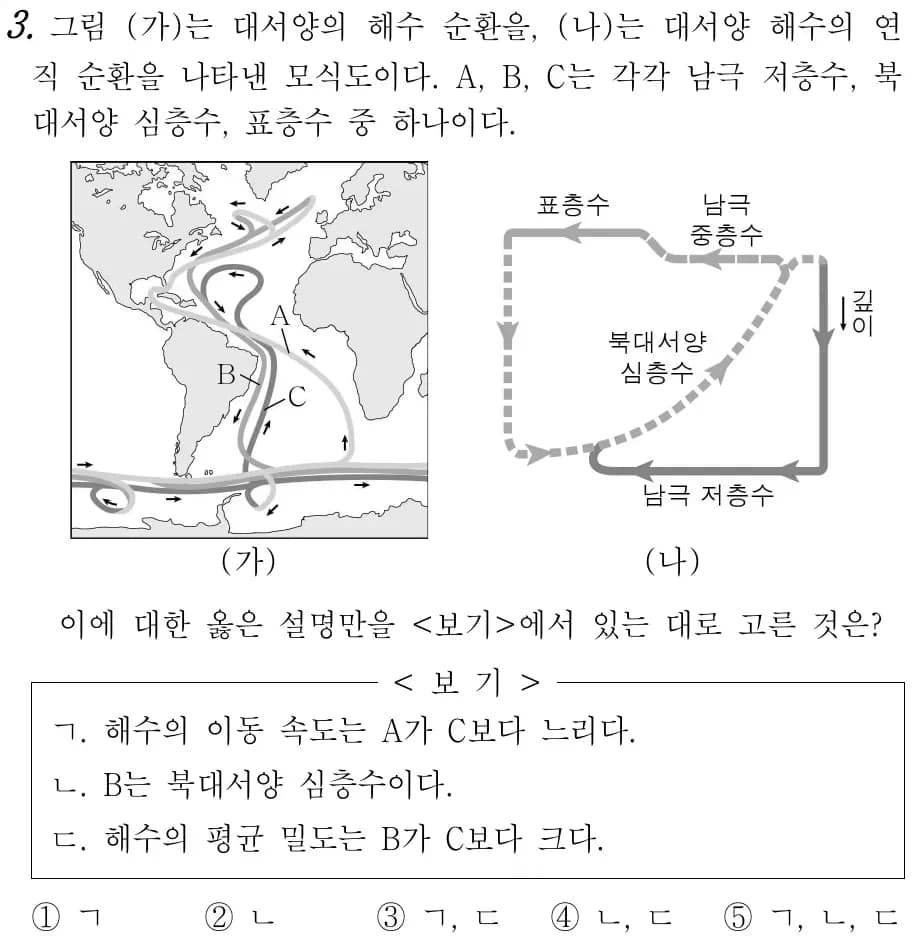
When I teach this content to students, I always show them this question.
In figure (a), you don’t need to memorize all the pathways of circulation.
You can understand deep-ocean circulation using the simplified diagram in figure (b).
3) Air Pressure and Weather Changes (12지구01-03)
[12지구01-03] 중위도 저기압과 고기압이 통과할 때 날씨의 변화를 일기도, 위상 영상, 레이더 영상을 종합하여 예측할 수 있다.This is the unit where the mid-latitude (temperate) low-pressure systems you studied in Integrated Science appear.
However, the difficulty level of questions on temperate cyclones will increase dramatically.
Take a look at the question below.
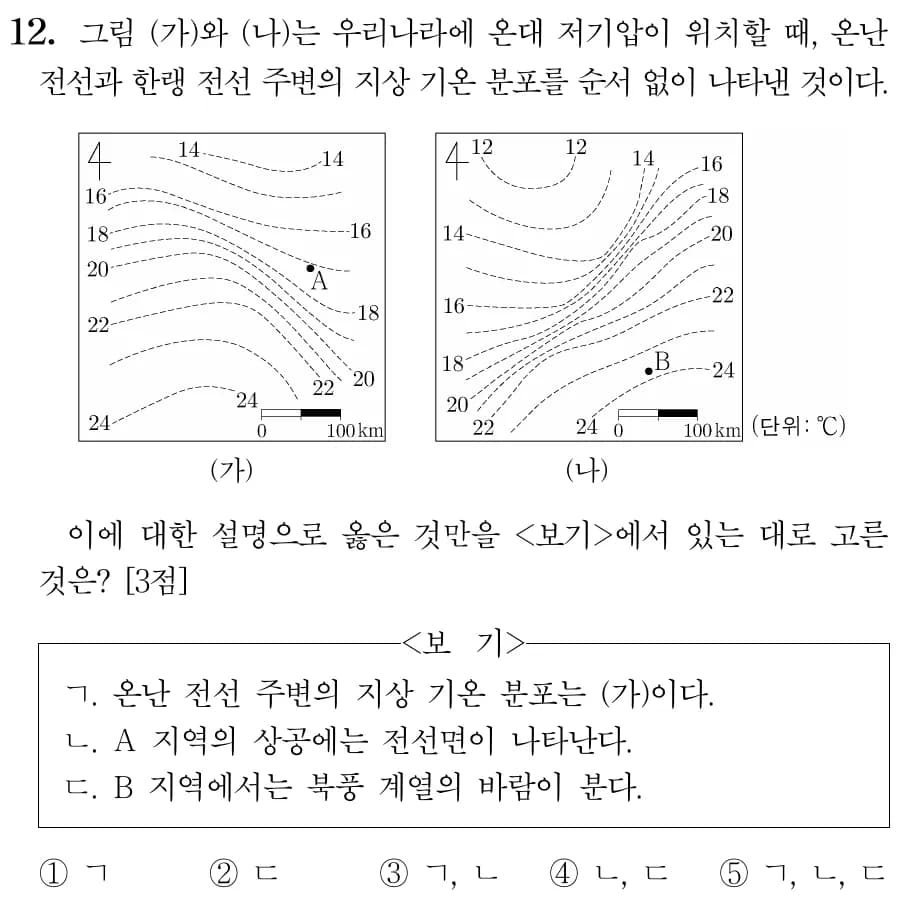
In the diagram, (a) is a warm front and (b) is a cold front.
The question above is from the 2021 CSAT, so it’s natural if you don’t know it yet.
Although this is for 2nd-year school exams, the curriculum content is identical to the CSAT, so if the school exam is set at a high level, the difficulty is comparable to the CSAT.
In any case, science teachers tend to pull images from mock tests or past CSAT exams, so it’s enough to get used to the typical question types.
Satellite images and weather charts may feel a bit unfamiliar as well.
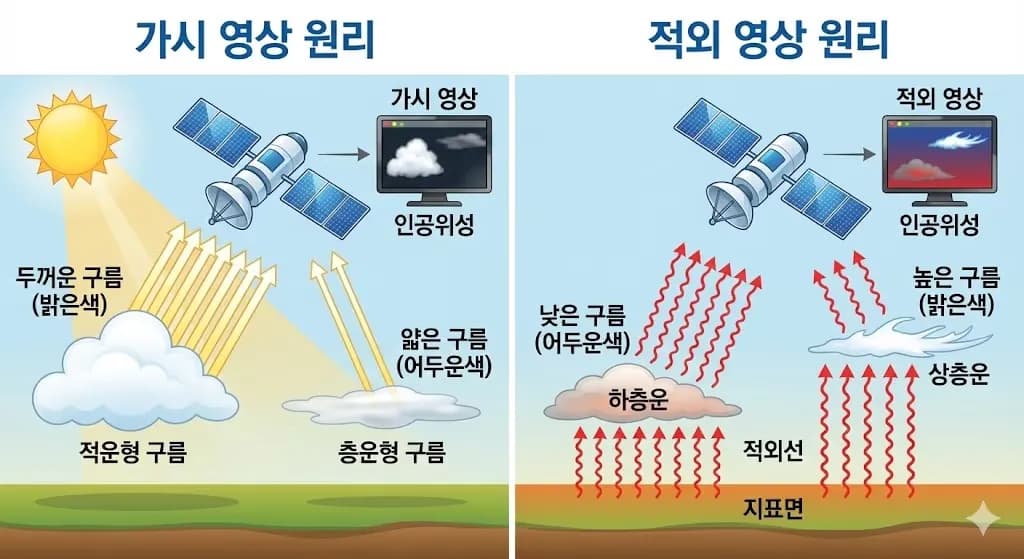
You learn how to interpret visible and infrared satellite images.
Thick clouds reflect light well, so they appear bright in visible images.
In infrared images, if low-temperature upper clouds are shown as dark, then you can’t show both the tops of thick clouds and lower clouds at the same time, so they are displayed as bright.
In discussions with students, I’ve found that they often get quite confused by infrared images.
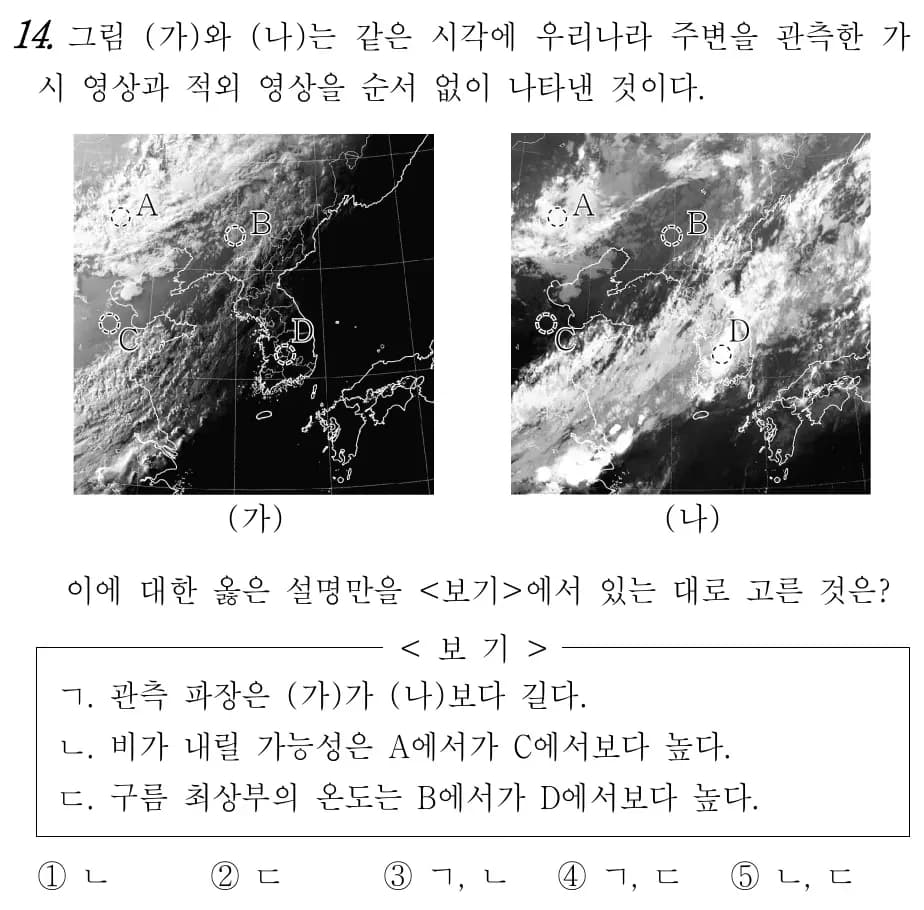
In this question, you’re asked which of the two is the visible-light image.
The correct answer is (a), which shows that it is night in Korea and thus there is no sunlight.
You can solve the rest of the question using knowledge you already have.
4) Typhoon Formation and Impacts, and Major Severe Weather in Korea (12지구01-04)
[12지구01-04] 태풍의 발생, 이동, 소멸 과정 및 태풍 영향권에서 날씨를 예측하고, 뇌우, 집중호우, 폭설, 강풍, 황사 등 주요 악기상의 생성 메커니즘과 대처 방안을 제시할 수 있다.Typhoons are not covered in Integrated Science, so this will be your first time studying them since middle school.
To put it roughly, the energy source of typhoons is the latent heat of water vapor; they transport equatorial energy to higher latitudes, and they move along parabolic paths.
The major severe weather phenomena are things you’ve heard of before, but this is probably the first time you’ll encounter them formally as textbook content.
The concepts themselves are not easy, and the harder the concepts, the more complex CSAT questions tend to become.
In particular, because there is so much observational data on typhoons, typhoon questions are all quite distinctive.
Let’s look at an example question.
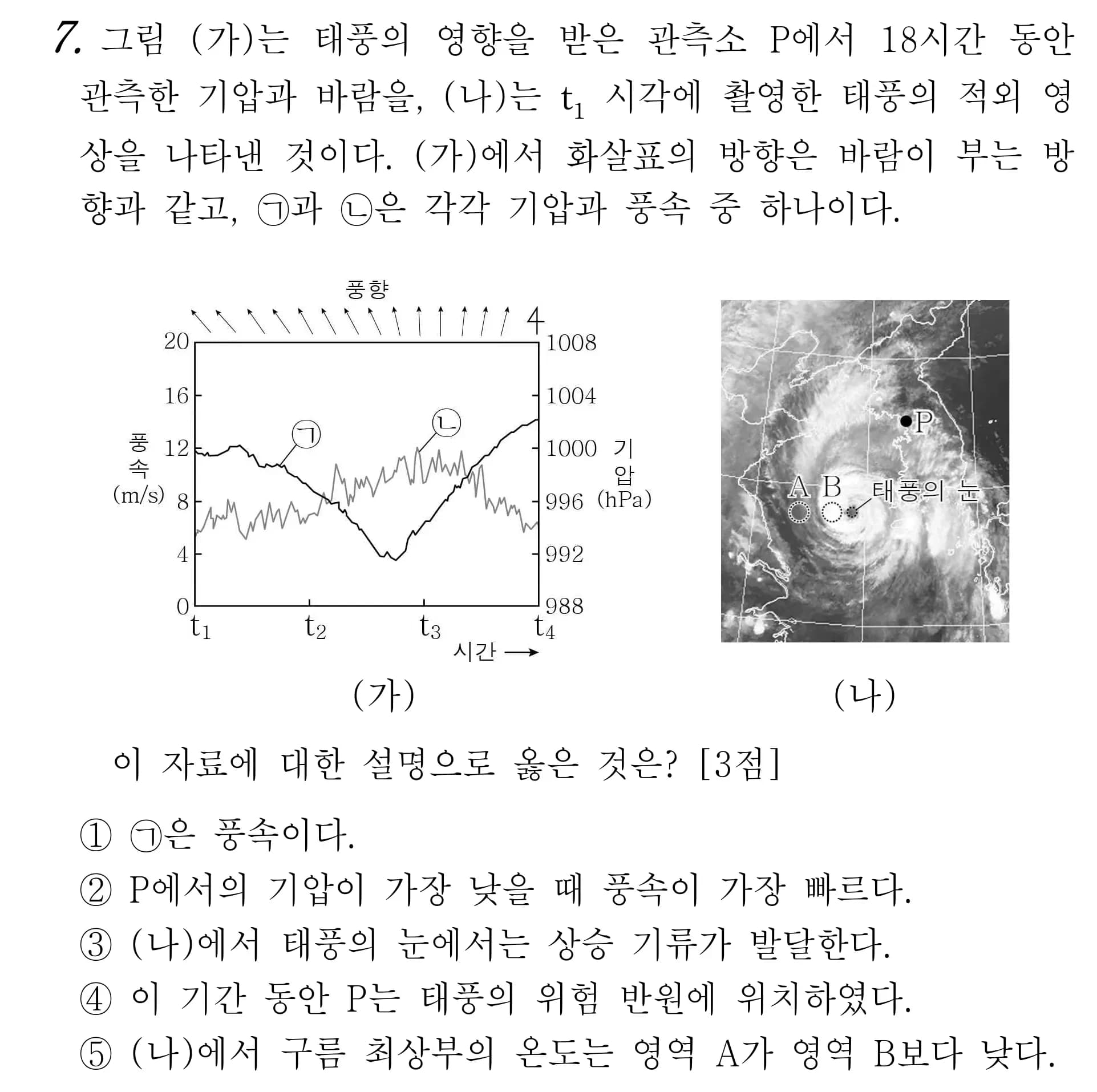
This question is about air pressure, wind speed, wind direction around a typhoon, as well as the safe semicircle and dangerous semicircle.
The last question 5 even incorporates an infrared image, asking about a really wide range of textbook content, which is probably why it is a 3-point question.
Let’s also look at a severe weather question.
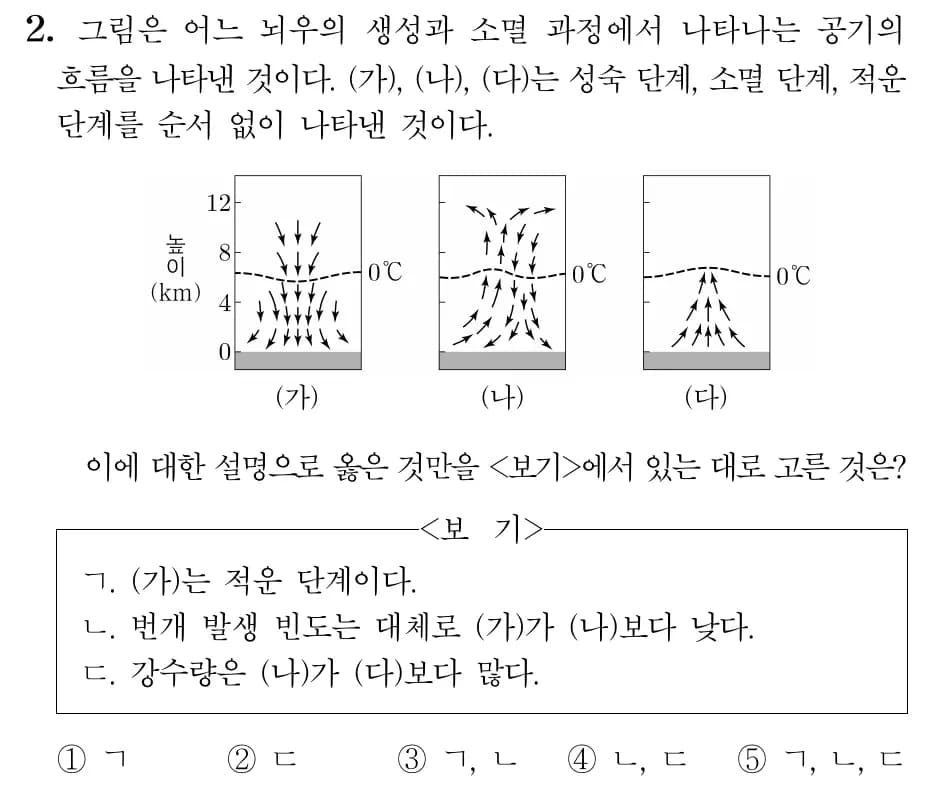
Because the difficulty level of the other topics under severe weather is relatively low, questions tend to focus almost exclusively on thunderstorms.
The main content is the development and dissipation process of thunderstorms, along with precipitation and thunderstorms.
5) Interaction Between the Atmosphere and the Ocean
[12지구01-05] 대기와 해양의 상호작용의 사례로서 해수의 용승과 침강, 엘니뇨-남방진동(ENSO)의 현상의 진행 과정 및 관련 현상을 설명할 수 있다.In Integrated Science, you mainly deal with El Niño.
In Earth science, you comprehensively cover El Niño and La Niña, along with the principles related to them.
La Niña is the opposite of El Niño.
The trade winds strengthen, there is more rainfall in the western Pacific, and stronger upwelling occurs in the eastern Pacific.
In Integrated Science, questions were mainly asked using sea surface temperature changes, but in Earth science, questions use various data such as sea surface slope and the depth at which the thermocline begins.
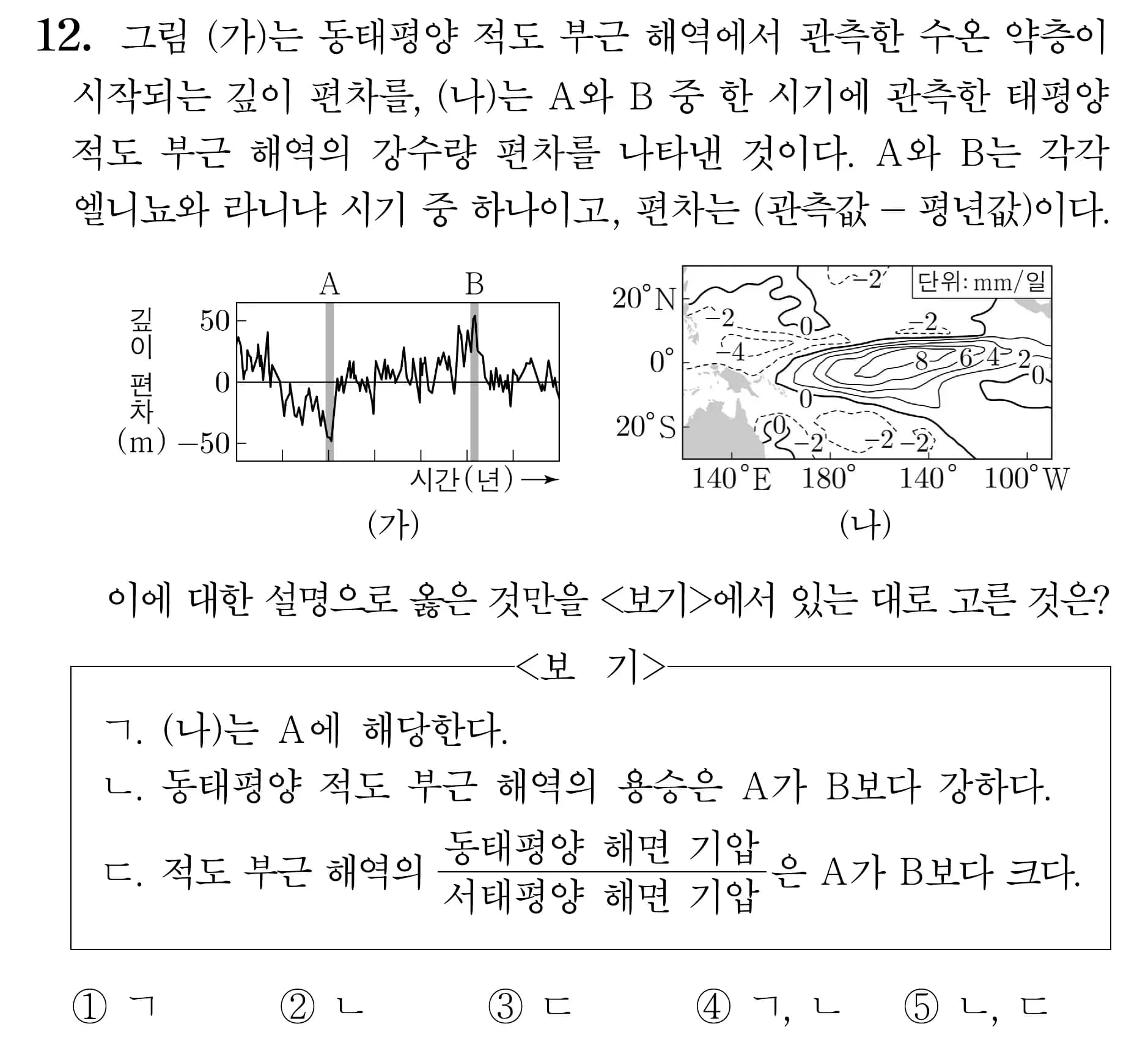
In (a), if the anomaly of the depth at which the thermocline begins is negative, the thermocline has become shallower than usual, so upwelling has strengthened; if it is positive, the thermocline has become deeper than usual, so upwelling has weakened.
In (b), since rainfall in the western Pacific has decreased compared to normal, and rainfall in the central to eastern Pacific has increased, you can infer that this is an El Niño period.
Questions are asked by providing various kinds of data like this and asking you to determine whether it is El Niño or La Niña and to interpret the associated values.
6) Earth’s Climate Change
[12지구01-06] 기후변화의 원인을 자연적 요인과 인위적 요인으로 구분하여 설명하고, 인간 활동에 의한 기후변화 문제를 과학적으로 해결하는 방법을 탐색할 수 있다.This unit examines Earth’s climate change along with global warming.
The content on global warming itself shouldn’t be too difficult, as you have covered it once in Integrated Science or in middle school, but the factors causing climate change may feel somewhat unfamiliar.
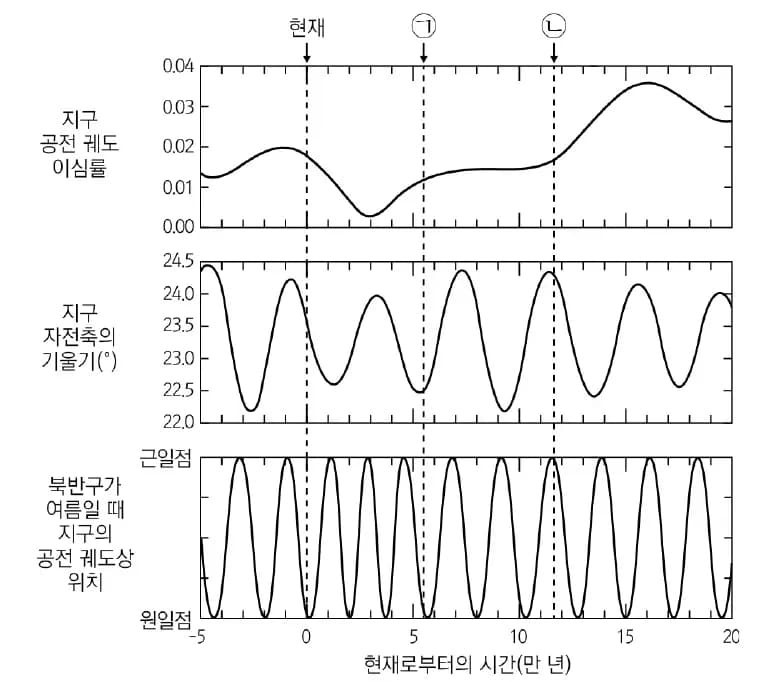
The natural causes of Earth’s climate change are divided into internal Earth factors and external Earth factors.
Internal Earth factors include volcanic eruptions, changes in the distribution of continents and oceans, and glaciers.
External Earth factors are mainly astronomical, such as changes in solar activity, precession, changes in the eccentricity of Earth’s orbit, and changes in axial tilt.
Questions are usually asked using these astronomical factors.
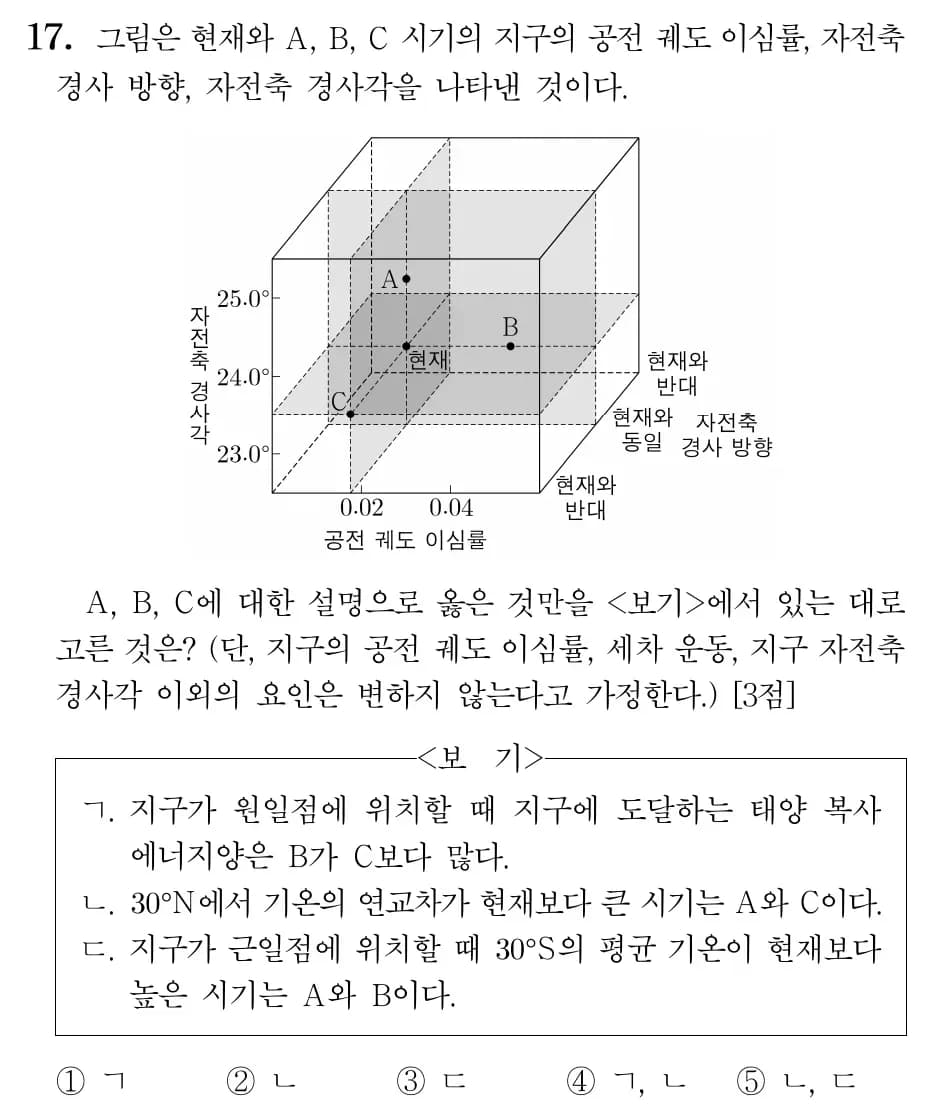
In the past, they even provided diagrams of Earth’s orbit, but recently the questions have become so “for veterans only” that they are asked purely in terms of numerical values.
If you study, it’s not to the point of being impossible.
The global warming section is completely identical to that in Integrated Science.
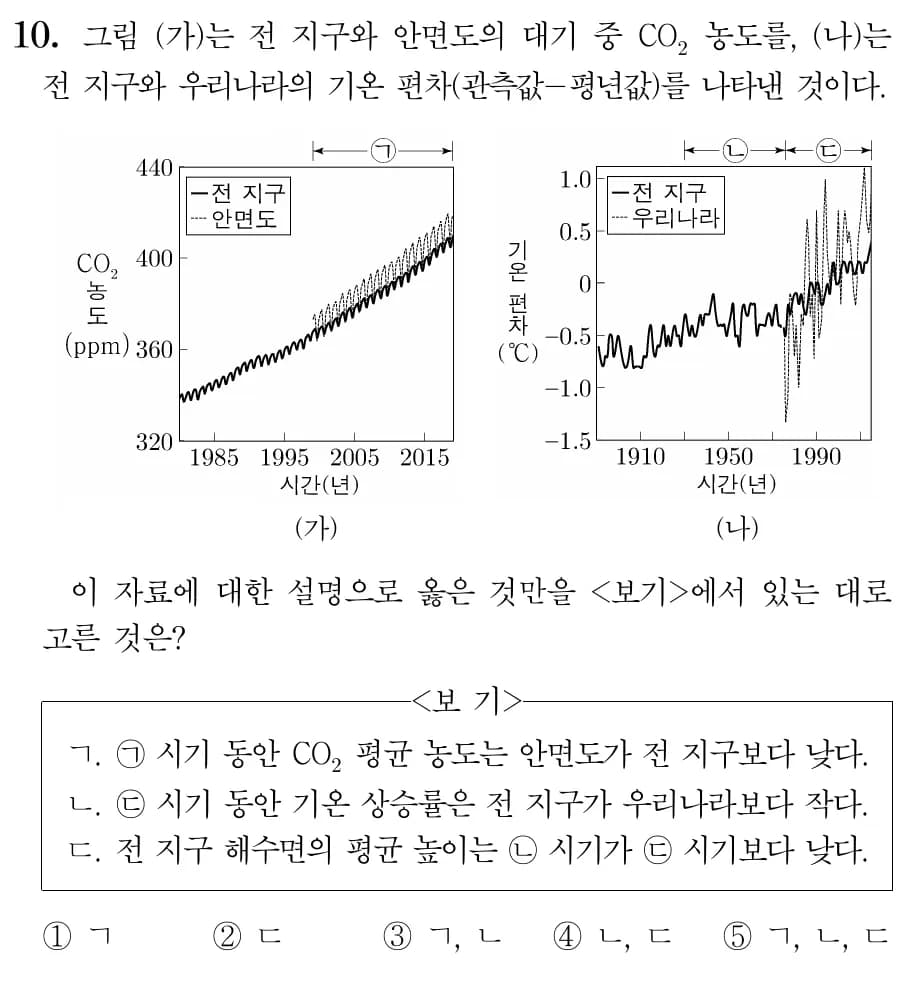
The only difference is that the data presented are somewhat unusual.
Even so, you can solve the questions if you read them carefully.
4. Summary
First, let’s identify the concepts that overlap with Integrated Science.
Concepts learned in Integrated Science
 - Structure of seawater, general circulation of the atmosphere, surface circulation of seawater, El Niño, Earth’s radiative equilibrium, global warming
New concepts
 - Temperature–salinity diagram, properties of seawater, deep-ocean circulation, meteorological images, temperate cyclones, weather chart analysis, typhoons, severe weather in Korea, factors of Earth’s climate change
Perhaps because the content of Integrated Science doesn’t go very deep, there are overwhelmingly many concepts that are newly introduced.
In fact, many of these were covered in middle school, but since people generally don’t remember them, it’s more comfortable to just treat them as new.
5. Closing Remarks
In this post, we looked at the overall content and example questions for Unit 1 of the 2022 revised curriculum.
In the next post, I plan to take a look at Unit 2.
I hope this is helpful for those who are considering whether to choose Earth science.





댓글을 불러오는 중...