Today, I'm going to explain the limb darkening of the sun using optical depth and the transfer equation.
1. What is Limb Darkening?
Limb darkening refers to the phenomenon where the brightness decreases from the center to the edge when observing a star like the sun.
To understand this, we need to understand optical depth and the Stefan-Boltzmann law.
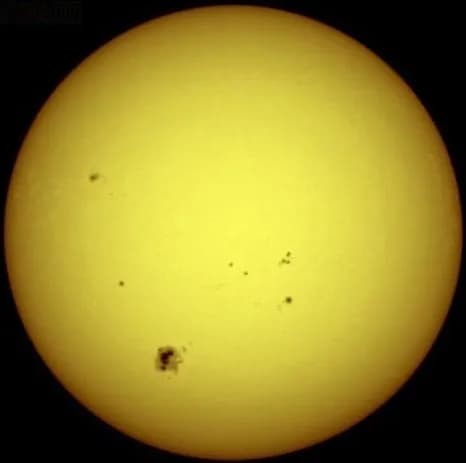
2. Why Limb Darkening Occurs
The sun's surface, the photosphere, is roughly the point where the optical depth is 1.
For a more detailed discussion on optical depth, see the previous post.
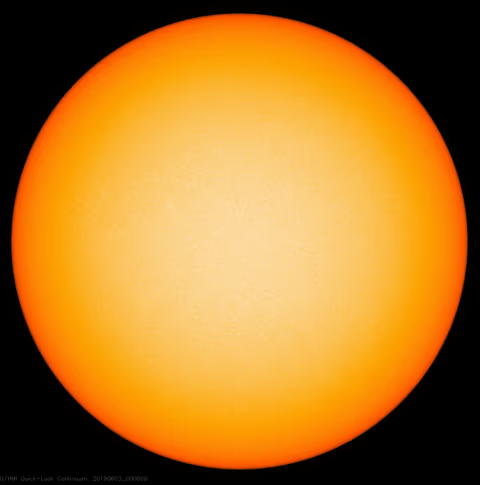
The issue here is that the point where the optical depth is 1 varies depending on the direction you view the sun.
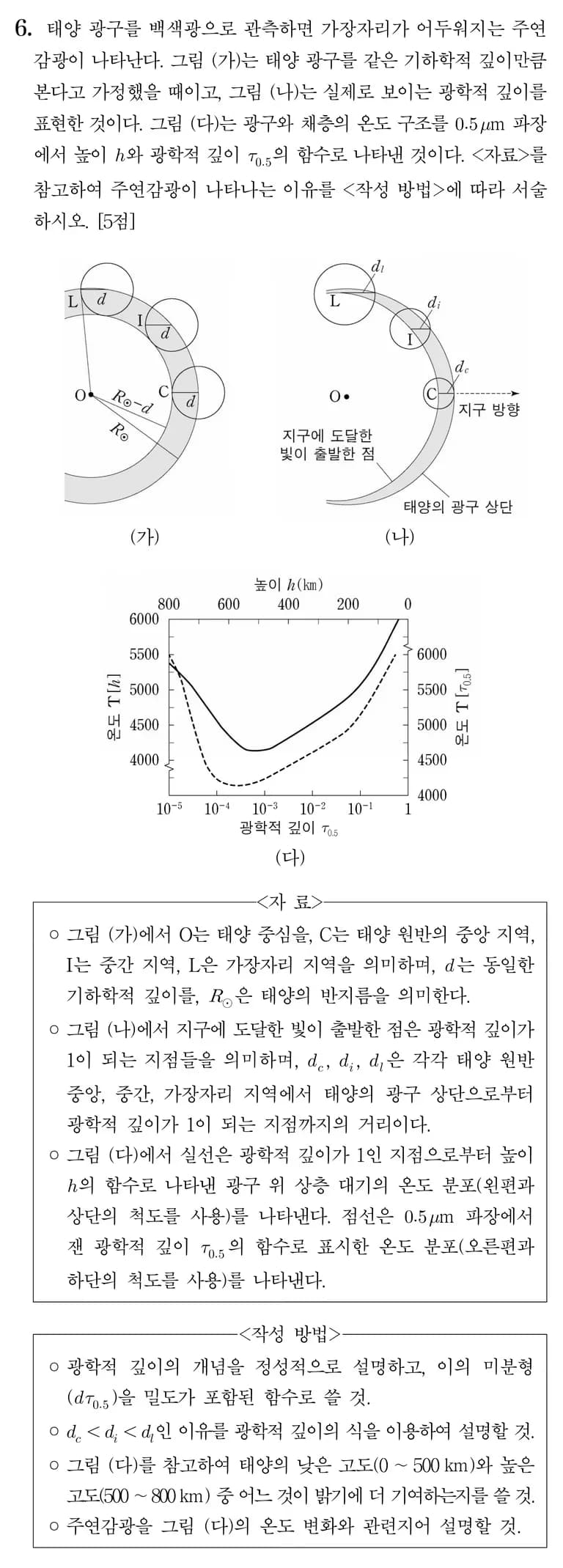
Look at the picture and the explanation below. This picture and explanation are from the 2019 Secondary Teacher Certification Exam (Stage 1) Earth Science Subject B, Question 6.
For your reference, the illustrations and explanatory materials are freely available and all copyrights are held by the Korea Institute for Curriculum and Evaluation.
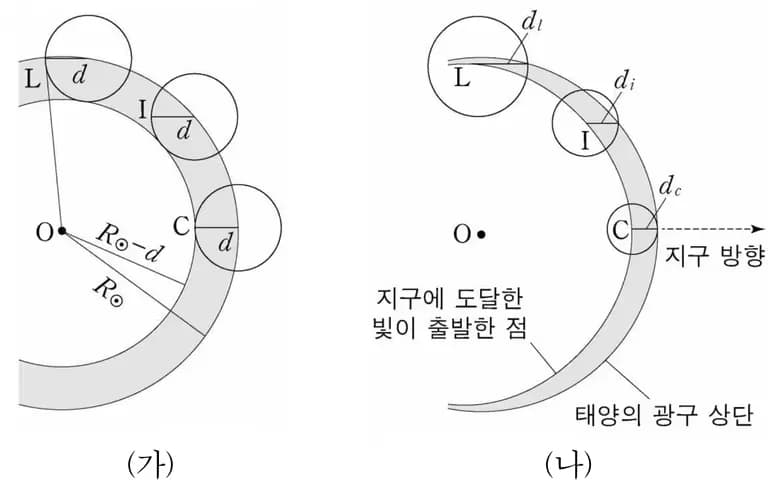
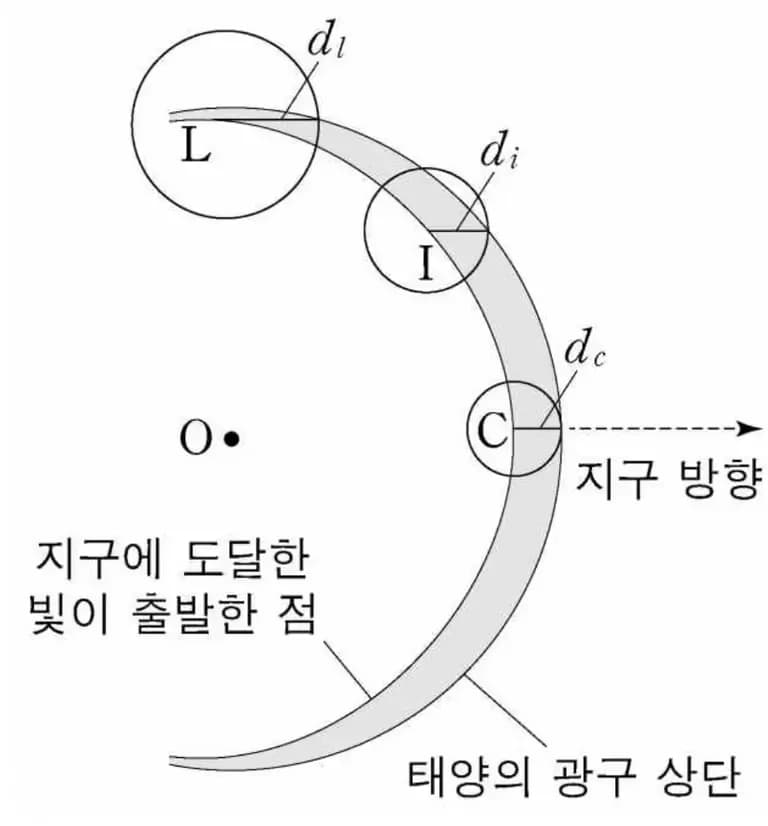
◦ (A) In picture (A), O means the center of the sun, C is the central region of the solar disk, I is the intermediate region, and L is the limb region. d means the same geometric depth, and R⊙ is the solar radius.
◦ In picture (B), the places where the light that reached Earth originated are the points where the optical depth is 1, and dc, di, and dl are the distances from the top of the photosphere to the points where the optical depth is 1 in the central, intermediate, and limb regions of the solar disk, respectively.
The diagram can help us understand limb darkening a bit more easily.
Limb darkening occurs because the depth at which the optical depth is 1 varies depending on the direction you view the celestial body.
When looking towards the center of the sun, the line of sight and the geometric center align, allowing a view into deeper layers.
However, as you move towards the edge, the line of sight and the geometric center don't align as much, so you see shallower layers.
If this is hard to understand, look at the diagram below.
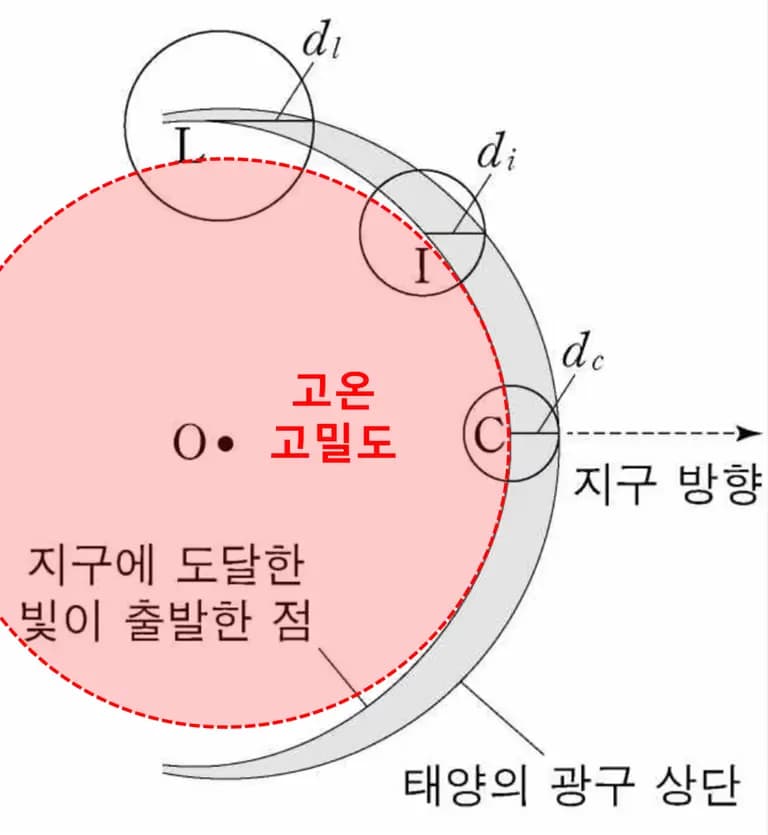
To make it easier to understand, I've exaggerated the hot, dense regions.
The physical properties of stars relate to the geometric radius R from the center of the sun.
Thus, drawing a circle around point O results in the shape above.
From point C, the point where the optical depth is 1 can reach the hot, dense region, but at point L, it cannot.
If the depth at which we see varies, it results in two differences below.
1) The temperature at the point where the optical depth is 1 differs.
2) The atmospheric density at the point where the optical depth is 1 differs.
Let's discuss these independently.
1) If the temperature at the point where the optical depth is 1 differs...?
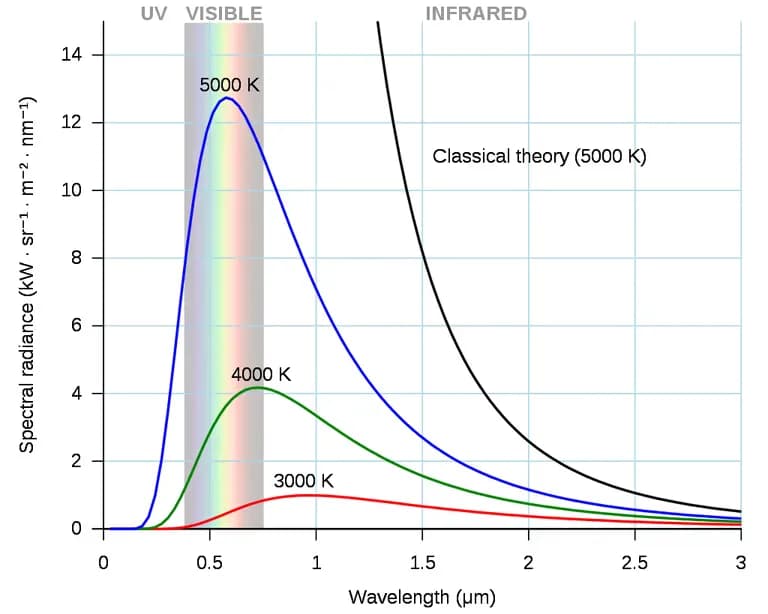 |  |
According to the Stefan-Boltzmann law, the total radiation emitted by a blackbody is proportional to the fourth power of its temperature. Therefore, the hotter the region, the more radiation we can observe.
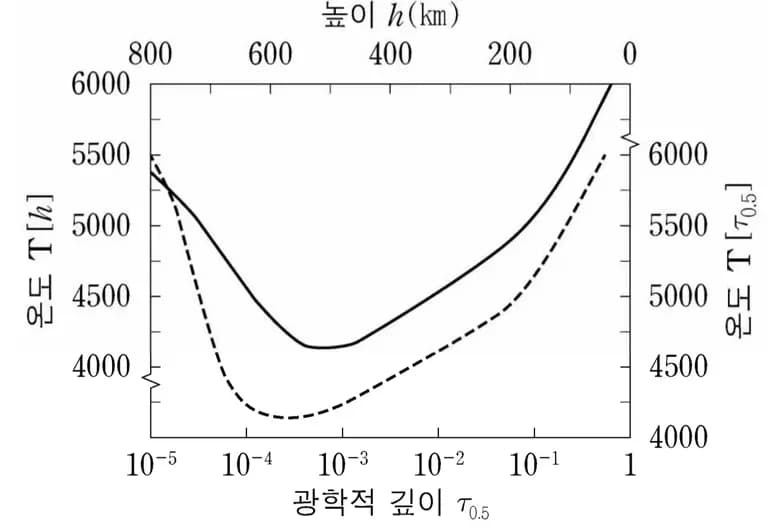
In the right picture, the closer to the photosphere, the higher the temperature.
The deeper the point where the optical depth is 1, the higher the temperature, and the higher the temperature, the more radiation is emitted, making it appear brighter.
Thus, the light emitted from deeper points appears brighter, while the light from shallower points appears dimmer.
Though this may seem to partially resolve the mystery, it's not completely resolved.
In the image above, each circle is drawn with the radius from the top of the photosphere to the point where the optical depth is 1.
As you can see, the distance from the top of the photosphere to the point where the optical depth is 1 isn't constant; it increases as you move away from the center.
This relates to the density of the solar atmosphere.
2) If the atmospheric density at the point where the optical depth is 1 differs...?

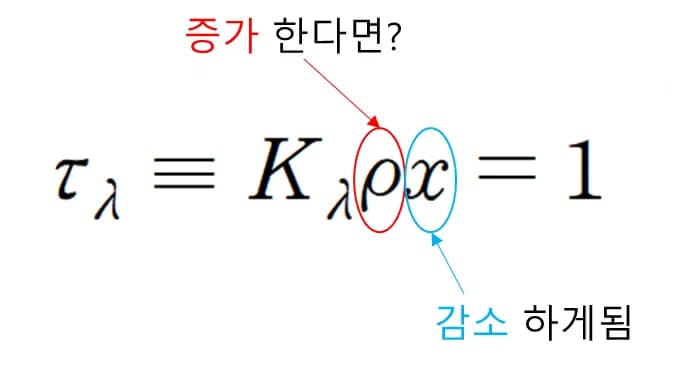
If the density of the atmosphere differs, the effective absorption also differs.
If the effective absorption differs, so does the distance to reach the same optical depth of 1.
Thus, the closer to the sun's center, the higher the effective absorption, and therefore, the shorter the distance to reach an optical depth of 1.
This results in longer absorption distances as you move towards the sun's limb.
3. Conclusion: Reasons for Limb Darkening
In summary, the reasons for limb darkening when observing the sun are as follows:
1) Because the sun is spherical, as you move toward the edge, you see the atmosphere with lower temperature and density.
2) Lower temperature results in less radiation emitted according to the Stefan-Boltzmann law.
3) Lower density results in lower opacity.
4. In Summary: 2019 Earth Science Teacher Exam, Subject B, Question 6
Finally, one of the questions in this exam was quite interesting.
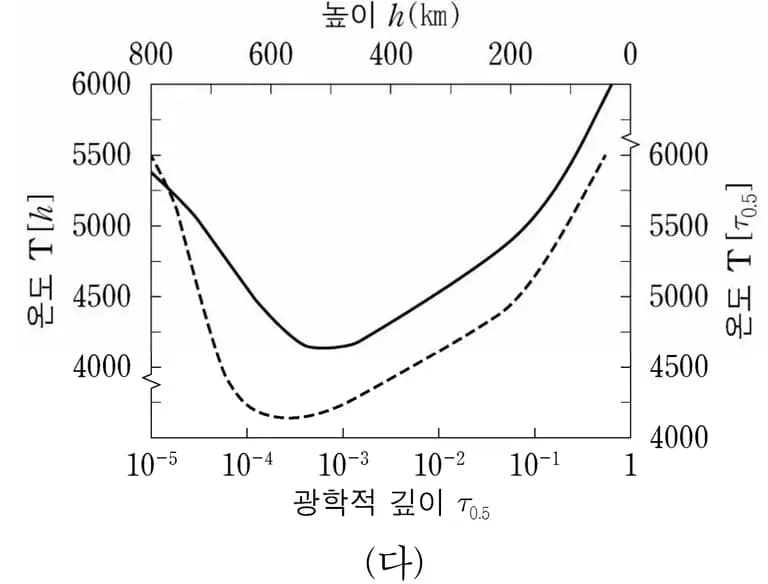
Based on picture (C), state whether the lower altitude (0 ∼ 500 km) or the higher altitude (500 ∼800 km) of the sun contributes more to the brightness.
The graph shows that the higher altitude of the sun is very optically transparent.
Also, calculating the average density by substituting the change in optical depth and change in height into the differential of optical depth, it is clear that the lower altitude of the sun is much denser.
Therefore, lower altitude contributes more to brightness due to higher density, temperature, and opacity compared to higher altitude.
Finally, I end with the original question document.


댓글을 불러오는 중...