Before understanding Earth's radiation balance, if you are not familiar with thermal equilibrium and energy transfer methods, it is recommended to read the following article first.

1. Energy Transfer
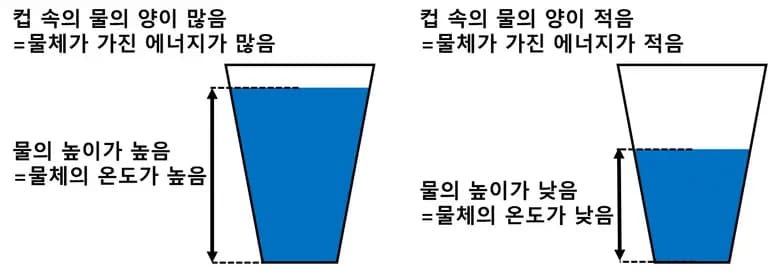
As mentioned in the previous post, objects with higher temperatures have a lot of energy, and objects with lower temperatures have less energy.
And energy moves from the side with a higher temperature to the side with a lower temperature, which is called heat.
And the more energy an object has, the higher its temperature.
This is similar to how the more water in a bowl, the higher the water level.
2. Energy Transfer and Temperature Change of Objects
The problem is that this energy transfer happens constantly, so the object's temperature is always changing.
At this time, temperature change of an object can be explained by energy input (incoming) and output (outgoing).
If the amount of energy coming into an object is greater than the amount going out, the object's temperature rises.
If the amount of energy coming into an object is equal to the amount going out, the object's temperature remains constant.
If the amount of energy coming into an object is less than the amount going out, the object's temperature drops.
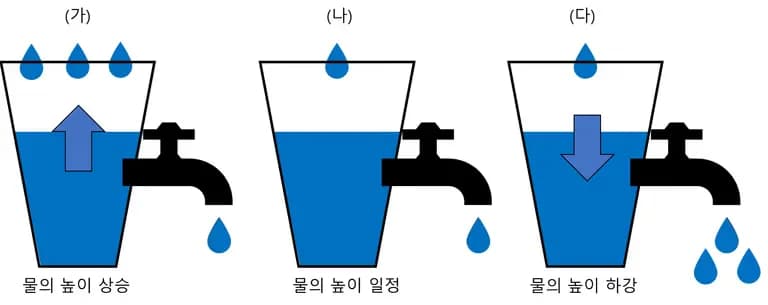
This can be explained by comparing it to a cup where water comes in and out.
In the cups above (a), (b), and (c), water is supplied and drained.
In cup (a) three drops of water come in, and one drop goes out. In this case, the water level will rise.
This is the same as situation 1) above.
In (b), the amount of water entering the cup is equal to the amount leaving, so the water level does not change.
This is the same as situation 2) above.
Likewise, situation (c) is the same as situation 3) above.
Understanding temperature changes of an object by comparing them to the change in water quantity and water level is easier.
3. Radiation Balance
Radiation balance refers to the state where the amount of radiation energy absorbed by an object is equal to the amount of radiation energy emitted, keeping the temperature constant.
Broadly speaking, radiation balance can be seen as a kind of thermal equilibrium state.
The difference is, radiation balance involves a 'radiation' equilibrium state among methods of heat transfer, including convection, conduction, and radiation.
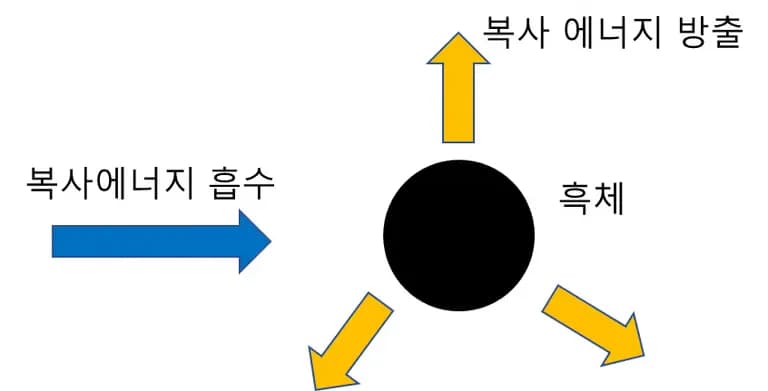
When learning about radiation balance, the term 'black body' is introduced, which is a hypothetical substance that absorbs all radiation.
Assuming a black body simplifies equations because there is no need to consider the amount of radiation reflected by the object.
If the radiation energy absorbed by an object is more than the radiation energy emitted, the object's temperature rises.
If the opposite is true, the object's temperature drops.
4. Earth's Radiation Balance
Earth continuously receives radiation energy from the Sun.
Simply put, sunlight is radiation energy coming from the Sun.
Despite constantly receiving energy, Earth's temperature remains relatively constant because Earth also emits energy.
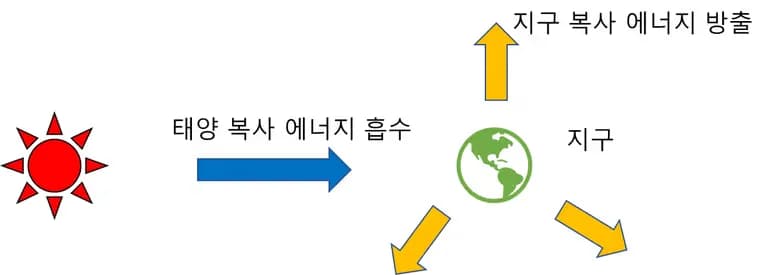
Since the area between the Sun and Earth is almost a vacuum, energy cannot be transferred to Earth through conduction or convection; instead, it is transferred in the form of radiation.
The energy leaving Earth for space is also done in the form of radiation.
The energy transferred from the Sun to Earth is called solar radiation energy.
The energy leaving Earth is called terrestrial radiation energy.
5. Earth's Radiation Balance Diagram
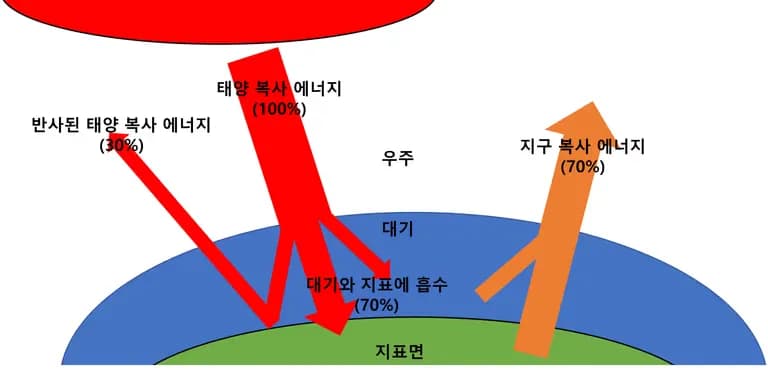
When the total amount of solar radiation energy entering Earth is 100%, since Earth is not a perfect black body, about 30% is reflected by clouds, glaciers, sand, etc., and only 70% is absorbed.
Since Earth is approximately in a radiation balance state, the total amount of terrestrial radiation energy emitted from Earth to space is also about 70% of the initial solar radiation energy.
If you break it down further, you get the diagram that appears in mock exams.
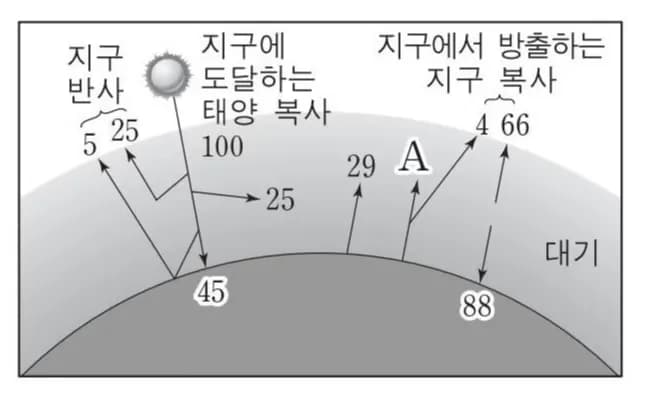
Although it gets a bit complex, calculations show that the total amount of energy absorbed by Earth is 70, and the total amount of energy emitted is also 70.
How much energy the atmosphere and surface absorb and exchange with each other is learned in high school courses.
6. Conclusion: Earth's Radiation Balance
Radiation balance refers to the phenomenon where the amount of radiation energy absorbed by an object is equal to the amount of radiation energy emitted, keeping the temperature constant.
Earth absorbs solar radiation energy and releases the same amount of terrestrial radiation energy to maintain a constant temperature. This is called Earth's radiation balance.
By expanding the content, I seem to have written more than a textbook.
I hope this helps middle school students studying Earth's radiation balance.


댓글을 불러오는 중...