Today, we're going to introduce a method for estimating the distance to celestial objects, specifically using moving clusters.
To understand this content, one must grasp the concepts of radial velocity, transverse velocity, and spatial velocity.
It would further help to have an understanding of LSR.
If you're not familiar with this, refer to the information below.
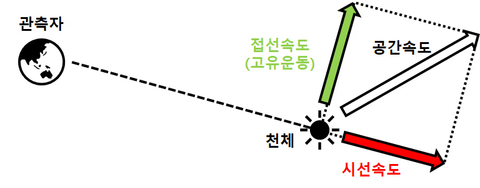
1. Moving Clusters
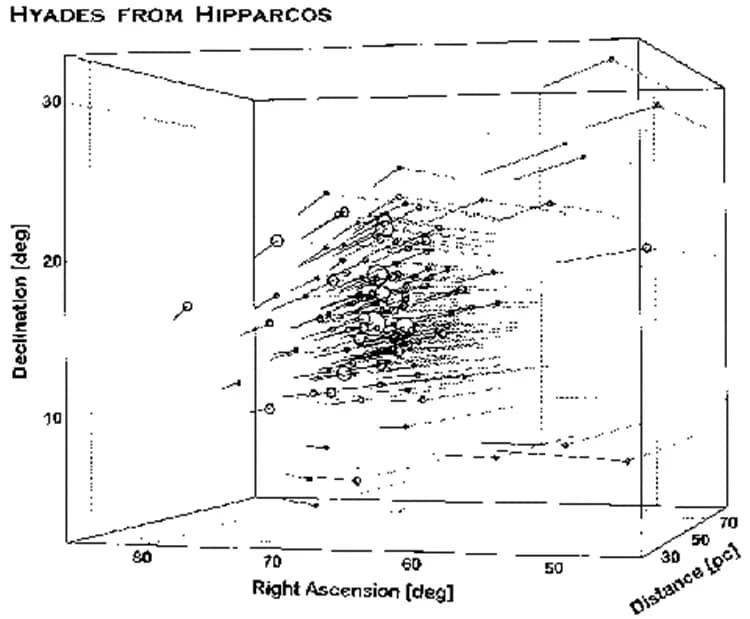
Like the Sun, star clusters orbit around our galaxy.
The motion of stars within a cluster is irregular, but overall, the stars move in one direction.
A cluster that appears to have stars moving in the same direction is called a moving cluster.
The stars in moving clusters all exhibit similar peculiar motion relative to the LSR.
At this point, the extension of the stars’ motion converges at a single point on the celestial sphere.
This point is called the convergence point.

For example, consider parallel railroad tracks that are laid out in the same direction like in the image above.
Though the tracks do not meet, to an observer, they appear to converge at a single point.
Similarly, the movement of stars in a cluster behaves the same way.
Even if stars move differently within the cluster, the stars’ motion appears to converge in the direction of the cluster's motion.
A well-known cluster recognized as a moving cluster is the Hyades Cluster.
Analysis of this cluster's movement in the early 1900s showed that all stars’ movements converge at one convergence point.
Moreover, because the cluster is nearby, with a relatively large apparent diameter on the celestial sphere, determining the convergence point through proper motion is easy.
2. Distance Measurement Using Moving Clusters
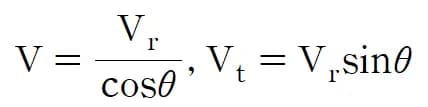

The angular distance θ between the cluster and its convergence point is equal to the angle between the cluster's radial motion and proper motion.
If you know the direction of cluster motion, measuring the radial velocity of any star within the cluster allows you to determine the cluster's distance.
The star's spatial velocity V, radial velocity Vr, and transverse velocity Vt have the following relationship.
Using the previous post's equation connecting the star’s proper motion and radial velocity, you can draw the following conclusion.
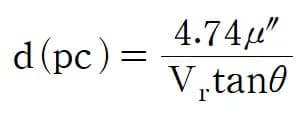
3. Conclusion: Distance Measurement Using Moving Clusters
To measure the distance to a moving cluster, the following conditions are needed.
1) It can be applied to clusters that occupy a relatively large area on the celestial sphere (near clusters).
2) The proper motion, radial velocity, and convergence point of stars within the cluster must be measurable.
3) Using the cluster's motion, you can determine the distance to the cluster within a maximum of 500pc.




댓글을 불러오는 중...