Following optical depth, we want to explore the transfer equation.
If you are not familiar with what optical depth is, I suggest reading the article below before continuing.
1. Qualitative Thinking of the Transfer Equation
The transfer equation represents the process of light transmission within a celestial body.
Generally, celestial bodies absorb and emit light simultaneously. Let's use a classroom analogy to explain.
1) Students pass coins sequentially to the teacher (observer) at the front.
2) Each student, upon receiving coins from the back, keeps one (extinction) and adds four more (emission).
3) How many coins will the teacher receive?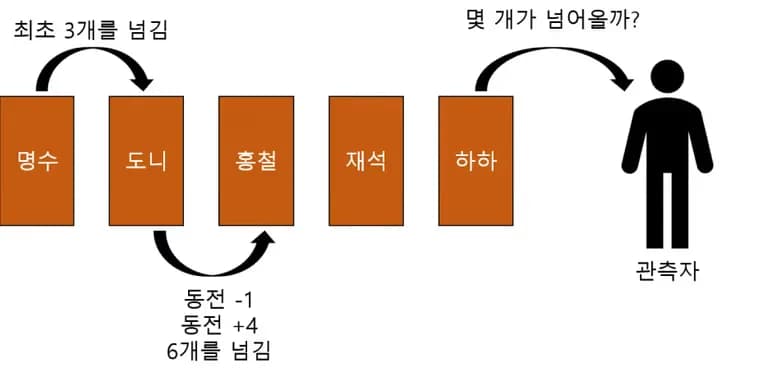
Then, at each student, the change in the number of coins is the amount added (emission) minus the amount kept (extinction).
And the degree of adding coins increases with the number of students passed (increased path length).
If the path length is long, all the money initially passed by Myungsoo will be taken by the students, preventing it from reaching the teacher.
The teacher won't know how much money Myungsoo passed, and this couldn't be observed if it were the atmosphere, as the observer would not be able to see light coming from within a point.
We would say it is unobservable due to opacity.
2. Quantitative Thinking of the Transfer Equation
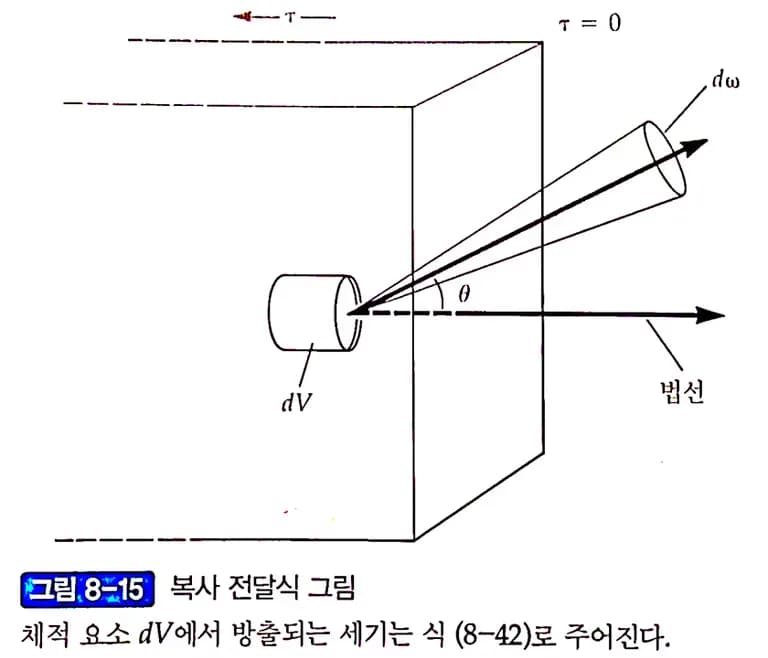
The anticipated transfer equation.
The illustration is from Introduction to Astronomy and Astrophysics, 4th Edition (Kyobo Book Centre), p. 228.
What needs to be considered is the path of light, the degree of extinction, and how the luminosity changes after passing through gas.
This is similar to the classroom analogy mentioned earlier.
1) Distance light has passed: As the angle of passage θ, the path is (dl/cosθ).
2) Change in luminosity of light passed: Emission degree - Extinction degree
3) The above value is proportional to the distance.
4) Therefore, the change in light luminosity = (Emission degree - Extinction degree) * Distance passed
Let's replace the above equation with abbreviations and establish it as a quantitative equation.
Note that in 3, optical depth is described based on 'wavelength,' whereas the transfer equation is described based on 'frequency' as written in astronomy and astrophysics.
Extinction coefficient (χ): Equivalent to (opacity*density)
Emission coefficient (η): Value emitted by the gas
Source function (S=η/χ): Emission of light/Absorption of light
Optical depth (τ): If you don't know, refer above again.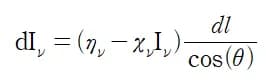
The above equation is just converting the initial qualitative thinking into a formula.
If you divide both sides by the derivative of optical depth and define μ=cosθ, the equation changes as follows.
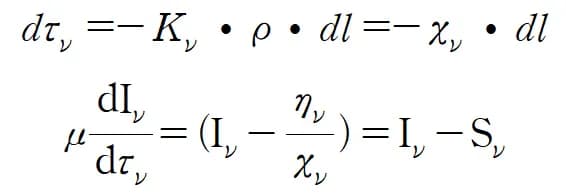
By multiplying both sides by the integrating factor, the solution is obtained as the final equation shown in Introduction to Astronomy and Astrophysics.

3. Conclusion - How to Understand the Transfer Equation
1) The transfer equation represents how light is transmitted within a celestial body.
2) Inside stars, both extinction and emission of light occur simultaneously.
3) Thus, the transfer equation subtracts the extinction amount from the emission amount and multiplies it by the distance light has passed.
In fact, even those preparing for certification exams do not fully understand the transfer equation, only qualitatively.
It is important to understand rather than memorize equations, as emphasized continuously.
The next article will delve into how this transfer equation is applied in the atmosphere of actual planets.




댓글을 불러오는 중...