Tidal force arises due to differential gravity. In this article, we will derive the magnitude of tidal force caused by differential gravity and explore the meaning of the tidal force formula.
If you do not know what differential gravity is, please read the previous article.

1. Universal Gravitation by the Moon and Differential Gravity
The phenomenon where different parts of a celestial body experience varying gravity depending on their distance is called differential gravity.
At this time, the force itself that makes objects try to move apart due to differential gravity is tidal force.
If you understand this, I think you will easily understand the diagram below. The diagram is taken from an introduction to astronomy and astrophysics.
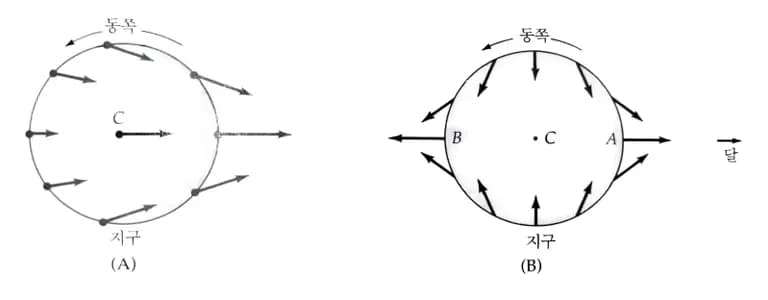
The Earth's radius is about 6,400 km, so each part is at a different distance from the Moon's center.
Thus, as in (A), different parts of the Earth are accelerated by different forces.
However, since the Earth's particles are held together by gravity, it is easy to think of them as being connected by strings, as in the above object.
From the Earth's perspective, it feels like the forces shown in (B) are acting.
The arrows in (B) are the vectors of each force in (A) subtracted to act at Earth's center C.
This is called differential gravity acceleration (or tidal force).
2. Magnitude of Differential Gravity Acceleration
Let's find the magnitude of differential gravity acceleration.
In the introduction to astronomy and astrophysics p94, the acceleration of differential gravity is derived.
The content is lengthy and complex, but we'll try to simplify it to a high school calculus level.
First, let's ignore the centrifugal force between the Earth and the Moon and use only the law of universal gravitation.
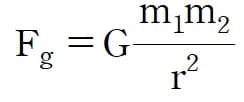
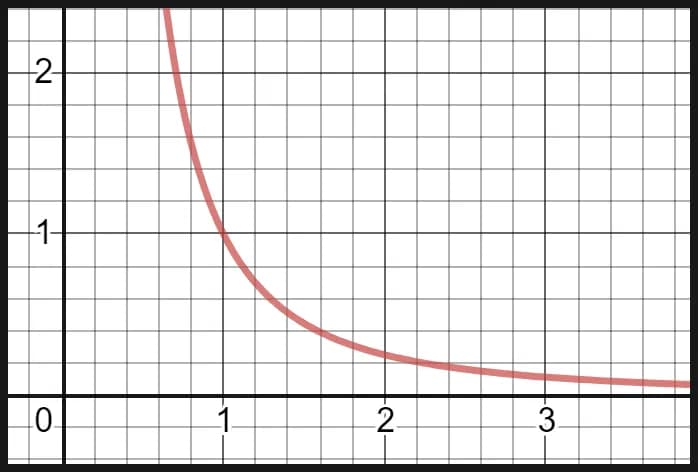
If we consider two objects as the Earth and the Moon, the mass of the objects doesn't change, so the gravitational force depends only on the distance between the two objects.
Since differential gravity is the difference in the magnitude of gravitational force, we need to find the force difference according to distance on the inverse square graph, as shown above.
If the x-axis of the graph represents the distance between two objects, and the y-axis represents the magnitude of gravitational force, differential gravity can be expressed as follows on this graph.
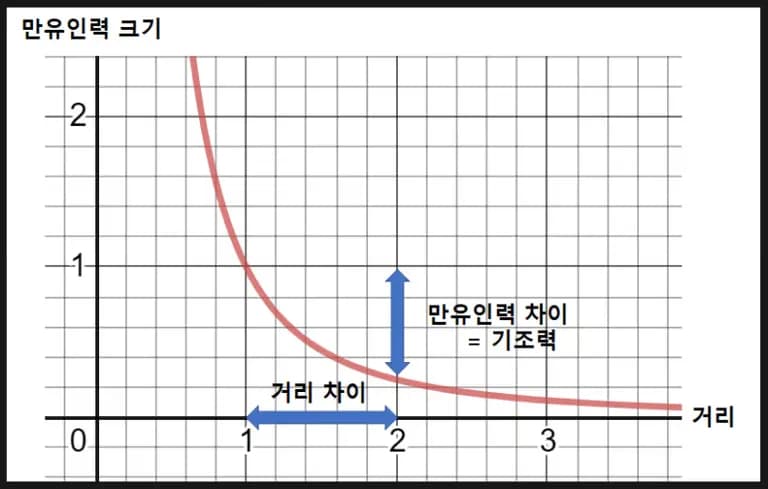
Therefore, by partially differentiating both sides with respect to distance r, we obtain the following equation.
If you don't know differentiation, just take a rough look at the formula.
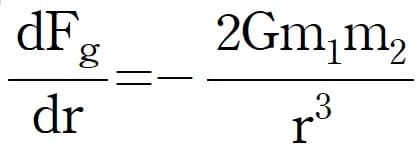
We obtain such a formula, and by slightly modifying the symbols and adding explanations, it becomes as follows.
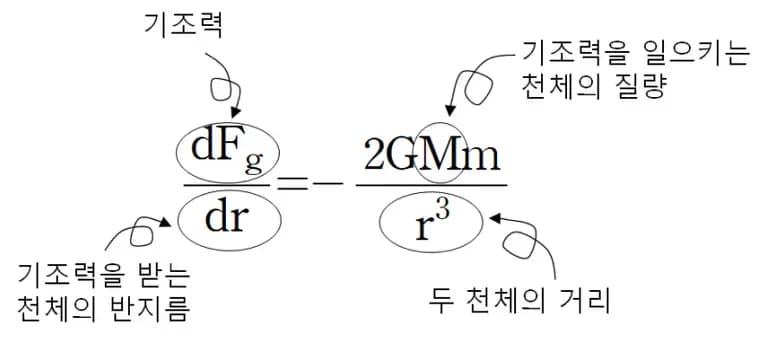
3. Meaning of the Differential Gravity Acceleration Formula
In the end, eliminating the unit mass of 1kg from the final equation above results in the differential gravity acceleration.
Let's interpret this.
M = Mass of the celestial body causing tidal force R = Radius of the celestial body receiving tidal force d = Distance between the two celestial bodies |
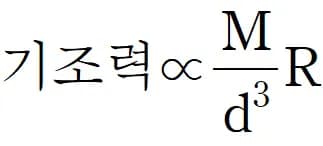
1) If M and d are constant? --> The larger the radius of the celestial body receiving the tidal force, the greater the tidal force.
2) If M and R are constant? --> The closer the distance between the two celestial bodies, the greater the tidal force.
3) If d and R are constant? --> The larger the mass of the celestial body causing the tidal force, the greater the tidal force.
- Differential gravity acceleration (tidal force) depends only on the distance between the two celestial bodies, the radius of the celestial body receiving the tidal force, and the mass of the celestial body causing the tidal force.(The magnitude of differential gravity acceleration is independent of the mass of the celestial body receiving the tidal force.)
4. Conclusion: Reasons for Tidal Force Occurrence
1) Why does tidal force occur? --> Due to differential gravity.
2) Why does differential gravity occur? --> Because gravitational force varies with distance.
3) Why does the opposite side of the Earth bulge? --> The Earth is first pulled by the Moon, and the water follows later.
4) How large is the magnitude of tidal force? --> It is proportional to the mass of the celestial body causing it and the size of the celestial body receiving it, and inversely proportional to the cube of the distance.
In this article, we examined the magnitude of tidal force.
It may be a bit challenging, but continuing to read will be very helpful, I think.
If you want a different topic or have any questions, please ask.



댓글을 불러오는 중...