To read this article, you need to understand differential gravity and tidal forces.
Let’s revisit previous content on tidal forces.
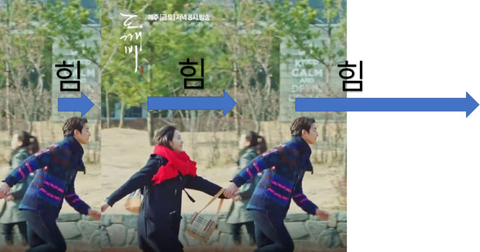
1. Roche Limit
When celestial bodies in space exert tidal forces on each other, what happens if the tidal force applied by a planet surpasses the satellite's own gravity?
At this point, the satellite will be stretched by the tidal force and break apart.
The orbital radius within which a satellite can approach a planet without being destroyed by tidal forces is called the Roche Limit.
2. Deriving the Roche Limit
1) Let's understand the Roche Limit using the previous tidal force formula. First, we define the symbols as follows.
Planet's mass and radius = M, R
Satellite's radius and mass = m, r
d = Distance between the two celestial bodies
2) The magnitude of the tidal force is as follows.
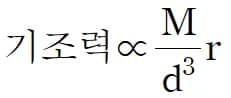
3) If the satellite approaching the planet has mass m, the gravity exerted on a unit mass on the satellite can be written as follows.
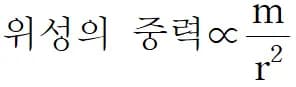
4) To find when the tidal force is greater than the satellite's gravity (Roche Limit), we use both equations and get the following result.
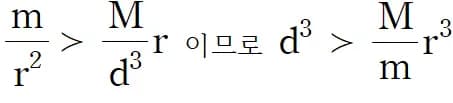
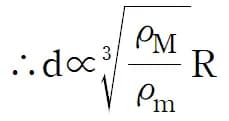
5) Here, the planet and satellite can be considered spheres. By calculating the volumes and substituting them into the equation, we get the following result.


3. Interpretation of the Roche Limit
Now, let's interpret the value we obtained. More important than the value itself is understanding how to interpret it.
- When the planet's density and radius are constant, the Roche Limit is inversely proportional to the satellite's density.
- When the planet's and satellite's densities are constant, the Roche Limit is proportional to the planet's radius.
- When the planet's radius and satellite's density are constant, the Roche Limit is proportional to the planet's density.
The important point here is that the Roche Limit is not significantly related to the satellite's radius, i.e., satellite size, but is inversely proportional only to the satellite's density and affected by the planet's size and density, i.e., the planet's mass.
The larger and denser the planet, the wider the Roche Limit.
If a satellite cannot approach a planet and approaches closer than the Roche Limit, it will be torn apart by tidal forces into small pieces.
4. Roche Limit for Satellites Orbiting Saturn
Looking at the Roche Limit on Wikipedia, you can find the Roche Limits of various planets in the solar system.
Today, we will use the physical quantities of planets from Wikipedia to estimate the Roche Limit around Saturn and check if the positions of Saturn’s satellites violate the Roche Limit.
First, let's look at Saturn's physical quantities below.
Radius of Saturn: 60,267km
Density of Saturn: 687.3kg/m^3
Since the planet is set as Saturn in the above equation, the Roche Limit around Saturn depends only on the rigidity, or density, of the satellite. By using estimated satellite densities orbiting Saturn, the Roche Limit can be calculated.
Planet | Satellite | Orbital Radius/Roche Limit | |
Solid | Fluid (Gas, Liquid) | ||
Saturn | Pan | 142% | 70% |
Atlas | 156% | 78% | |
Prometheus | 162% | 80% | |
Pandora | 167% | 83% | |
Epimetheus | 200% | 99% | |
Janus | 195% | 97% | |
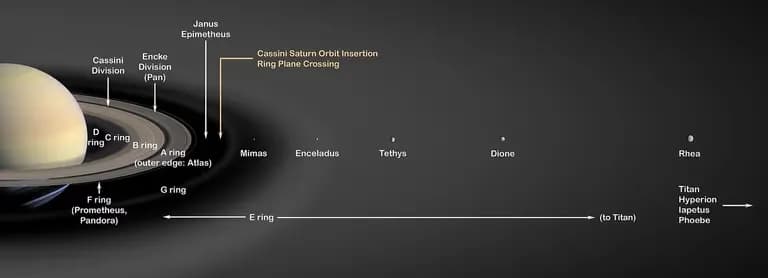
Through this, we can see that Saturn’s satellites are generally outside the Roche Limit.
If the satellite's density is significantly greater than Saturn's, it would collide with Saturn before reaching the Roche Limit.
Thus, it cannot reach the Roche Limit.
5. Conclusion
We have looked at the Roche Limit, the range where a planet destroys its satellites, starting from tidal forces through differential gravity.
Rings existing around planets are mostly within the Roche Limit.
Some of Saturn's rings are outside the Roche Limit. This may have occurred when they were destroyed passing through the Roche Limit or failed to merge into a satellite during the formation of proto-planets.
Therefore, rings existing around planets can be considered as having resulted from captured satellites or existing ones breaking apart as they approach inside the Roche Limit.
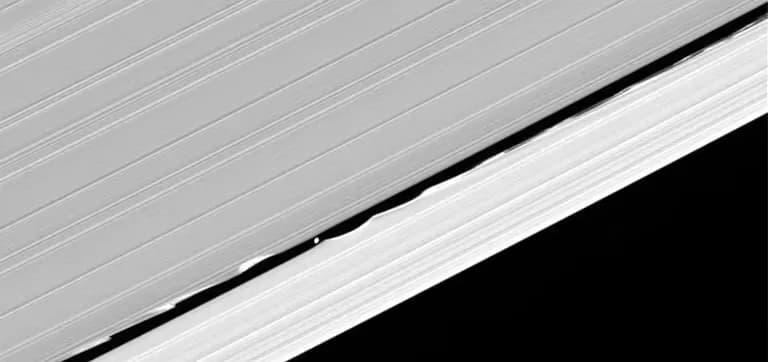
As you look at Saturn’s rings and the satellites nestled between them below, I hope you imagine the constant tug-of-war physically between planets and satellites.

댓글을 불러오는 중...