In my third year of college, I remember struggling for a long time to understand the concept of the radiative transfer equation and optical depth that I had learned for the first time.
This article is based on personal reflections on optical depth, introductory astronomy and astrophysics, and my college astronomy notes.
This article will cover optical depth. If you can understand optical depth, you can somewhat easily grasp the radiative transfer equation.
1. Stellar Atmosphere and Optical Depth
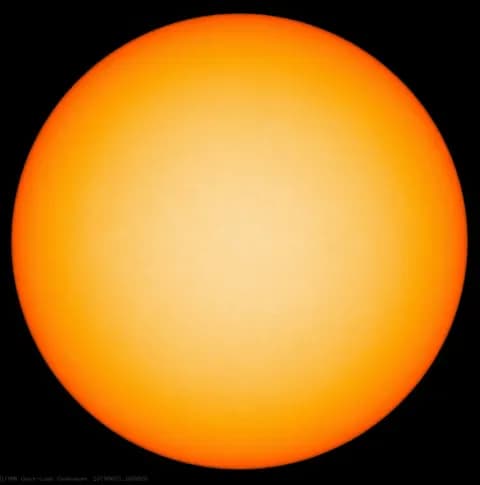
Looking at the Sun, in visible light, we can see the Sun's surface, which is called the photosphere.
It's fascinating to think more deeply that the Sun appears to have such a clear boundary with its surroundings.
The Sun is mostly made up of hydrogen and helium and does not actually have a clear boundary.
The reason it appears as though the Sun has a boundary is because the atmosphere is somewhat 'opaque' to visible light.

Consider looking at a cloud, for example.
In reality, when you look at a cloud up close, it does not have a clear boundary with its surroundings.
The reason it seems like clouds have a boundary is because there is a region where the light is completely blocked by the back of the cloud.
This phenomenon occurs because clouds scatter and absorb light.
The more opaque the clouds, the clearer the boundary appears to be.
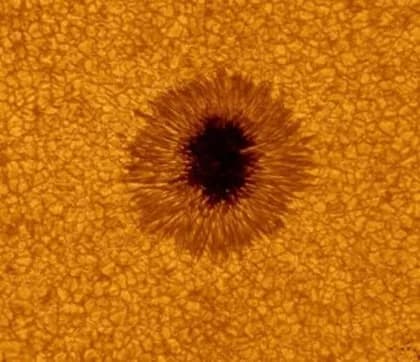
This phenomenon also occurs in the atmosphere of stars like the Sun.
The reason we cannot directly observe the nuclear fusion occurring deep inside the Sun is because the Sun’s atmosphere is somewhat opaque to all wavelengths.
Then, to what depth are we observing when we look at the photosphere?
Qualitatively, we could say we are observing the part where 'the light coming from inside is almost absorbed by the atmosphere.'
This degree of light scattering, absorption, and reflection is called optical depth.
2. Qualitative Thinking of Optical Depth
Optical depth refers to the amount of light that is scattered and absorbed.
If much extinction (degree of light removal) occurs, we say the optical depth is deep, and if little extinction occurs, the optical depth is shallow.
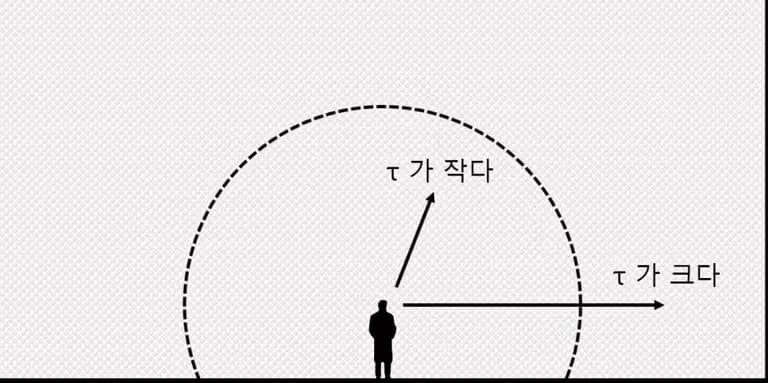
For example, as in the picture above, there is a person in the fog.
Assuming scattering occurs uniformly in any direction this person looks.
When looking at a nearby object, there will be less scattering.
The further you look, the more scattering occurs.
When looking at nearby objects, the optical depth is shallow; when looking at distant objects, the optical depth is deep.
So then, where is the boundary of the space in the fog for this person?

When a person looks around in the fog, the actual boundary of the fog cannot be clearly defined.
But, if we roughly set a boundary, it is the point where all light coming from outside the fog is blocked and invisible.
The extinction rate of light in terms of optical depth occurs exponentially, so light coming from beyond the point where the optical depth is 1 is 'almost none!'
Therefore, the boundary of the space in the fog that this person sees is approximately where the optical depth is 1.
Let's examine this more quantitatively.
3. Quantitative Thinking of Optical Depth
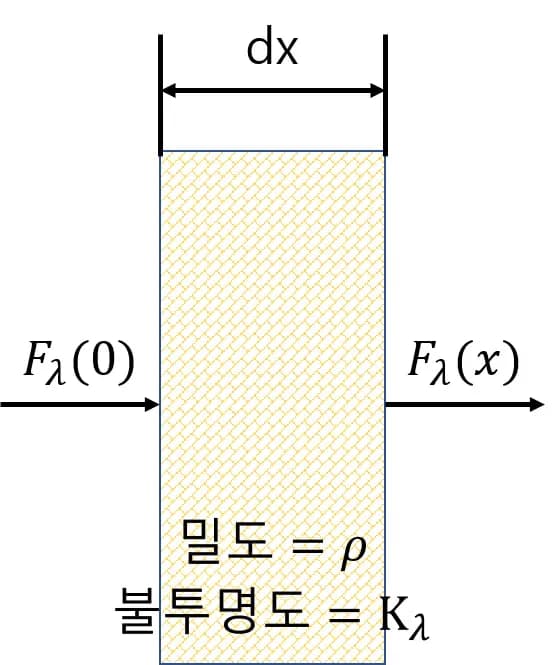
What happens to optical depth when only extinction occurs?
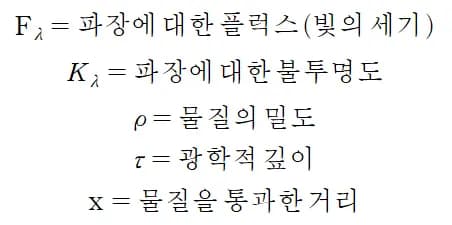
Let's calculate the change in light flux (intensity change) as it passes through gas with thickness dx.
In this case, the change in light flux passing through the gas would be proportional to the opacity, density, and distance traveled.
Also, since the light intensity decreases, the change will be negative.
Using this, we can derive the following formula.

This can be organized as follows.
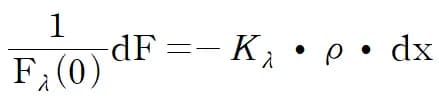
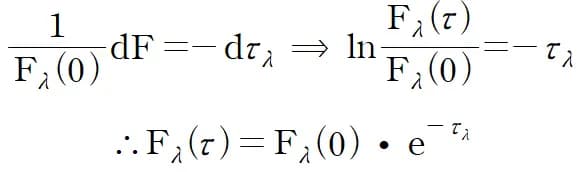
Since optical depth is the degree of light removal, it is defined by differentiating with respect to distance.

By integrating from 0 to tau, using optical depth, we get the following expression.
To understand the above formula, let's draw a graph of the exponential function.
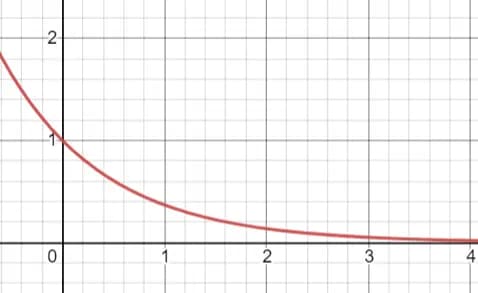
When the graph of y=exp(-x) is drawn, when x=1, the y-value is reduced to approximately 0.368.
Thus, we can distinguish between cases where the optical depth is greater than or less than 1.
If the optical depth is greater than 1, it is optically thick, reducing the number of photons that can pass through, while if the optical depth is less than 1, it is optically thin, allowing many photons to pass.
τ >1: Optically thick (deep optical depth). Opaque, making it difficult for photons to pass.
τ <1: Optically thin (shallow optical depth). Transparent, allowing more photons to pass.
4. Conclusion - What is Optical Depth?
1) Optical depth refers to the degree of light removal. Alternatively, it indicates the degree of opacity.
2) Optical depth is related to the density, opacity, and path length of the material.
3) If the removal of light is significant, the optical depth is said to be deep, or thick.
4) If the removal of light is minimal, the optical depth is said to be shallow, or thin.
This article explored optical depth.
Optical depth is simpler than the radiative transfer equation because it only assumes extinction.
Optical depth is a familiar topic for those preparing for the Earth Science teaching exam.
It's often used to calculate atmospheric transparency at various angles or the degree of extinction along different directions in the Milky Way plane.
However, in the atmosphere of a star, extinction and emission occur simultaneously.
In such cases, the radiative transfer equation must be used.
Let's learn about the radiative transfer equation in the following article.


댓글을 불러오는 중...