When learning about the spectral types of stars, you might have heard something like this:
Oh Be A Fine Girl Kiss Me
A classic mnemonic for star spectral types
This categorizes stars based on their temperature.
The person who first classified stellar spectra into A, B, C order, based on the strength of hydrogen Balmer absorption lines, was Annie Jump Cannon, a female astronomer at Harvard Observatory.
But why does the strength of Balmer lines not directly correlate with temperature, leading to the mixed order above?
This article is for those who can't accept the simple explanation that 'stellar spectra are classified by temperature,' such as hardcore science students or exam candidates.
Today, through the Boltzmann equation and the Saha equation, we'll explore why stellar spectral types are determined as they are.
1. Factors Determining the Strength of Hydrogen Balmer Lines
Hydrogen Balmer lines occur when hydrogen at the n=2 level absorbs electromagnetic waves corresponding to its transition energy.
For example, when excited from energy level n=2 to n=3, it selectively absorbs light that has the corresponding energy.
This absorption line of all frequencies that can be absorbed while exciting from energy level n=2 is called the 'Balmer line.'
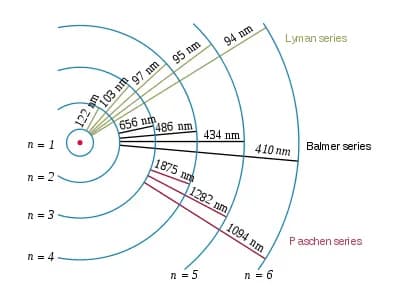
The most crucial factor affecting the strength of a hydrogen Balmer absorption line is 'how many hydrogen atoms are at the n=2 energy level in the star.'
The more hydrogen at the n=2 level, the stronger the Balmer series absorption lines.
Let's first think about this qualitatively.
Not covered in high school but atomic energy levels can be excited or de-excited by collisions.
This is called 'collision excitation' and 'collision de-excitation.'
Higher temperatures in hydrogen gas mean higher atomic average kinetic energy, leading to higher collision occurrences.
Thus, hotter gases tend to have more atoms at higher energy levels.
However, if the temperature is too high, all atoms become ionized rather than being in high energy states.
This weakens the Balmer absorption lines.
Therefore, an 'optimal temperature' is needed for hydrogen's n=2 level to absorption lines to occur.
1. Energy levels can be excited or de-excited by collisions.
2. Hot gases have atoms with high kinetic energy, leading to collision excitation.
3. The hotter the gas, the more atoms have higher energy states. (Boltzmann equation)
4. The hotter the gas, the more atoms are ionized. (Saha equation)
5. Considering the effects of both 3 and 4, we must find the 'optimal temperature'. (Boltzmann-Saha equation)
Now, let's examine this mathematically.
2. Boltzmann Equation
The Boltzmann equation is a function that determines the ratio of excited atoms due to collisions and spontaneous transitions in a gas.
The higher the gas temperature, the higher the atomic average kinetic energy.
Students who studied gas kinetics in Physics 2 may recall this formula:
Atomic kinetic energy is proportional to temperature.
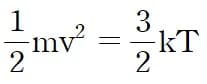
Thus, the hotter the gas, the more molecules have high energy levels due to collisions, and absorption lines at higher energy levels become stronger.
This principle was summarized by Austrian physicist Ludwig Boltzmann.
The Boltzmann equation is as follows:
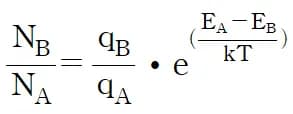
N = number density of each state
q = degeneracy of each state
E = energy of each state
We should always remember that there's no need to memorize all these equations. The Boltzmann equation is basic physics knowledge to aid understanding astronomical phenomena, not an end in itself. Let's focus a bit more on what these equations mean.
1) In the Boltzmann equation, if energy E(A) is less than E(B), the logarithm value is always negative.
2) Therefore, as temperature increases, the ratio N(B)/N(A) increases, and as temperature decreases, the ratio N(B)/N(A) decreases.
The Boltzmann equation indicates that more atoms have higher energy states as temperature increases.
The problem is that at high temperatures, ionized atoms also exist.
This can be explained by the Saha equation.
3. Saha Equation
In high-temperature gases, radiation or collisions provide sufficient energy to ionize atoms, and higher electron density N(e) increases the recombination probability.
When ionization and recombination rates equalize, ionization equilibrium is achieved. This was quantitatively expressed by Indian physicist Meghnad N. Saha.
The Saha equation is as follows:
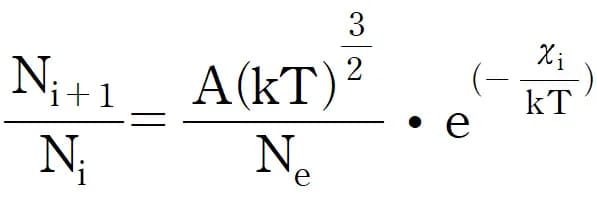
N(i) : number density of atoms at each ionization stage
A : certain atomic constants
N(e) : electron number density
X(i) : ionization energy at each stage
k : Boltzmann constant
T : absolute temperature
The Saha equation is similar to the Boltzmann equation but proportional to electron density and temperature to the power of 3/2.
This indicates a greater effect of temperature.
Larger energy than ionization energy ionizes atoms, and higher electron kinetic energy decreases recombination rates.
Curious to see if this was true, I plotted it as a function.
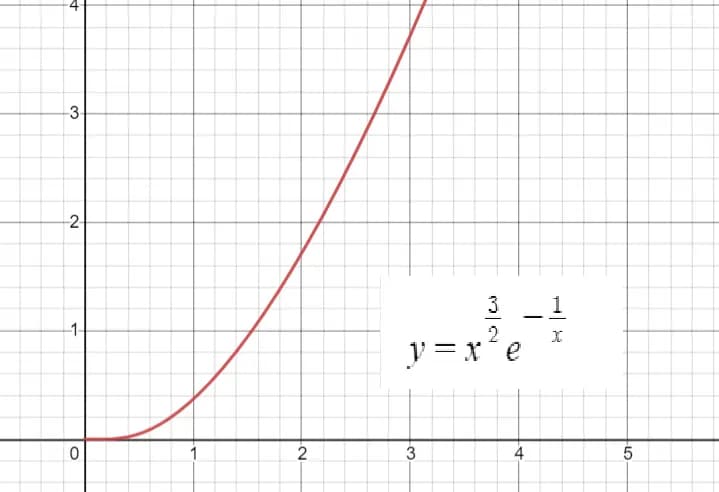
Treating other numbers as constants, I plotted the graph based on temperature.
The y-value increases exponentially with x, showing that the atomic ionization/neutral atomic ratio increases exponentially with temperature with the Saha equation.
As temperature increases, the proportion of N(i+1)/N(i) also increases.
Now let's analyze the Balmer lines of hydrogen by combining the Boltzmann and Saha equations.
4. Boltzmann-Saha Equation
Let's combine the Boltzmann-Saha equation as per the steps below and apply it to the hydrogen Balmer lines.
1) Saha equation --> Determine how much neutral hydrogen is present in the hydrogen gas.
2) Boltzmann equation --> Determine how much hydrogen at n=2 level is present among neutral hydrogen.
3) Boltzmann-Saha equation --> Calculate the proportion of hydrogen at n=2 level in the hydrogen gas.
4) Conclusion: Determine the temperature-dependent proportion of hydrogen atoms at the n=2 level, which relates to the Balmer line strength.
And there are a few assumptions required for this calculation.
- Most neutral hydrogen is in the ground state.
- Hydrogen has only one ionization stage.
1) Hydrogen Balmer Line involves calculating the proportion of neutral hydrogen at the n=2 stage.
2) The total number of atoms, N, can be thought of as a sum of ionized hydrogen, N(+), and neutral hydrogen, N(0).
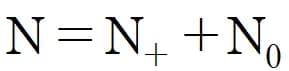
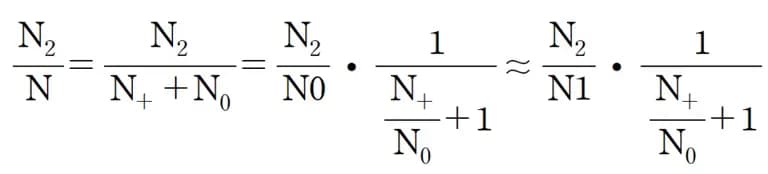
3) Assuming most neutral hydrogen, N(0), is in the ground state, N(1), then the amount of hydrogen at n=2 level relative to total atoms, N, can be expressed as follows:
4) The solution to this equation can be interpreted as:
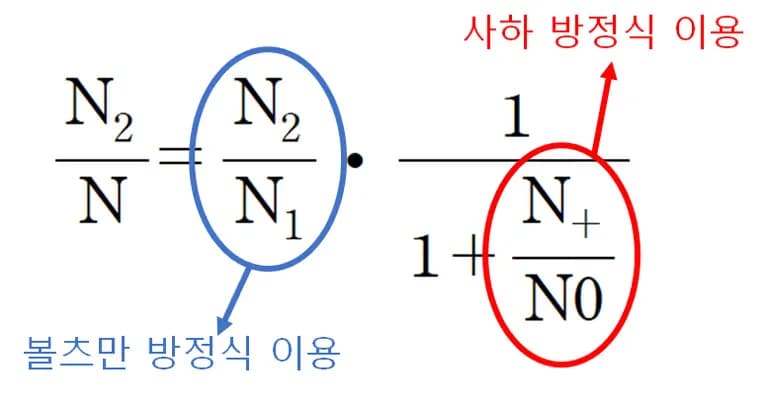
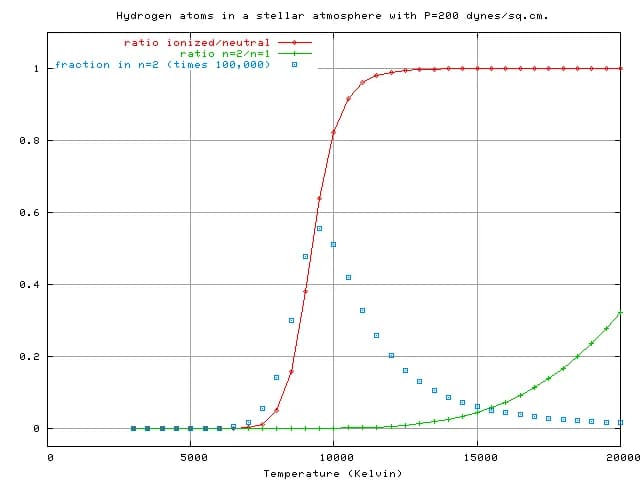
5) In conclusion, a graph can be drawn based on this equation as shown below:
5. Oh! Be A Fine Girl Kiss Me - Conclusion
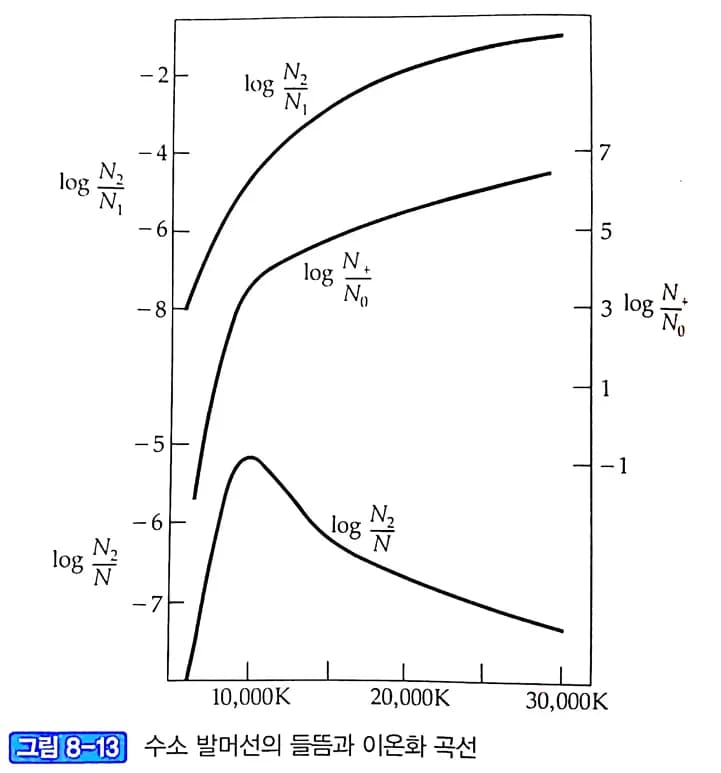
If the temperature is too low, there are many neutral hydrogens but insufficient energy to reach n=2 level; if too high, hydrogen becomes ionized, unable to form Balmer absorption lines.
For example, O and B-type stars are hotter than A-type stars but have ionized hydrogen, while K and M-type stars have plenty of neutral hydrogen but insufficient energy to climb to n=2 level.
Thus, the estimated temperature where Balmer lines are strongest, derived from the Boltzmann-Saha equation, is around 10,000K, corresponding to A-type stars.
This explains why the original orderly naming based on Balmer line strength was rearranged with temperature classification.
Astronomical phenomena, often memorized without thought, often require profound physical understanding upon closer inspection.
Instead of memorizing equations, consider what they represent. This makes complex concepts more approachable.





댓글을 불러오는 중...