I was about to write about moving star clusters, but I felt I also needed to write about the space velocity of stars.
I want to explore the radial velocity, tangential velocity, and space velocity of stars.
1. Radial Velocity, Tangential Velocity, and Space Velocity of Stars
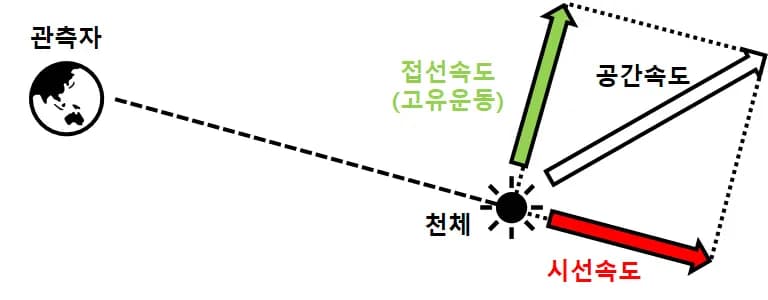
The general motion of celestial bodies moves in a random direction relative to the observer.
The actual speed at which a star moves in space is called space velocity.
The velocity in the direction of the observer's line of sight is radial velocity, and the velocity in the direction perpendicular to the line of sight is tangential velocity.
2. Measurement of Radial Velocity
Radial velocity can be determined using the Doppler effect of spectral lines.
You can compare the observed wavelength (λ) with the intrinsic wavelength (λ0) measured in the laboratory to find the Doppler shift (∆λ) and, from this, calculate the star's radial velocity.
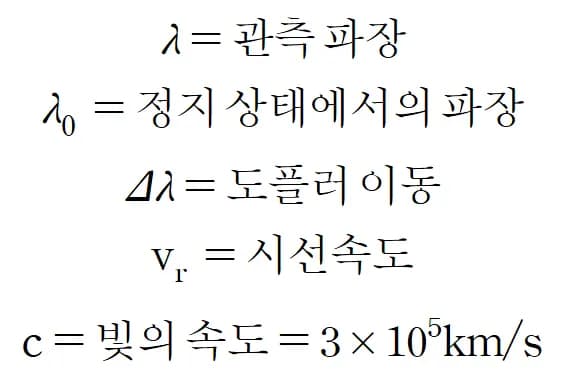
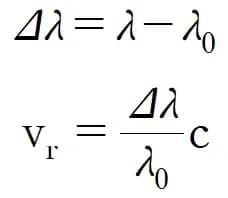
If a star is moving away from the observer, redshift occurs, and the wavelength of the observed spectrum is lengthened.
In this case, the radial velocity is positive.
If a star is approaching the observer, blueshift occurs, and the wavelength of the observed spectrum is shortened.
In this case, the radial velocity is negative.
3. Measurement of Tangential Velocity
Due to the tangential velocity of a star, it appears to move across the celestial sphere, which is called proper motion.
Proper motion is measured by how many arc seconds per year a star moves, with units of ''/yr.
For example, Barnard's Star is a representative star that shows significant proper motion.
The proper motion value of Barnard's Star is 10.3"/yr. The image below shows Barnard's Star moving from 1985 to 2005.

You can use proper motion to calculate a star's tangential velocity.
Assume a star showing proper motion (μ) is at a distance d.
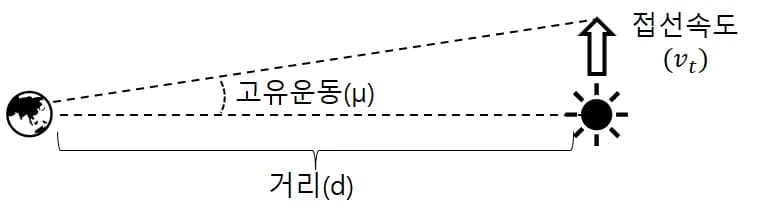
Because the distance to the star is much greater compared to its movement, it can be thought of as a part of circular motion.
Therefore, if you consider proper motion as angular velocity and the distance as the radius of circular motion, tangential velocity is given by the product of these two values.
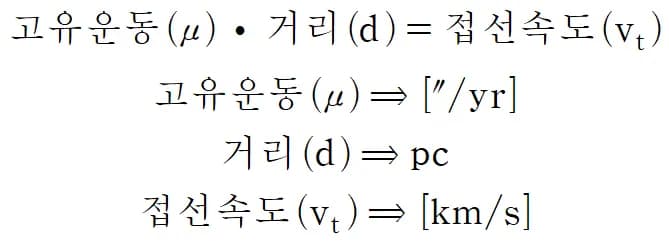
The unit of tangential velocity is km/s, so you must unify the units when multiplying the above values.
By multiplying '' (seconds) and pc, you get the unit Au, and if you convert one year into seconds for calculation, you get the following value.

By substituting the actual value of 1 Au, 149,597,870,700m, into the above formula, you can obtain approximately 4.74 km/s.
If you re-adjust both sides using this, it is expressed as follows.

4. Space Velocity of Stars
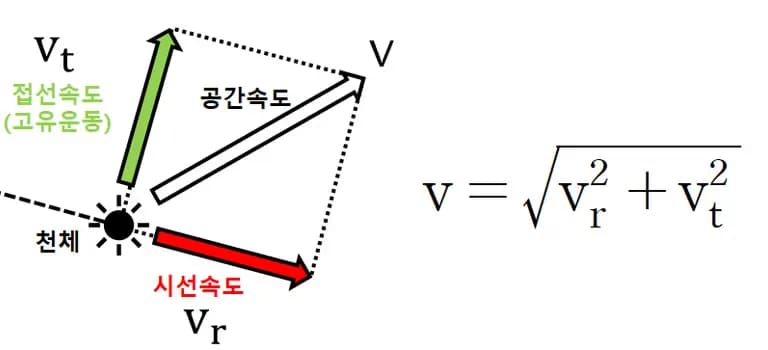
The space velocity of a star can be calculated using the Pythagorean theorem.
Calculate the square root of the sum of the squares of radial velocity and tangential velocity to determine the space velocity.
4. Conclusion
Stars move in all directions. The speed of a star is called space velocity. Space velocity is the sum of radial and tangential velocity.
The speed in the direction of the line of sight is called radial velocity. Radial velocity is measured through the Doppler effect.
The speed in the tangential direction is called tangential velocity. You can calculate tangential velocity using proper motion if the distance to the star is known.
Space velocity can be calculated using the Pythagorean theorem by combining radial and tangential velocity.




댓글을 불러오는 중...