In high school, when studying the H-R diagram and stellar evolution, you probably learned that the Sun's lifetime is approximately 10 billion years.
Since the time spent on the main sequence constitutes the majority of a star's life, time on the main sequence ≈ a star's lifetime can be said.
So far, humanity has never observed the exact moment a star like the Sun is born or dies.
But how did we come to know that the Sun's lifetime is roughly 10 billion years?
1. The star that serves as the standard for all stars: the Sun's lifetime and stellar lifetimes
The star with the most observational records in the universe is the Sun.
Therefore, certain stellar quantities like metal abundance, luminosity, and lifetime are often expressed relative to the Sun.
You have probably heard that the Sun's lifetime is 10 billion years. This value is derived through the following process.
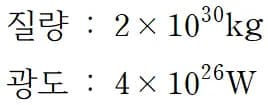
We know the Sun's mass, luminosity, and other information.
In main-sequence stars, the energy generation reactions occur by nuclear fusion, and during the fusion of 4 hydrogen nuclei into 1 helium nucleus there is a mass loss of about 0.0072 atomic mass units per hydrogen atom, which is released as energy.
Only 10% of a star's mass participates in nuclear fusion during the main sequence.
Total available energy ÷ stellar luminosity = stellar lifetime.
2. Hydrogen nuclear fusion reactions and mass loss
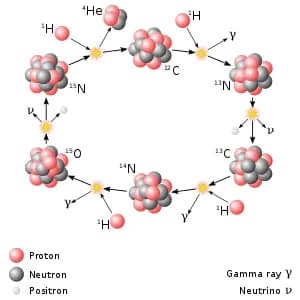
Hydrogen nuclear fusion in stars mainly proceeds via two pathways: the P-P chain reaction (P-P chain) and the C-N-O cycle (CNO cycle).
I will not cover here the detailed pathways by which these reactions synthesize nuclei.
What we focus on is that both reactions fuse 4 hydrogen nuclei into 1 helium nucleus.
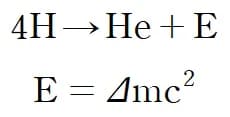
At this point, the atomic mass of hydrogen (H) is 1.008, and the atomic mass of helium (He) is 4.002602.
Using these, comparing the mass of 4 hydrogens to 1 helium gives a mass difference of 0.029398, corresponding to a mass loss of 0.0073495 per hydrogen atom.
Dividing by the hydrogen atomic mass shows that hydrogen nuclear fusion results in a fractional mass loss of about 0.00729.
The mass defect is converted into and released as energy (E), which is radiated into space. The amount of energy produced can be calculated from Einstein's mass–energy equivalence (E=mc2).
3. Ten percent of the star: mass available for nuclear fusion
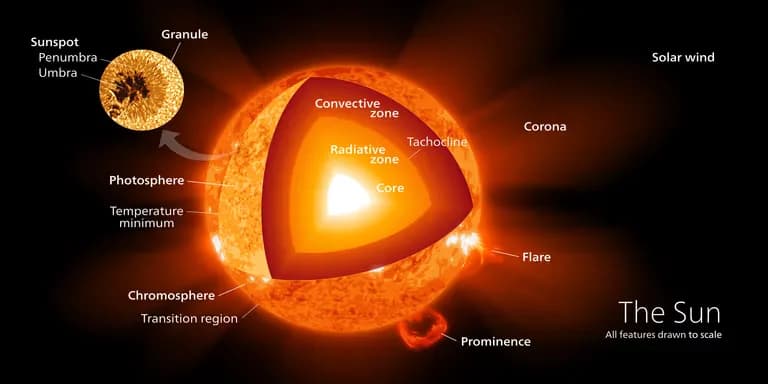
Nuclear fusion in a star occurs in its core.
Here, the mass of the core is about 10% of the total mass. Using this gives the total energy a star can produce while on the main sequence.
Using the Sun's mass, this is calculated as follows.

Using this, the total energy the Sun can produce during the main sequence is as follows.

4. The Sun's lifetime
Now finally let's calculate the Sun's lifetime (t). The Sun's lifetime is the total energy divided by the luminosity as shown above.

Since the total energy and luminosity are in J and W respectively, the stellar lifetime (t) comes out in seconds.
Convert this into years.
Divide by the number of seconds in a year (365*24*60*60).

Using this, you can estimate the Sun's approximate lifetime.
5. Lifetimes of stars with different masses
Knowing that the Sun's lifetime is about 10 billion years allows rough estimates of the lifetimes of stars with other masses.
Generally, on the main sequence, a star's mass and luminosity roughly follow the relation below.
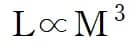
A star's luminosity is proportional to the cube of its mass.
However, this relation involves many approximations, such as neglecting opacity.
Roughly, luminosity scales as mass to the power of about 2.3–4.
Using this fact, let's calculate a star's lifetime (t*).
Expressing things relative to the Sun, if you divide by the Sun's lifetime (t⊙) below, constants like 0.1 cancel out, making the expression simple.
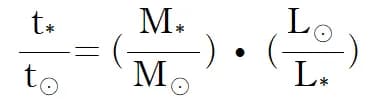
Since a star's luminosity roughly scales as the cube of its mass, it can be written as follows.

Using the Sun's lifetime (t⊙) of 10 billion years, knowing only a star's mass allows you to estimate its approximate lifetime.
From the above formula, you can quantitatively infer why higher-mass stars have shorter lifetimes and leave the main sequence more quickly.
6. Closing remarks
Today we looked at a simple way to calculate the Sun's lifetime.
Next time we will quantitatively examine how the mass–luminosity relation on the main sequence is estimated.
I hope this article is helpful to young students who like astronomy.


댓글을 불러오는 중...