I remember getting a lot of questions from younger students about color–color diagrams and the Balmer jump.
Even so, there doesn’t seem to be much information on color–color diagrams on the internet, so I decided to write this post.
In general, when we describe the properties of stars, we often use the color–magnitude diagram.
The diagram that appears in the secondary school curriculum is also the color–magnitude diagram.
Today I’d like to go a little further and write about the color–color diagram.
1. Color–Color Diagram
Unlike the color–magnitude diagram, the color–color diagram is a graph whose two axes are different color indices.
The X-axis is (B−V), and the Y-axis is (U−B).
In a color–color diagram, a distinctive shape appears that you cannot see in an ordinary color–magnitude diagram.
In particular, another unique feature is that, for a graph assuming blackbody radiation, the result appears differently depending on whether the star is a main-sequence star or a supergiant.
Then what is the reason for this difference in the color–color diagram?
2. Color–Color Diagram, Balmer Jump, and the U Filter
In the color–color diagram, the graph for an object assumed to be a blackbody appears as a straight line.
If we assume a blackbody, it follows the Planck curve perfectly, so by this law, a perfect straight line appears.
However, the fact that actual main-sequence stars and supergiants show different shapes in the color–color diagram is due to the following three reasons.
Balmer jump caused by hydrogen absorption lines
Wavelength ranges of the U, B, V filters
Density difference between main-sequence stars and supergiants
1) Balmer Jump
As discussed in a previous post, the general classification of stars uses the Harvard College Observatory Cannon classification, and this is based on the strength of the star’s hydrogen Balmer lines.
The hydrogen Balmer lines are absorption lines caused by photons absorbed by hydrogen atoms that are excited from the n=2 level.
Light with a wavelength shorter than that of photons that ionize hydrogen atoms in the n=2 level is absorbed by hydrogen and ionizes the hydrogen atom.
Therefore, all photons with wavelengths shorter than λ = 3648Å (364.9μm) are used to ionize hydrogen and are absorbed (continuously absorbed).
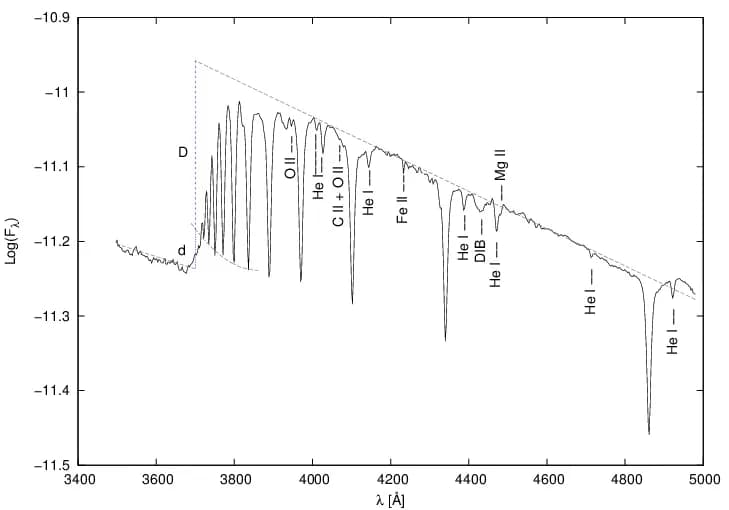
In the graph above, the x-axis is wavelength and the y-axis is flux at each wavelength.
Looking at the plot, you can see that the flux suddenly drops between 3600–3800Å.
“D” is the first Balmer-series absorption line in a B-type star, and all wavelengths shorter than D are due to absorption of photons that ionize hydrogen.
This phenomenon is called the Balmer jump because, when looking at the stellar spectrum, the flux in the Balmer series appears to change abruptly, as if it “jumps.”
2) U–B–V Magnitude System
If we combine the effect of the Balmer jump with the effect of the observing instruments, it becomes easy to understand why the graph in the color–color diagram looks the way it does.
When observing a star, each monochromatic filter and broadband filter has its own observable wavelength range.
For example, among the monochromatic filters we have the Hα filter, and among broadband filters we have the U, B, V filters.
The color index is determined by broadband filters, and the U filter is centered around 3650Å, the B filter around 4400Å, and the V filter around 5500Å.

The Balmer jump is centered at a wavelength of 3648Å, so it has the greatest effect particularly on the U-filter magnitudes.
Therefore, A0-type stars (surface temperature about 10,000K) are most strongly affected by the Balmer jump because the population of hydrogen at n=2 is the largest.
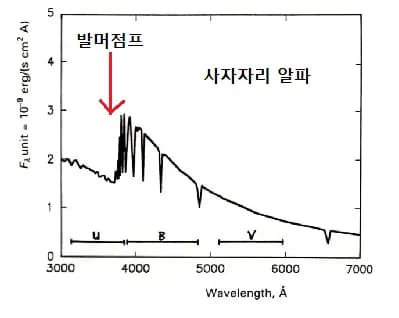
If this is unclear, think it through using the following steps.
1) In the color–color diagram, the x-axis represents the (B−V) magnitude and the y-axis represents the (U−B) magnitude.
2) Along the x-axis, moving to the right means the (B−V) magnitude increases, and along the y-axis, moving downward means the magnitude increases.
3) An increase in magnitude means the brightness difference in each filter becomes larger.
4) The fact that the graph of real stars in the color–color diagram differs from that of a blackbody means that, for stars with the same color index, the (U−B) value is larger.
5) A larger (U−B) value means the magnitude in the U filter is larger (the star is fainter in U).
6) This is because the Balmer jump makes the U-filter magnitude larger.
Let’s look at the axes of the graph again.
Please keep in mind once more that the axes show only the differences in U−B or B−V magnitudes, not the actual luminosity.
3) Density Difference Between Main-Sequence Stars and Supergiants
Then what is the reason that the color–color diagrams differ between main-sequence stars and supergiants?
This is due to the difference in density between the two types of stars.
Stellar absorption lines occur because of “photon absorption” in the stellar atmosphere.
Photon absorption is related to opacity.

If you recall that “density” is involved in opacity, you can see that the star’s absorption spectrum is affected in the same way.
However, in the case of supergiants, the star is in an expanded state, so its density is low, and thus the difference from the blackbody curve in the color–color diagram appears more “gradually.”
3. What Do the Color–Color Diagram and the Balmer Jump Mean?
What does the difference between a blackbody and the actual observed values of stars in the color–color diagram signify?
It can be summarized as follows.
1) Compared to a blackbody, the effects of the star’s constituent elements (the Balmer jump) appear in the color–color diagram. This shows that a star is not a perfect blackbody.
2) Observations with the U, B, V filters bring out these effects. Therefore, when interpreting data, one needs an understanding of the observing instruments, and results can vary greatly depending on the instruments used.
3) Differences in surface density between stars appear as differences in the color–color diagram.
The reason the Balmer jump (Balmer discontinuity) appears is because most of a star is composed of hydrogen.
I have watched and studied astronomy for a long time, but it is still amazing and fascinating that we can learn so many things from the spectrum of starlight.





댓글을 불러오는 중...