During a lesson on cloud formation for 9th-grade students, I explained adiabatic expansion.
The most common question from the students is "Why does the temperature drop when air expands?"
Students find the topic of adiabatic expansion difficult, but I realized there are not many easy explanations on Naver Blog.
So this time, I'm going to try writing about adiabatic expansion.

1. Kinetic Theory of Gases
The kinetic theory of gases is a theory that explains the physical phenomena of gases through the motion of molecules.
In 7th grade, students learn about diffusion.
Explaining the process of a perfume's scent spreading as the motion of particles, this can be seen as a taste of the kinetic theory of gases.

The most important point in the kinetic theory of gases is how to explain any physical properties of gases.
The kinetic theory of gases assumes a perfect gas that satisfies the assumptions below.
An ideal gas is a hypothetical gas that satisfies physical laws but does not actually exist.
1. Gas molecules have mass but no volume.
2. Gas molecules do not exert forces on each other.
3. All collisions between gas molecules are perfectly elastic.
4. Gas does not liquefy or sublime at any temperature or pressure.
5. The average molecular kinetic energy of gas is proportional only to absolute temperature, independent of size, shape, or type of molecules.
[Wikipedia - Kinetic Theory of Gases]
Items 1, 2, 3, and 4 above are intended to exclude other physical factors like molecular attraction or the volume of molecules when explaining physical phenomena with molecular motion.
Therefore, the physical characteristics of an ideal gas depend only on the gas's pressure (P), volume (V), and absolute temperature (T).
Gas pressure: P
Gas volume: V
Gas temperature (absolute temperature): T
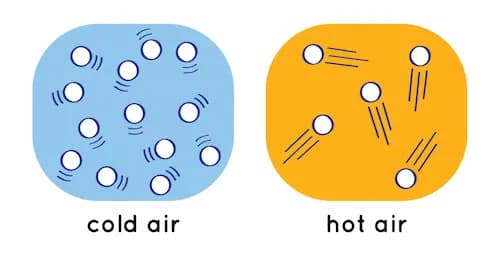
What we need to focus on here is assumption 5. The average kinetic energy of gas molecules is proportional only to absolute temperature.
The term 'average' is used because molecular motion is disorderly, meaning that even with an assumed single temperature, the speeds of molecules in the gas differ.
Anyway, this means the higher the absolute temperature (T), the more active the particles within the gas.
The higher the temperature of the gas, the higher the 'average' speed of molecular motion, and the lower the temperature, the lower the 'average' speed of molecular motion.
Understanding this is the first step in understanding why the temperature drops during adiabatic expansion.
2. Why Adiabatic Expansion Occurs
Adiabatic changes include both adiabatic expansion and adiabatic compression.
The term 'adiabatic' is used because there is no heat exchange with the surroundings although the volume of the air changes.
Simply put, the volume of the air increases or decreases without heating or cooling the air.
When the air moves up and down in the atmosphere, the volume of the air changes.
This is because the pressure changes.
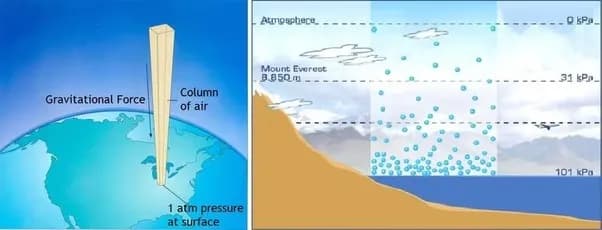
Air has weight, so the air near the surface is compressed due to the pressure from the air above, resulting in higher pressure.
As you rise from the surface into the air, the amount of air mass pressing down decreases, and the pressure drops.
If some heated air on the surface rises, the surrounding pressure decreases, causing the volume of the air to increase.
This change is called adiabatic expansion. Conversely, when air descends from high altitudes, adiabatic compression occurs, reducing the volume.

For example, if a large helium balloon is lifted as shown in the image above, it bursts and falls in the stratosphere.
In the stratosphere, the pressure decreases significantly, so the volume of the balloon, initially the size of a desk, inflates to the size of a room.
Even this change in balloon size constitutes an adiabatic change since it is not caused by heat.
3. Adiabatic Changes and Temperature Changes of Gases
Let's first look at what happens during adiabatic expansion. When a balloon or gas expands as in the image below, it is due to the motion of gas molecules.
When molecules push against the boundary of the gas and then return, the speed decreases.
The decrease in molecular speed means a decrease in temperature. Therefore, when a gas expands, its temperature drops.
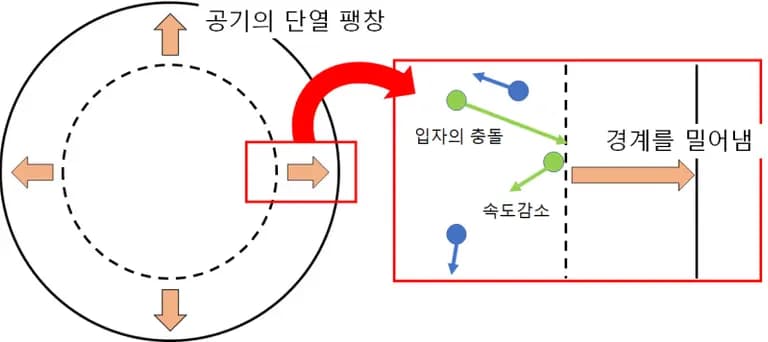
Let's think about this more simply. If you throw a baseball at an object that can move freely, what will be the speed of the ball when it returns?
The object would be pushed back, and the speed when returning would be significantly reduced.
If such an experiment were conducted in space, the object would be moving with speed in the opposite direction of the baseball.
In such a case, since the object shared its kinetic energy with the baseball, we say the object "did work" on the baseball.
Similarly, if gas expands and pushes the surrounding gas, it is said to have done work on the surroundings.

Conversely, during adiabatic compression, the opposite situation occurs where external gas molecules collide, and the internal molecular speed increases due to higher external pressure.
This results in a temperature increase. It can be easily understood by considering a situation where a baseball collides with an incoming object as in the image below.

4. Conclusion
The above can be summarized as follows.
The kinetic energy (speed) of gas molecules and gas temperature are proportional. As gas expands, the internal molecules push outwards, decreasing kinetic energy.
Therefore, during adiabatic expansion, the gas temperature decreases.
The following video is taken from YouTube. I think it will help in understanding this concept.




댓글을 불러오는 중...