1. Issue Discovery
While browsing the school meal site I created, I suddenly encountered the following issue.
Ah... I can't stand these issues...
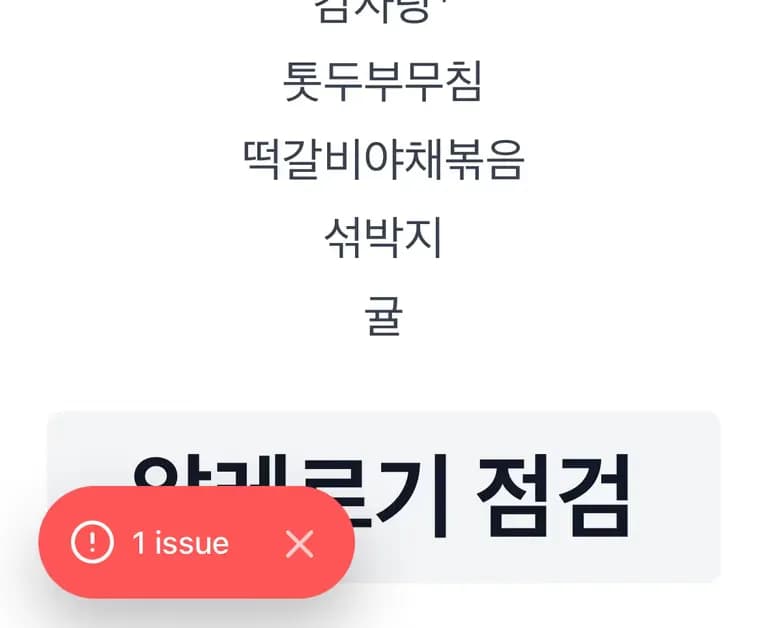
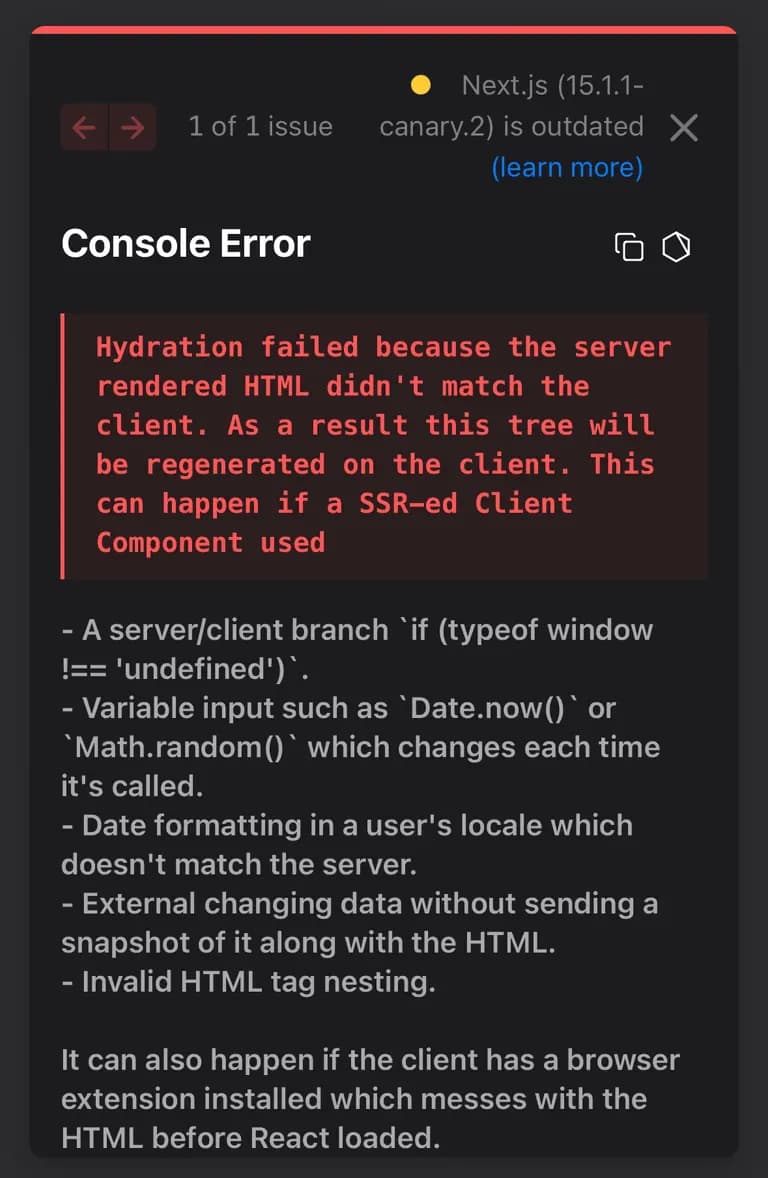
Clicking through, it turned out to be a 'Hydration failed' message.
To summarize, it means the page rendered by the server is different from the one the client sees.
The causes can be varied according to the documentation.
2. Official Documentation
Next.js Official Documentation identifies the causes of hydration errors as follows:
Incorrect use of HTML tags
Nesting <p> tags within a <p> tag
Nesting <div> tags within a <p> tag
Nesting <ul> or <ol> within a <p> tag
Using logic like
typeof window !== 'undefined'Using browser APIs like
windoworlocalStoragein rendering logicUsing time-dependent APIs like Date() in rendering logic
Browser extensions that modify HTML
Improper CSS in JS libraries
Misconfigured Edge/CDN attempting to modify HTML responses like Cloudflare auto-minify
But no matter how much I looked, none of these applied to me.
So, I debugged from start to finish.
3. Debugging Process
I commented out and saved each line of code to find the broken part.
Wow, this must be why we develop in dev environments.
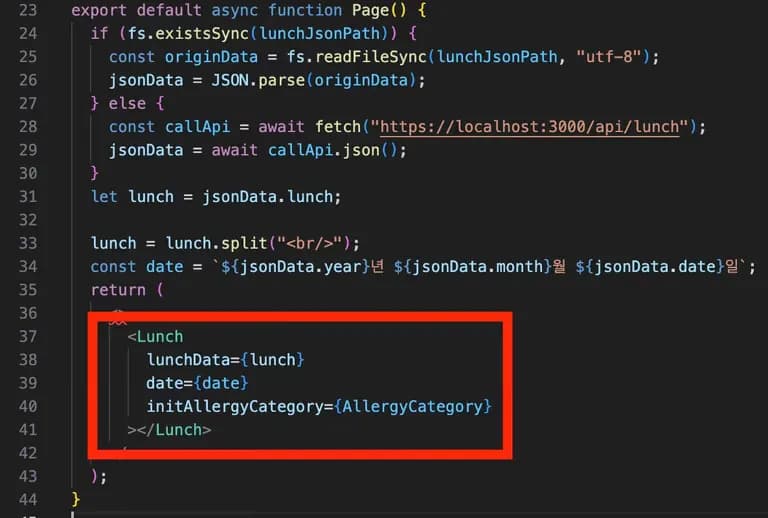
Eventually, I discovered the error occurred in the Lunch component...
I figured it out...
So, I went into Lunch and commented out each part again.
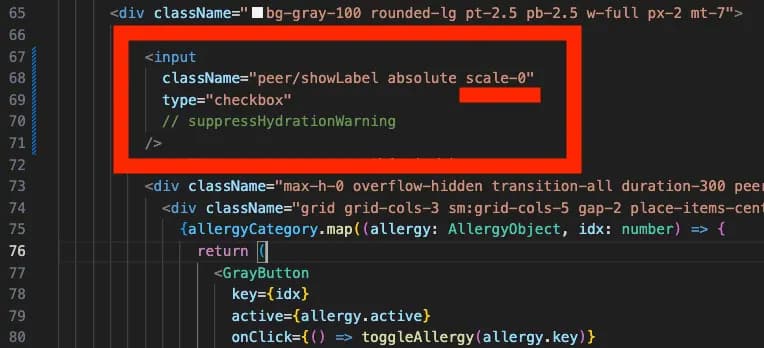
Strangely, input tags were the cause of the hydration failed error.
I experimented in various ways, and every className hiding elements like scale-0, opacity-0 caused the error!
Changing it was annoying and unsatisfactory.
4. Solution

Ignoring such pointless errors is the answer.
Even trivial things can cause issues
Add the suppressHydrationWarning attribute to the element.
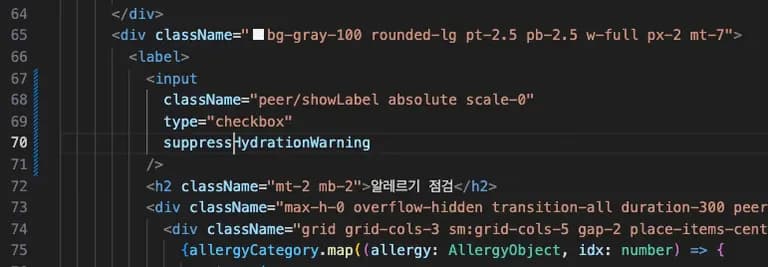
After doing this, there are no errors.
5. Review
I struggled as there were no similar cases.
Teaching myself coding sometimes leads to taking the long way around for simple problems.
I hope this article helps at least a little.
댓글을 불러오는 중...