When I was a senior in college, a close junior asked me about tidal forces.
He said he understood that the side of the Earth facing the Moon is stretched because it is pulled by the Moon’s gravity, but he couldn’t quite grasp why tides also occur on the side directly opposite the Moon.
Most students are probably like that.
In general, since deformation of an object occurs in the direction in which the force is applied, it’s easy to look at the diagram below and think that the Earth is somehow being pulled from both sides.
However, this must be understood through the concept of “differential gravity.”
1. Universal Gravitation and Differential Gravity
Tidal forces arise due to universal gravitation.
Therefore, to understand why tidal forces occur, we first need to look at the formula for universal gravitation.
The formula for universal gravitation is, as everyone knows, as follows.
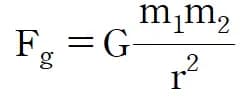
People reading this article probably have some background knowledge, so I’ll skip explaining each term and move straight to the point.
The important thing here is that gravity depends on distance.
So what kind of phenomenon can this lead to?
For example, as in the figure below, imagine three objects of equal mass connected by some string and placed at different distances from the Earth.
Assume the string does not stretch or shrink.

Since the masses are the same in the formula for universal gravitation, the gravitational force depends only on distance.
Therefore, the magnitude of the force acting on each object will be greatest for object 1, which is closest, and smallest for object 3, which is farthest.
Expressed in a diagram, it looks like this:

As shown in the figure, for a single celestial body, the strength of gravity varies with distance; this is called differential gravity.
How should we describe the forces in terms of object 2?
The forces acting on the three objects are all different, but because they are tied together by one string, they must share the same acceleration.
Object 1 must pull on object 2 by the difference between their forces, and object 2 must likewise pull on object 3 by the difference between their forces.
Expressed in a diagram, it looks like this. Let’s see what force object 2 experiences in this situation.
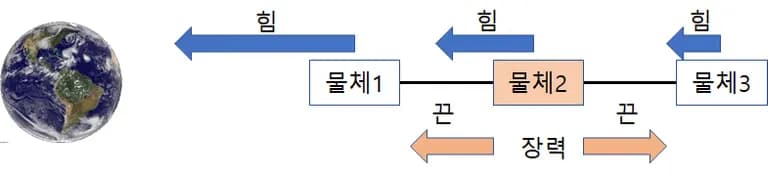
From the perspective of object 2, tension acts toward both object 1 and object 3.
Because of differential gravity, it experiences forces pulling it in both directions.
2. Understanding Differential Gravity Through an Example
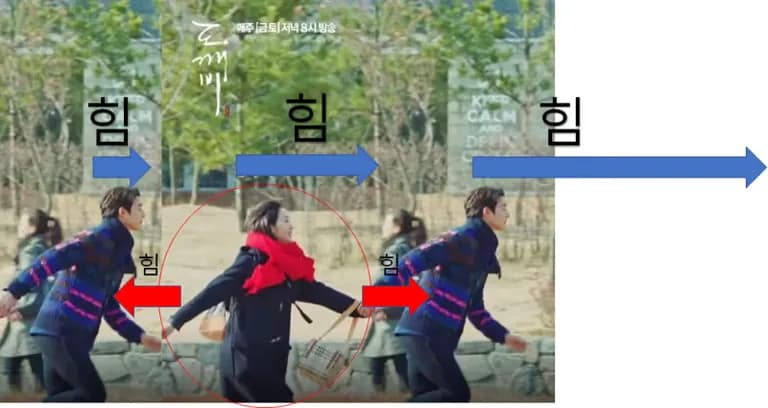
For anyone who still finds this hard to grasp, I’ll explain it a bit more simply. Imagine the three people below holding hands and running.
The person at the very front runs with the greatest force, and the farther back you go, the weaker the running force becomes.
However, because they are all holding hands, the person in the middle accelerates with the same overall force as the others.
In that case, the woman in the middle will probably feel as though she is being pulled from both sides.
This is because the person in front is pulling her forward, while she has to pull the person behind her forward.

3. Conclusion: What Is Differential Gravity?
1) The gravitational force between massive objects is inversely proportional to the square of their distance. The same goes for the magnitude of gravitational acceleration.
2) The closer two objects are, the greater the gravitational acceleration; the farther apart they are, the smaller the gravitational acceleration.
3) Celestial bodies are extremely large, so even within a single body there are differences in gravitational acceleration depending on the distance to another body that produces the gravity.
4) Because gravity depends on the distance between celestial bodies, the fact that different parts of a single body feel different gravitational pulls is called differential gravity.
If you understand this article, you should be able to understand tidal forces easily as well.
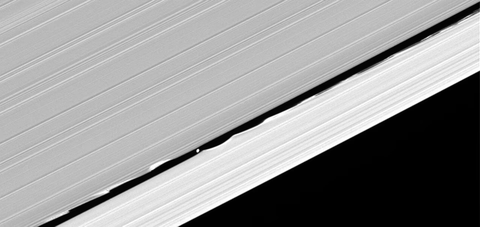
Differential gravity gives rise to tidal forces, and tidal forces can destroy a planet’s satellite to form rings, or cause synchronous rotation in which the orbital and rotational periods become the same.
If you want a deeper understanding, read the article below.




댓글을 불러오는 중...