Today I learned about populations and samples.
I was very busy because I have a leather craft class tomorrow, but thanks to my wife, who put the kids to bed early, I was able to study for an hour.
I feel like I really need to study harder.
1. Population vs. Sample
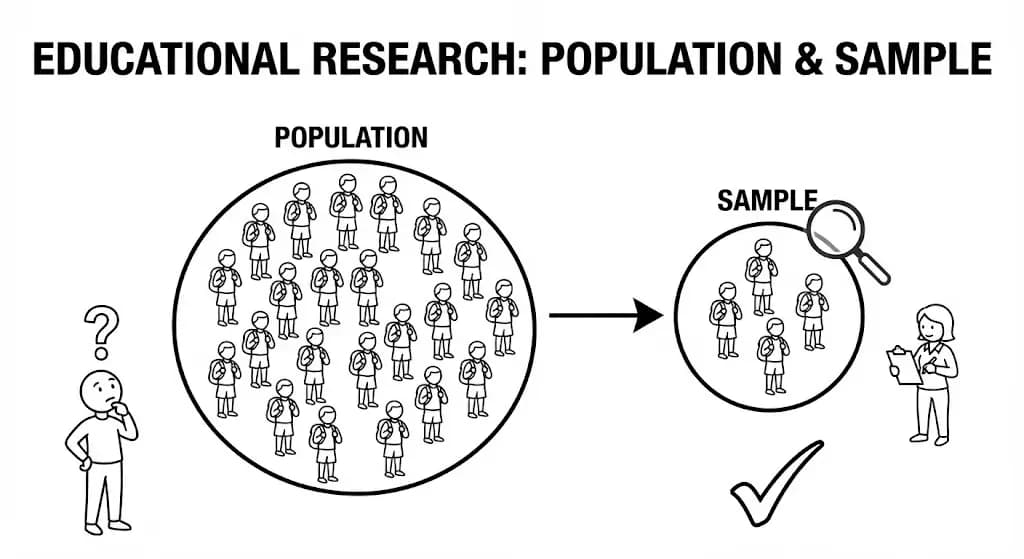
Understanding the difference between a population and a sample is extremely important for the validity of research results.
Let’s say a researcher makes the following claim.
For middle school students enrolled in Gyeonggi-do, eating breakfast does not help improve academic performance.What this researcher wants to say is that breakfast does not help improve academic performance for all middle school students, or at least for middle school students in Gyeonggi-do.
However, in an actual study, the number of selected middle school students is small compared to the total number of middle school students.
This is where an important conceptual distinction arises.
The researcher wants to talk about the effect of breakfast on all students, but in reality, only some of them are analyzed.
Here, based on the data from the selected middle school students, statistical inference is used to generalize the findings to all middle school students.
2. Representativeness of the Sample and Random Sampling
What is needed for a sampled sample to represent the population?
If the selected middle school students are biased in terms of household income, gender, etc., would the conclusions inferred from them be valid?
If the sample does not represent the population and there are large differences, then the inferences drawn from the research are not valid.
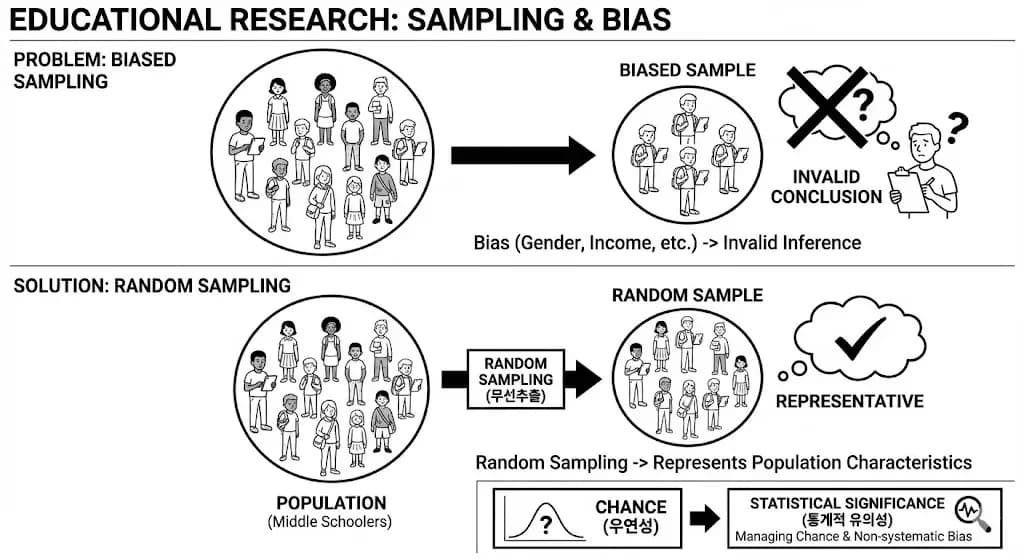
The key is how you do the sampling.
If you use random sampling, the characteristics of the population are reflected evenly.
However, even if random sampling is done well, the conclusion drawn from the sample does not necessarily match the result in the population.
The effort to statistically deal with chance variation (non-systematic bias) in the sample is called statistical significance.
3. Understanding Statistical Significance
Let’s say we draw multiple samples from a population.
In the population, breakfast has no effect.
In a sample, the value obtained from the analysis can differ by chance.

If we collect all the estimates from these samples, the probability that a value greater than the central value of 0.358 will appear is the significance probability (p-value).
The paper demonstrates that, under the assumption that breakfast has no effect, the probability that an effect size of 0.358 will be observed by chance in a randomly drawn sample is less than 0.001.
Therefore, since a value of 0.358 cannot occur in the population, it proves that there is no effect in the population.
4. Reflections
It seems that logical validity is extremely important in academic papers.
In a way, I think that people who are meticulous and persistent in digging into things are well-suited to writing papers.
Perhaps you have to break your thoughts down into small pieces and constantly check whether the bridges between those thoughts are pointing in the right direction.
I need to plan my thesis, and it feels like the things I have to think about are steadily increasing.






댓글을 불러오는 중...