Session 2 covers experimental research within quantitative research.
All figures in this post are taken from the paper below.
Choi, Hyo-Sik, Kwon, Hee-Kyung, Min, Ji-Yeon, Choi, Ji-Young. (2014). The effects of pretesting on delayed memory. The Korean Journal of Educational Psychology, 28(1), 71-87.1. Reading the research abstract
The research question of this paper can be briefly summarized as “Does taking a test on something you haven’t learned yet help?”
It tests whether experiencing pre-retrieval facilitates delayed memory.
Just from reading the abstract, it is not as easy to understand as the paper on the correlation between breakfast and grades that we read in Session 1.
The reasons can be summarized in the two points below.
The previous paper dealt with everyday content and terminology, whereas this one is in the field of educational psychology.
This is an experimental study, so the researchers intervened directly, defining and controlling variables operationally in an active way, and the constructed concepts differ from everyday concepts.
2. Experimental procedure

Learners are assigned to retrieval, highlighting, and control groups for the experimental treatment.
In the retrieval group, the content is not shown and left blank with ( ), while in the highlighting group, words are bolded for emphasis.
The control group receives no markings at all.
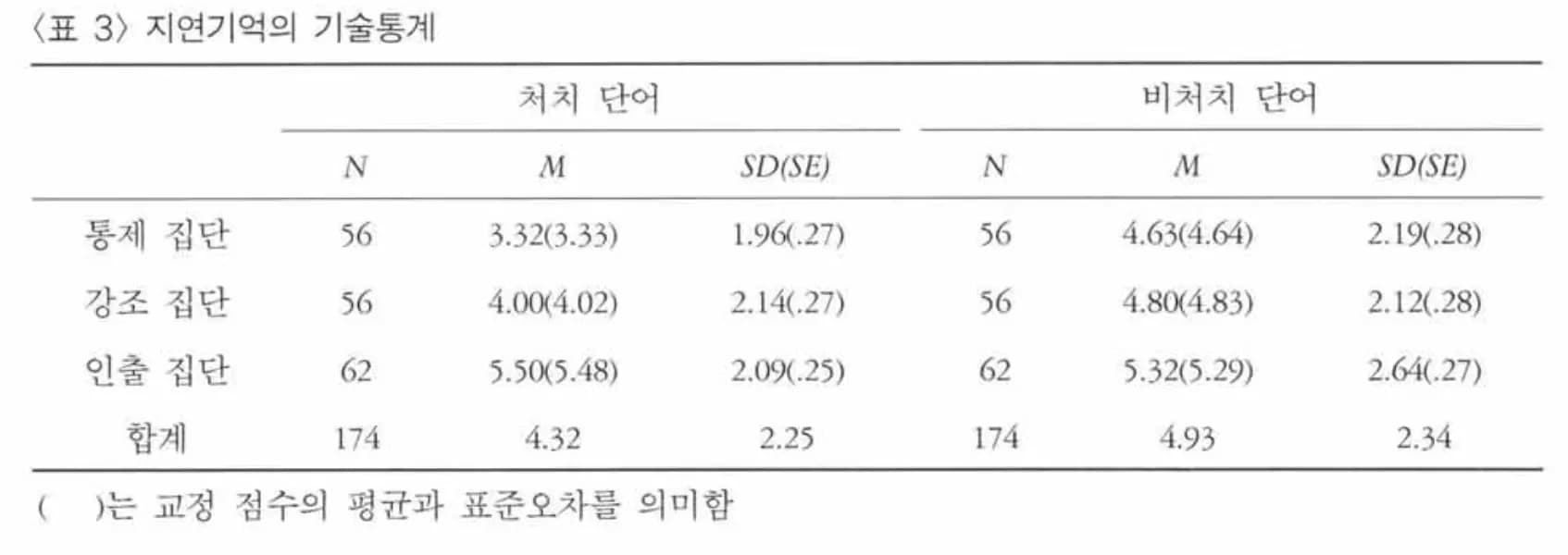
“Treated words” are words to which treatments such as retrieval or highlighting are applied, and “untreated words” are words to which no treatment is applied.
In the table above, even though the untreated words were not studied, their mean (M) appears similar to that of the treated words.
The question is whether this is statistically significant.
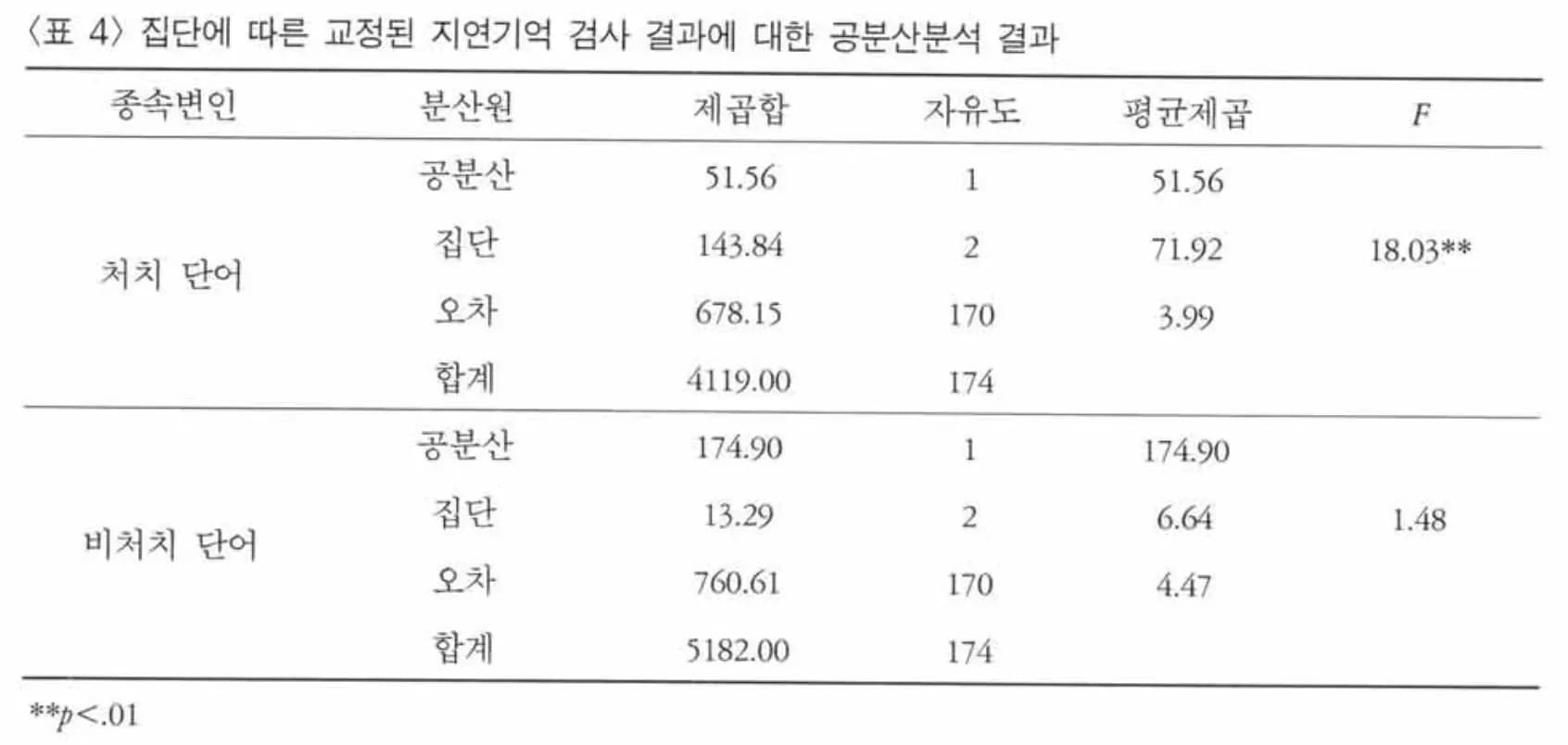
When these values are analyzed with covariance analysis, only the treated words show a significant value (**).
Thus, the conclusion is that a pretest does not simply produce an effect through “attention (highlighting)”; rather, evaluation promotes more elaborate processing of information.
2. Why the researchers examined the effects on untreated words

The reason the researchers tested the effects on untreated words was to check whether a result that is expected to show no treatment effect actually shows none.
This process can increase the overall validity of the experimental design.
What if there were differences between the retrieval and control groups for untreated words, and those differences were statistically significant?
That would mean either that the two groups were originally different from each other, or that some unintended kind of experience occurred.
This would lower the overall validity of the study.
3. Non-experimental research and experimental research
Experimental research is a research method in which the researcher directly manipulates the independent variable and measures the change in the dependent variable resulting from that manipulation in order to rigorously test causal relationships.
Unlike non-experimental research, which uses previously collected data, experimental research involves the researcher actively collecting data and controlling the situation.
The researcher defines, manipulates, and controls everything: what type of learning materials are used, what the environment is like, who the learners are, and then directly observes them.

4. Features of educational psychology research design and analysis
Research conducted in a laboratory where the researcher has direct control
Dividing participants into groups and checking mean differences between groups – ANOVA (analysis of variance)
Further removing (or adjusting for) any pre-existing differences between groups and then checking mean differences between groups – ANCOVA (analysis of covariance)
5. Afterthoughts
When I took a course on research methodology at Kwangwoon University last year, I remember the professor saying that in experimental research, you must define your concepts clearly at the outset.
Back then I only vaguely understood, but taking the course a second time makes things much clearer.
Because it is an experiment, precise operational definitions are necessary.
Both in terms of statistical analysis methods and in terms of content, I feel that experimental research may be suitable for teachers who want to write papers.





댓글을 불러오는 중...