Earth Science 1: The Physical Properties of Stars - Blackbody Radiation

힘센캥거루
2022년 4월 9일(수정됨)
13
earth

In this post, we will cover the topic of blackbody radiation, which is part of the content of Earth Science 1.

If you're curious about the history of stellar spectral types, luminosity classes, or blackbody radiation theory, please refer to previous postings.

Before we discuss blackbody radiation, let's learn about the three methods of energy transfer.

If you don't know about these, please refer to the post below.

1. The Relationship Between Temperature and Radiation

Uploaded image

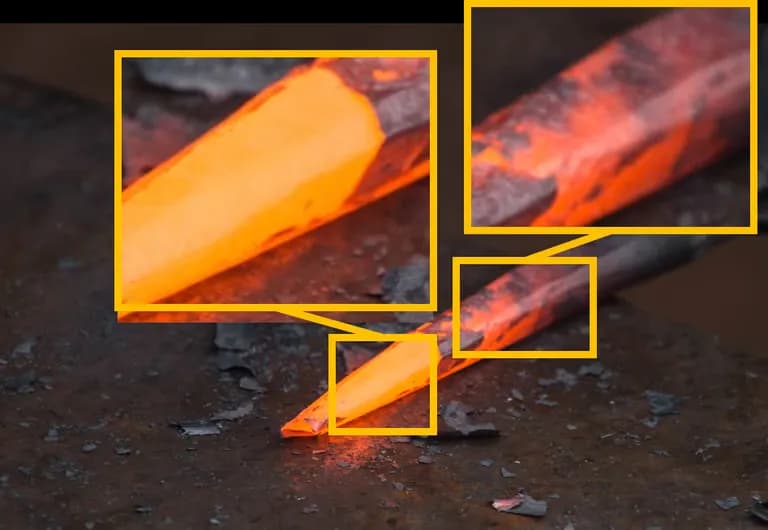
The above photo is of metal heated to a high temperature. Upon observing the photo, you can easily identify the hottest part.

It is likely that the brightest edge is the hottest part.

Furthermore, if you look closely, you'll notice a slight color change.

Uploaded image

The hotter parts of the object appear orange, and the cooler parts appear redder.

This is because the amount of radiant energy emitted and the wavelength at which maximum energy is emitted vary with temperature.

If studied and calculated quantitatively, the temperature of the object can be inferred from just its color and brightness.

This is known as the 'Law of Radiation'.

2. What is a Blackbody?

Uploaded image

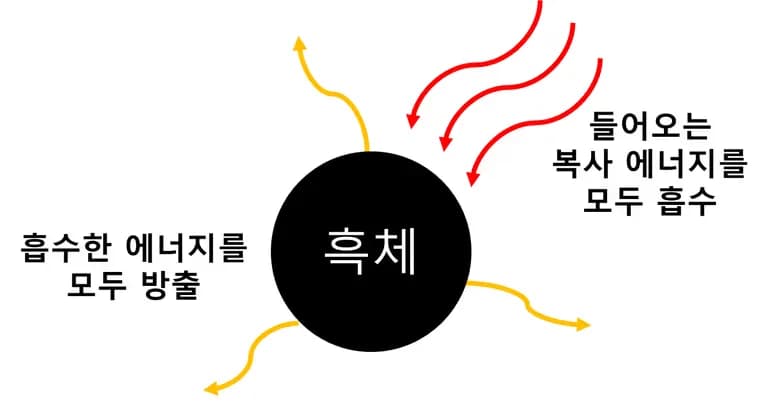
The Law of Radiation starts with the assumption that all objects are 'blackbodies'.

A blackbody is an ideal object that absorbs all incoming radiant energy regardless of angle and emits all absorbed radiant energy.

If a blackbody is not at a high temperature, it would appear completely black when exposed to visible light as it absorbs all wavelengths of light.

Why do we assume such a blackbody?

Uploaded image

The above photo captures black leather. Areas where light is reflected appear bright, while those in shadow appear dark.

This occurs because the black leather surface partially reflects light.

Although black is generally known as a color that absorbs light, absorption and reflection of light occur simultaneously in all materials.

The reflectivity (extent of light reflection) also varies depending on the material type.

Therefore, by assuming a blackbody, one doesn't need to consider the reflectivity of particles regarding radiation by type or angle, thus simplifying the equations.

3. Blackbody Radiation

A high-temperature blackbody emits energy to its surroundings, and when a blackbody maintains a certain temperature, the radiation it emits is known as blackbody radiation.

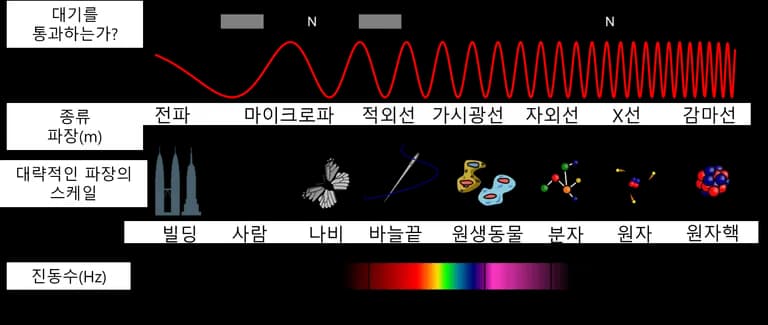
Radiation is how heat is transferred in the form of electromagnetic waves.

Electromagnetic waves can be divided into radio waves, microwaves, infrared, visible light, etc., according to wavelength and frequency.

A blackbody emits energy across the entire electromagnetic spectrum.

However, the issue is that the amount of energy emitted varies by wavelength, and moreover, differs depending on the blackbody's temperature.

The equation for this has been quantified in Planck's Law of Radiation, and the graph representing it is the Planck Curve.

4. Planck Curve

Uploaded image

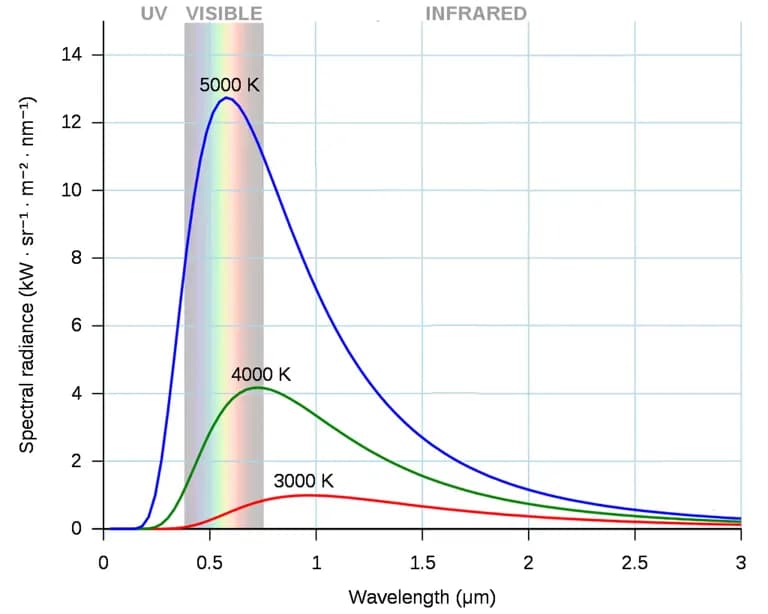
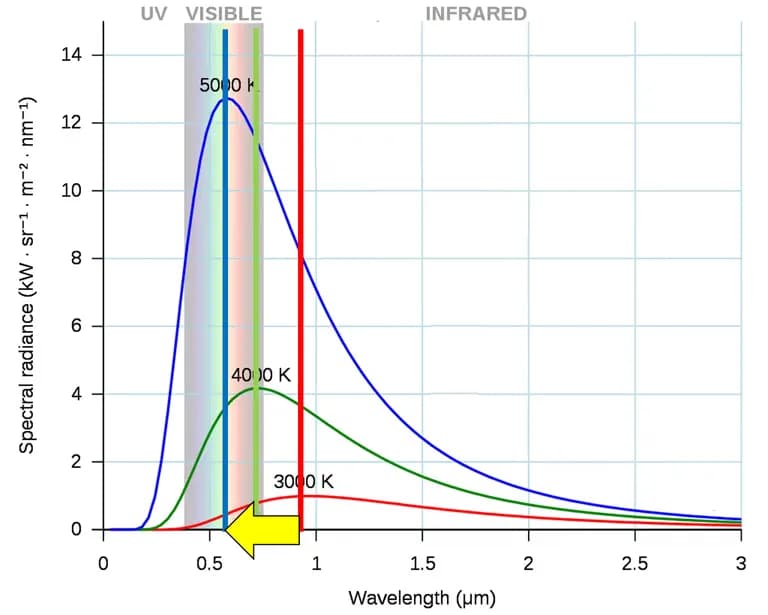
The Planck Curve represents the intensity of energy radiated by a blackbody according to the radiation's wavelength.

For example, a blackbody at a constant absolute temperature of 5,000K emits the most energy in the visible spectrum and less in the ultraviolet or infrared.

Also, when considering the total energy emitted (the area under the Planck Curve), higher temperatures mean more energy is emitted.

Wien's Displacement Law and Stefan-Boltzmann Law effectively describe changes to the Planck Curve relative to temperature.

5. Wien's Displacement Law

Wien's Displacement Law states that the wavelength at which a blackbody emits the maximum energy shortens as the blackbody's temperature increases.

In the graph above, as the blackbody’s temperature increases, you can see the peak point (wavelength with maximum energy emission) moves to the left.

This can be expressed in the following equation.

As always said, there's no need to memorize constants for exams. The key takeaway is that the wavelength of maximum energy emission (λ max) is inversely proportional to the blackbody’s temperature (T).

Using this, if the wavelength of peak emission is known, it's possible to calculate the blackbody's temperature.

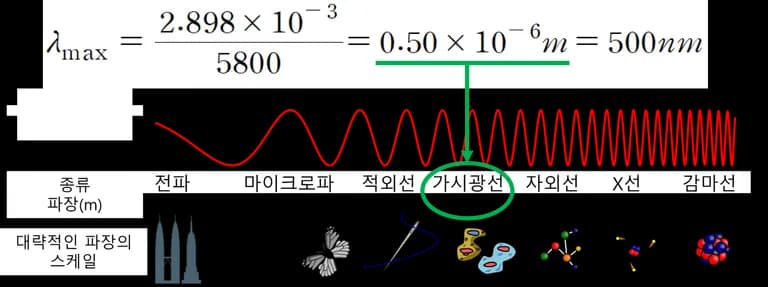
Let's use Wien's Displacement Law to find the wavelength at which the Sun emits its maximum radiation.

The Sun’s photosphere has a temperature of about 5,800K. Substituting this temperature T, we obtain the following value.

As commonly known, the Sun emits its maximum radiation energy in the visible range.

6. Stefan-Boltzmann Law

The Stefan-Boltzmann Law is a formula for the total radiation energy emitted by a blackbody.

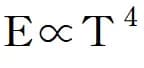
The total radiation energy emitted by a blackbody equals the sum of the energies emitted at each wavelength, represented by the area under the Planck Curve, and is expressed mathematically as follows.

E represents the total radiation energy emitted by the blackbody, and T is the blackbody's temperature.

Removing the cumbersome constant sigma and units from the equation, you get the following.

The total amount of energy emitted by a blackbody is proportional to the fourth power of the temperature.

A high-temperature blackbody emits more energy than a low-temperature blackbody.

7. Conclusion

The key points from the above content are summarized as follows:

  • A blackbody emits radiation energy across all wavelengths of electromagnetic waves.

  • A high-temperature blackbody emits more energy per unit time at all wavelengths than a low-temperature blackbody.

  • The wavelength of maximum energy emission emitted by a blackbody is inversely proportional to the blackbody's temperature. - Wien's Displacement Law

  • The total energy emitted per unit time and per unit area by a blackbody is proportional to the fourth power of the blackbody's temperature. - Stefan-Boltzmann Law

Although the writing got a bit lengthy, I hope it's helpful for students to understand blackbody radiation.

The next article will briefly discuss why stars are assumed to be blackbodies.

댓글을 불러오는 중...