Estimating Galactic Mass - Mass Estimation Methods Through the Virial Theorem

힘센캥거루
2021년 10월 8일(수정됨)
12
earth

In a previous article, we discussed the virial theorem.

This time, we will cover how to estimate the mass of a galaxy using the virial theorem.

If you are not familiar with the virial theorem, please refer to the article below.

1. Estimating Galactic Mass Through the Virial Theorem

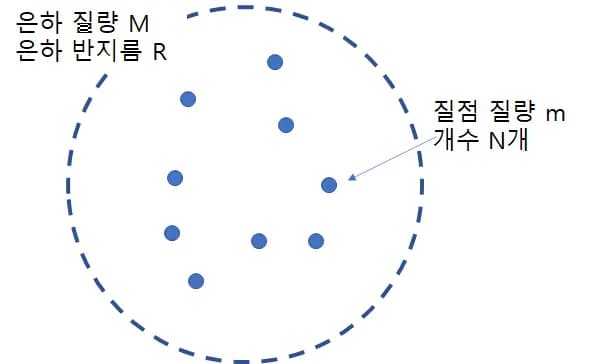
Consider an elliptical galaxy with mass M and radius R containing N point masses of mass m distributed uniformly.

The mechanical energy and kinetic energy of this sphere can be expressed as follows:

The reason for expressing the equation proportionally is as follows:

1) To calculate the mechanical energy of the sphere, we need to integrate the mechanical energy of the spherical shell.
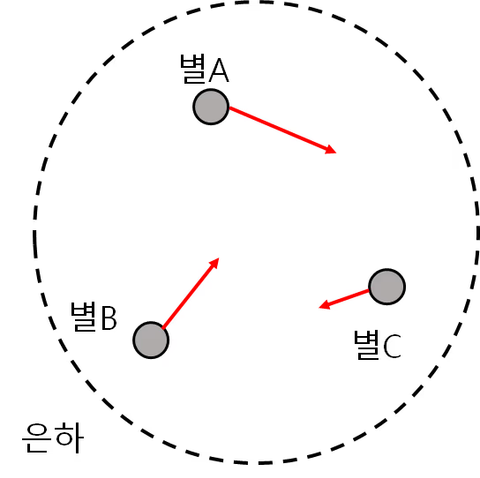
2) To find the average mechanical energy of the particles inside the sphere, we use velocity dispersion. When measuring the spectrum of galaxies or star clusters, both redshift and blueshift appear due to each star's unique movement within the celestial body. This widens the line width, known as Doppler broadening. Using this method, we can determine the velocity dispersion within a galaxy.

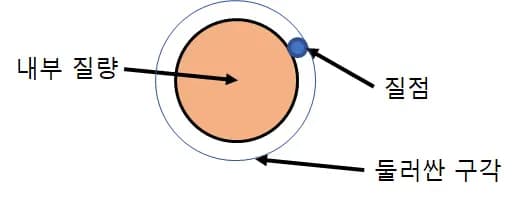
To derive a more quantitative formula, we must integrate the amount of mechanical energy the external point mass has on the internal mass for a uniform sphere.

Another problem is that such external point mass surrounds the internal mass.

Therefore, by using the formula for the volume of a sphere to find internal mass and the formula for surface area to find the amount of point mass, we can proceed.

Of course, we must multiply the volume by density to find the mass. The equation is represented as follows:

Whole density of the sphere being total mass divided by volume can be re-expressed as follows:

This is how the equation comes out. This is why it is expressed in proportional terms.

Within a stable system, kinetic energy equals half of mechanical energy.

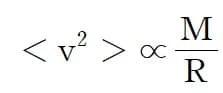
This can be re-expressed in proportional terms as follows:

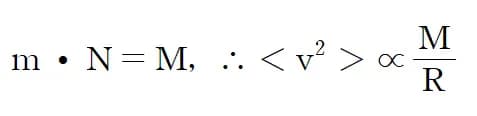
Given that the product of point masses and the number of point masses equals total mass, transforming this provides the equation below:

What this equation suggests is that one can estimate the mass of celestial objects such as elliptical galaxies and galaxy clusters by measuring only velocity dispersion and radius.

Velocity dispersion can be obtained through Doppler broadening, and radius can be determined via angular diameter. By measuring these two, one can roughly estimate the mass of astronomical objects.

2. Estimating the Mass of Gas Nebulae

For gas nebulae, the mechanical energy of gas particles equates to thermal energy, calculated as follows:

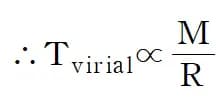
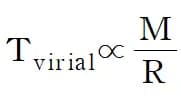
Expressing this equation simply in proportion is as follows:

What this equation means is you can estimate mass by measuring the temperature of gas.

3. Mass Estimation Using the Virial Theorem and Dark Matter

Using methods 5 and 6, i.e., mass estimation using the virial theorem for galaxies or clusters, nebulae, is defined.

This is called gravitational mass or dynamic mass.

There is also another way to estimate the mass of celestial bodies...

This is the mass-luminosity relationship of main-sequence stars.

Simply put, the greater the mass, the more energy it emits.

Therefore, by measuring the luminosity of galaxies and stars, you can estimate their rough mass.

Comparing dynamic mass with the mass of light-emitting materials reveals the existence of dark matter.

Since dark matter does not emit light, if there is a lot of it, the M/L value will be much greater than 1. If there is less dark matter, it will be close to 1. The M/L ratio for galaxies and large-scale structures is shown below:


Spiral galaxy

Elliptical galaxy

Galaxy group

Galaxy cluster

M/L ratio

2~10

1~200

~180

~200

This indicates the existence of dark matter.

4. Conclusion

1) By measuring the velocity dispersion and radius of stars within celestial bodies like elliptical galaxies or star clusters, one can estimate the galaxy's mass using the virial theorem.

2) By measuring the temperature and radius of gas-based celestial bodies, one can estimate the galaxy's mass using the virial theorem.

3) A very high M/L value for a celestial body's mass estimated via the virial theorem compared to optical brightness suggests the presence of dark matter.

This article discussed estimating the mass of galaxies through the virial theorem, comparing it with the mass of light-emitting substances to reveal the existence of dark matter.

It's amazing how much we still can't discover despite the advancement of scientific technology.

If there is any error or you have questions, please comment.

댓글을 불러오는 중...