Understanding the Virial Theorem - Easy with High School Physics

힘센캥거루
2021년 8월 31일(수정됨)
19
earth

This article is written because there doesn't seem to be a clear explanation of the virial theorem.

It may be useful for those preparing for teaching exams or science high school students.

Before reading this article, make sure to understand how mechanical energy, potential energy, and circular motion are physically described.

In this article, we will explore the virial theorem, and in the next article, we will look at estimating a galaxy's mass through the virial theorem.

1. Virial Theorem

The virial theorem describes the forces among multiple particles moving chaotically.

In astronomy, the use of the virial theorem is crucial because the formation of stars and galaxies isn't done at a single mass point but through the sum of irregularly moving multiple mass points.

In astronomy, the virial theorem is the sum of both the momentum and direction of particles.

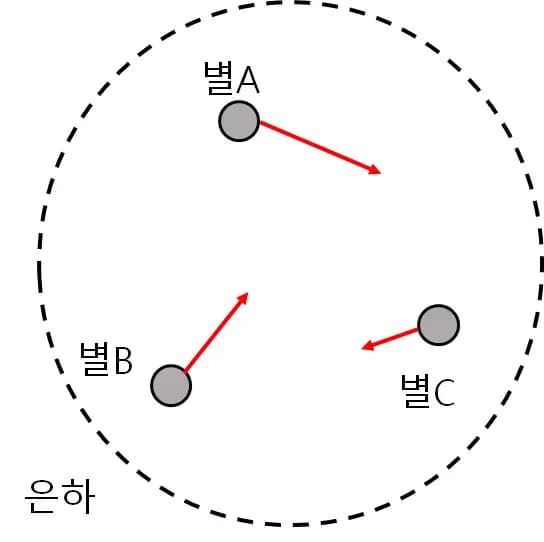
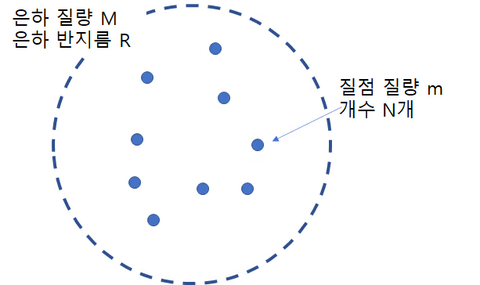
For instance, suppose there's a galaxy with only three stars, as shown above.

Within this galaxy, you must sum the products of the momentum and direction of all celestial bodies in motion. Calculating the virial theorem from this galaxy would look like this.

Although difficult to understand when viewed directly, the change in the virial value over time reveals its significance.

To understand this, let's examine what meaning differentiating the product of momentum and direction over time has. We will define the equation as follows.

Mass of object = m, velocity = v
Acceleration = a, momentum = p = m * v
Gravity = F
dp/dt (change in momentum over time) = ma = F

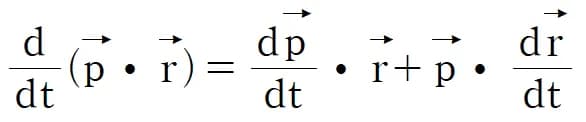
When differentiating the product of distance and momentum over time, we get the following equation.

Here, the change in momentum over time equals force, and the change in distance over time equals velocity, so this equation can be modified as follows.

Ultimately, differentiating the product of momentum and direction over time results in the sum of the mechanical energy an object possesses.

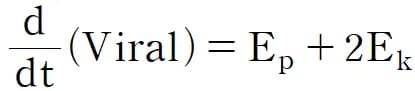
Similarly, differentiating the virial value over time yields the sum of the mechanical energy of a system.

The value equals the sum of twice the potential and kinetic energy of the system.

When the virial theorem is applied to the galaxy above and differentiated over time, the result is the sum of the mechanical energy of stars A, B, and C.

If a galaxy or nebula is stable and in equilibrium, there should be no change in mechanical energy.

Therefore, there should also be no change in the virial value.

In a mechanically stable and equilibrium state galaxy or nebula, the total mechanical energy internally is half of the total potential energy.

This allows the mass of a galaxy or gas nebula to be calculated if its size, velocity dispersion, and temperature are known.

2. Virial Theorem in Unstable Systems

If the system is not stable, the virial value will continuously change.

If the virial value decreases, the system will shrink; if it increases, the system will expand.

This can be used to calculate the maximum compressible mass when a star is being formed.

3. Understanding the Virial Theorem with High School Physics

Now let's look at how this equation can be easily understood at the high school level.

Celestial bodies are constrained by mutual gravity.

The virial theorem is the integral of all celestial bodies under mutual constraints, but in the end, it equals the sum of the mechanical energies in one celestial body.

Therefore, we will see how the mechanical energy of a single celestial body is calculated.

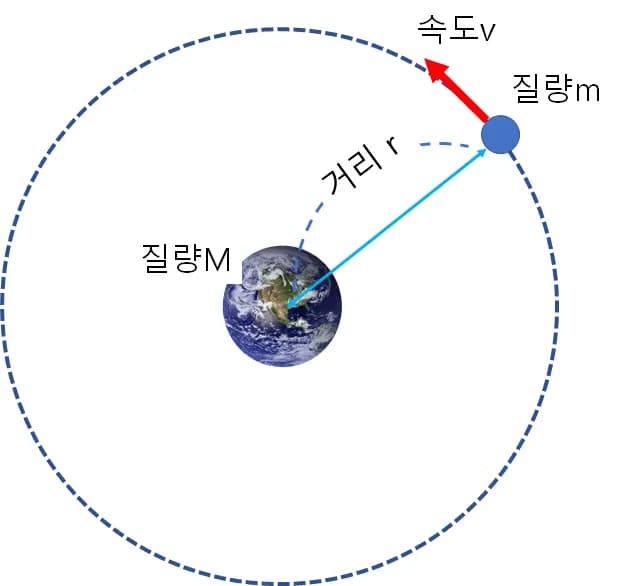
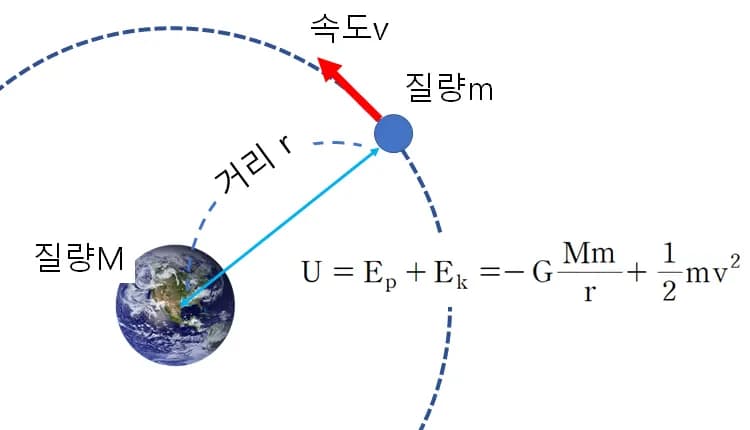
Suppose a mass m is revolving around Earth, as shown above.

The celestial body orbits around Earth.

At this time, the mechanical energy of the celestial body is as follows.

Let's find the speed of circular motion.

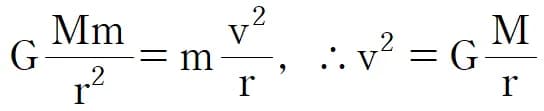
Circular motion occurs due to gravity, so the centripetal force and gravity should be equal.

When rearranged in terms of speed:

This produced the following equation.

Let's plug this into the mechanical energy of the celestial body described initially! Then...

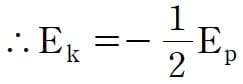
This is the conclusion.

Ultimately, in a gravitationally bound system, the total kinetic energy equals half of the potential energy.

This conclusion matches the one derived from the virial theorem above.

The important thing is how this can be used to estimate the mass of celestial bodies.

This will be covered in the next post.

4. Virial Theorem and Radiative Emission

If a celestial body very far from Earth approaches Earth and eventually becomes gravitationally bound, what happens to the total energy of the system?

Assuming the object was initially stationary, the total energy of the system would have been zero.

But if this celestial body is gravitationally pulled in and begins orbiting Earth, the potential energy decreases and converts into kinetic energy.

In this case, when assuming the system is in a 'stable' state and calculating the total mechanical energy, interestingly, the energy decreases compared to the beginning.

Half of the potential energy of the bound celestial body disappears.

The disappeared energy is converted into heat.

Because space is a vacuum, conduction and convection mean the energy remains in the system and isn't lost.

However, radiation is free from this, so it can escape into space.

Therefore, in a stable system, this amount of energy must leave the system through 'radiative emission'.

5. Conclusion: What is the Virial Theorem?

1) The virial theorem is the sum of the momentum and direction of mass points inside a celestial body.
2) The change in virial value over time determines the stability of celestial bodies.
3) In a stable and equilibrated celestial body, there is no change in the virial value, and this can be used to estimate the mass of celestial bodies.

Next time, we will look at methods for estimating celestial masses using 3). Those who wish to continue reading can follow the link below.

댓글을 불러오는 중...