In Earth science, when learning about westerly wave patterns and western intensification, vorticity is something that cannot be excluded.
When I first learned about vorticity, I had no clue what it was.
In the hope that students wishing to start studying meteorology or oceanography can understand vorticity more easily, I wrote this article.
1. Definition of Vorticity
Vorticity is one of the pseudo-vector fields that describes the local rotational motion (a measure of the tendency to rotate) of a continuum at a point observable by an observer located at that point moving with the flow. - Source: Wikipedia- |
Vorticity is described as such in Wikipedia.
It's difficult to understand just from reading that.
Simply put, it can be thought of as the tendency to rotate an object.
Then, in what situations and how does the object rotate? Let's explain with a few examples.
2. Qualitative Understanding of Vorticity
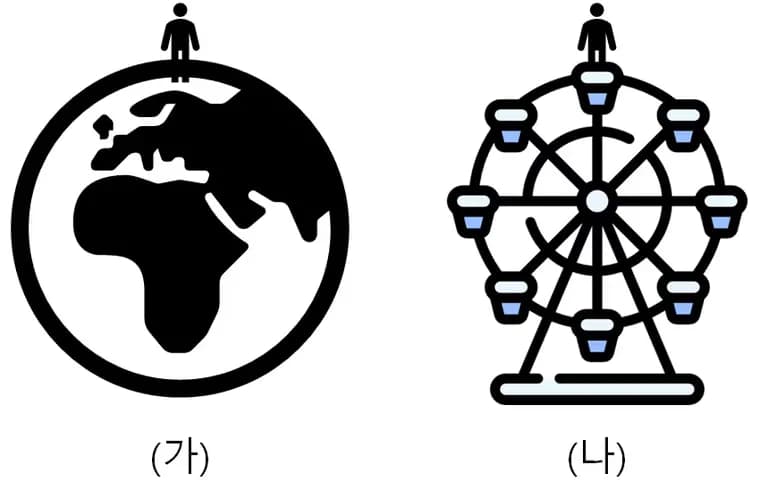
Consider two scenarios like the following figure.
(a) represents a person on the rotating Earth, and (b) represents a person inside a rotating Ferris wheel.
What differences are there in the rotational component of a person when both the Earth and Ferris wheel are rotating?
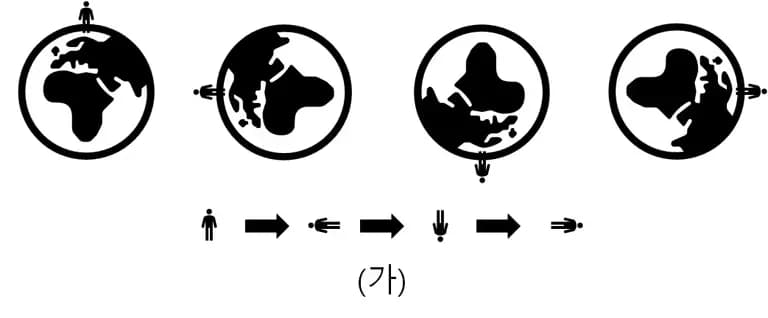
In case (a), the person also makes a complete rotation while the Earth rotates.
If the Earth rotates counterclockwise as shown in the figure below.
The person's movement is as follows.
This is called a rotational flow when there is a rotational component (rotation) and, in terms of fluid dynamics, vorticity exists.
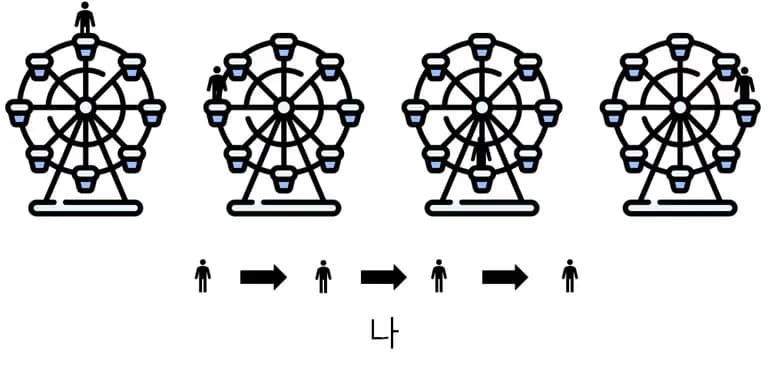
In case (b), there is no rotation of the person during one complete turn of the Ferris wheel.
From the perspective of the person, they are simply standing still.
When there is no rotational component like this, it's called a non-rotational flow, and we say there is no vorticity in the fluid.
As such, vorticity refers to the rotational component within a fluid.
However, vorticity is generally not discussed in terms of particles.
As mentioned in the definition of vorticity, vorticity is represented by a vector field.
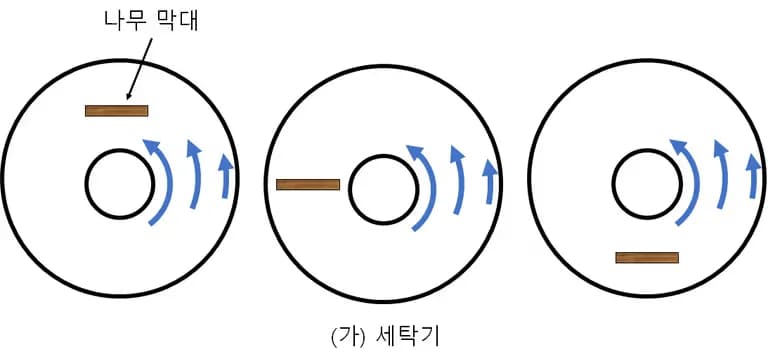
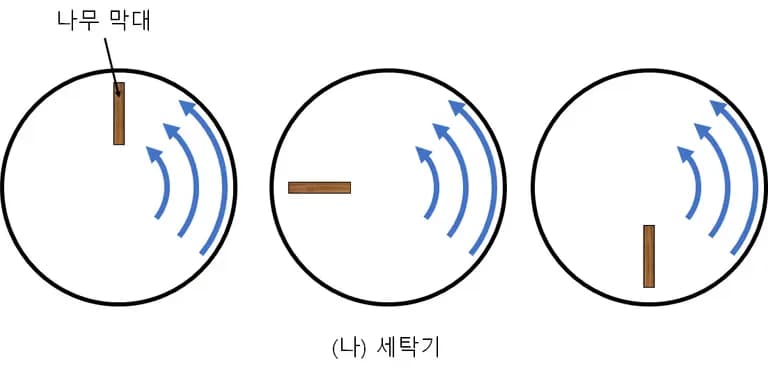
To understand this, let's look inside a top-loading washing machine portrayed below.
In case (a), the washer's agitator rotates and moves the laundry, and in case (b), the drum of the washer rotates and moves the laundry.
The flow within each drum is shown with arrows.
If you want to check whether vorticity exists within each drum, just insert a stick into the drum.
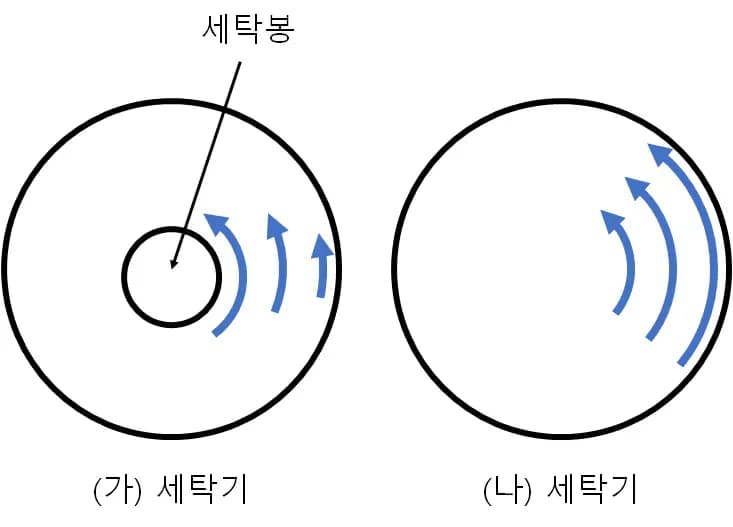
In case (a), as you move from inside to outside, the fluid's speed decreases.
Upon inserting the stick, due to the internal speed being fast and the external speed being slow, the stick will rotate around the agitator but will not spin on its own.
Such a fluid is called a non-rotational flow.
There are no internal rotational components in the fluid.
In case (b), as you move outward, the fluid's speed increases.
Different from case (a), if you insert a stick, it will rotate with the washer.
This tendency to try to rotate itself is called vorticity.
Therefore, in the fluid inside washer (b), vorticity exists, and it's called a rotational flow.
3. Quantitative Expression of Vorticity
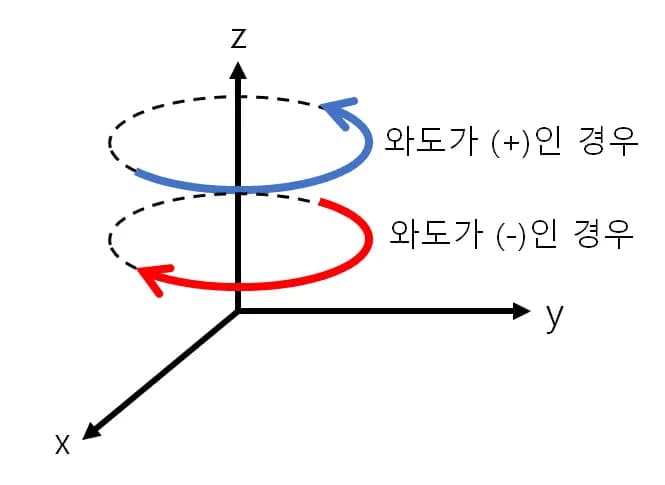
Now let's represent vorticity as a vector.
The direction of vorticity is similar to the right-hand rule in electric current.
Define counterclockwise vorticity as positive (+) and clockwise vorticity as negative (-).
It's expressed as rotation concerning the x, y, and z axes.
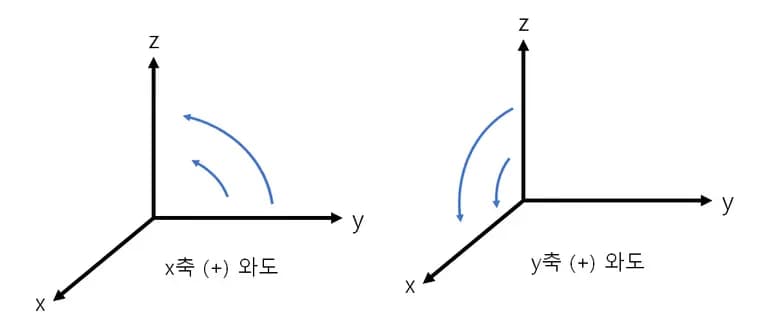
However, when defining vorticity in the atmosphere or oceans, vorticity in the x and y directions is not considered.
The reason is that the force of vorticity is significantly smaller compared to atmospheric pressure.
This is similar to why the Coriolis force is neglected in small-scale atmospheric movements.
Therefore, we focus on vorticity along the z-axis, namely vorticity in the xy-plane.
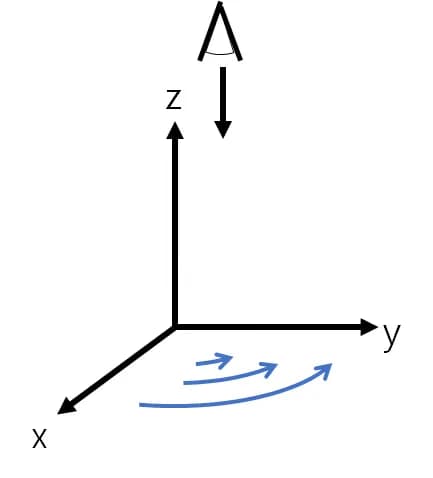
First, the rotational flow in the xy-plane about the z-axis is depicted as above.
The figure below is based on positive vorticity in the z-axis direction (+).
From now on, we will express the wind speed in the x-direction as u, in the y-direction as v, and in the z-axis direction as w.
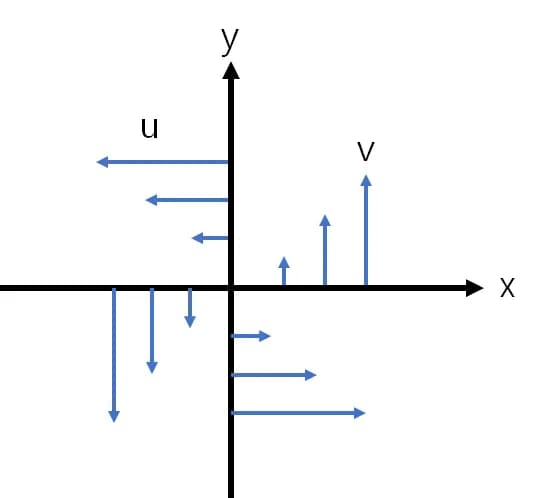
In the above figure, as the x-axis value increases, the y-direction speed increases, and as the y-axis value increases, the x-direction speed increases in the (-) direction.
Adding these two values results in vorticity (ζ, zeta).
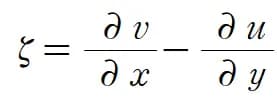
In more precise terms, it's expressed as the rotation (curl) concerning all axis directions of the wind speed (ω, omega).
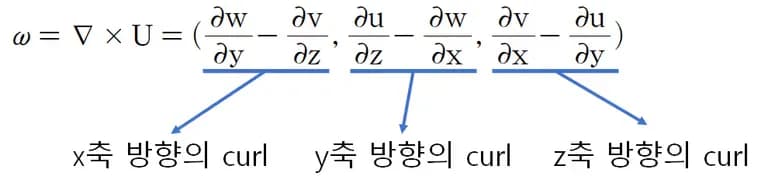
In large-scale meteorology and oceanography, only the curl concerning the vertical component z is considered, which is called vorticity.
4. Conservation of Vorticity: Relative Vorticity and Planetary Vorticity
If you have understood the previous sections, it’s time to delve deeper into vorticity.
First, there are three types of vorticity that students learn: absolute, relative, and planetary vorticity.
Absolute vorticity is the sum of relative vorticity and planetary vorticity, and just like all energy is conserved, absolute vorticity is conserved.
Relative vorticity is the vorticity of the fluid moving on the Earth, and planetary vorticity is the vorticity due to the Earth's rotation.
Relative vorticity, which is the vorticity of the air itself, is easy to understand, but it is not easy to comprehend what planetary vorticity means.
The figure below (a) shows the view of the Earth from the North Pole with its rotation speed, and (b) shows the coordinate system and position of an air parcel moving from the equator to the pole.
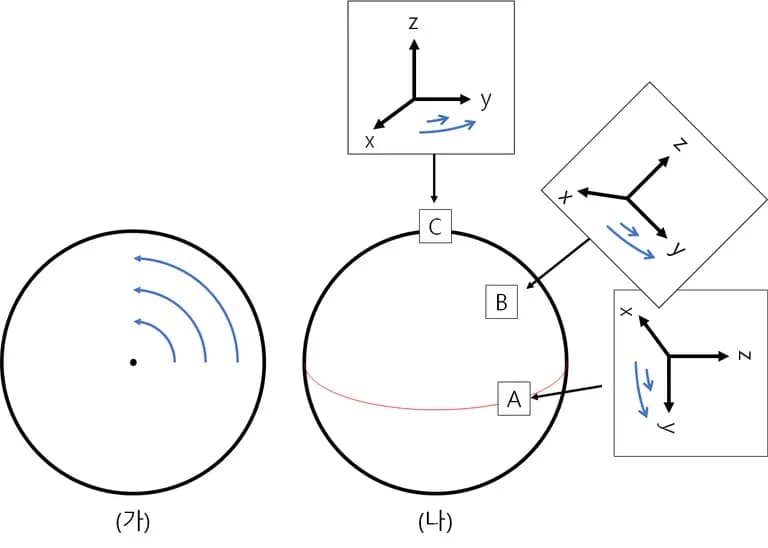
From the view in (a), the Earth is performing disk rotation around its axis.
The rotation speed near the equator is fast, while it is slow near the poles, and the fluid on Earth has vorticity in the direction of the axis of rotation.
In (b), it shows an air parcel moving from point A on the equator to point C via B.
As the surface position changes, the coordinate system of the air also rotates along the surface. At this point, the z-axis vorticity of the air, which was initially zero, increases.
Since all energy should be conserved, vorticity must also be conserved, so the increase in z-axis vorticity must be accompanied by a reduction in the air's vorticity.
Thus, relative vorticity decreases, and there is a tendency for clockwise rotation.
This is represented by the formula below.

5. Conclusion
1) Vorticity represents the tendency to rotate, and vorticity in the atmosphere and ocean is vorticity about the z-axis.
2) Planetary vorticity is the rotation of the axis due to the Earth's rotation, and relative vorticity is the vorticity of the air itself.
3) The sum of relative and planetary vorticity is called absolute vorticity. As vorticity should be conserved, absolute vorticity is constant.
4) As latitude increases, the coordinate system at the surface rotates, increasing the z-axis vorticity.
5) Since absolute vorticity is constant, the relative vorticity, i.e., the air's own z-axis vorticity, must decrease.
Today, based on the understanding of vorticity, we explored the concepts of absolute vorticity, relative vorticity, and planetary vorticity.
If there are many views on this article or many comments, I might write the next one about Rossby waves and westerly wave patterns.
If this helped in understanding, please leave a comment or express your appreciation.
Even a single expression of appreciation can be a great encouragement to the author.

댓글을 불러오는 중...