In high school Earth Science, you learn that all performance aspects of a telescope are related to its aperture.
Magnification is not a very important factor because it can be changed as much as desired simply by swapping eyepieces.
The most important factors are light-gathering power and resolution.
You probably know that light-gathering power increases with the square of the telescope's aperture because the larger the area receiving light, the more light it collects.
But why is larger aperture better for resolution?
1. Light Diffraction
Diffraction is the phenomenon where waves bend around obstacles and spread into the region beyond.
Due to diffraction, the path of light near an obstacle gets altered. Since light is a wave, this diffraction occurs.
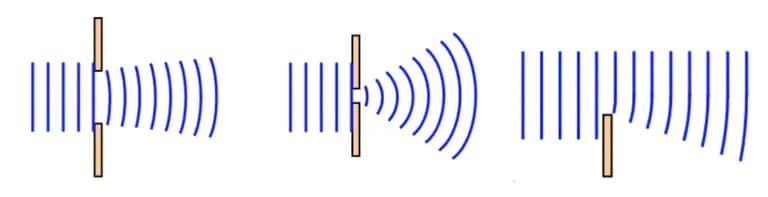
When light passes through a narrow space, it exhibits unique patterns due to path differences.

At this time, the size of the patterns created by diffraction is proportional to the wavelength and inversely proportional to the size of the space (slit) that the light passes through.
The problem is that this phenomenon also occurs when observing stars or planets through a telescope.
2. Resolution and Single Slit
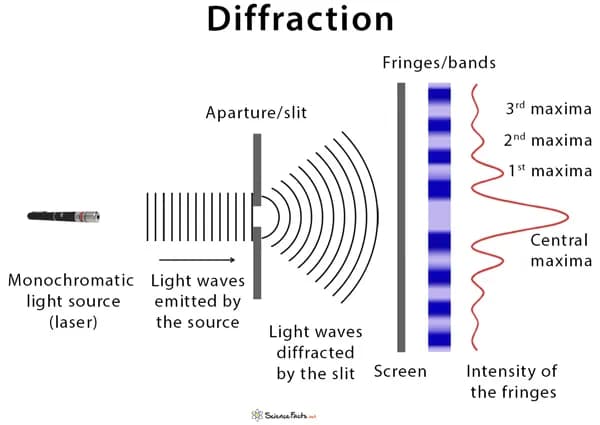
When observing stars, the telescope's aperture acts as a kind of single slit.
In the image above, just like light diffracts when passing through a single slit, light diffraction occurs at the edge of the telescope's aperture, causing images to appear blurry.
The image below shows a telescope with an aperture stop, capturing point light sources that are 0.5mm apart as the aperture changes.
The larger the amount of light entering through the open aperture, the better the light is resolved.
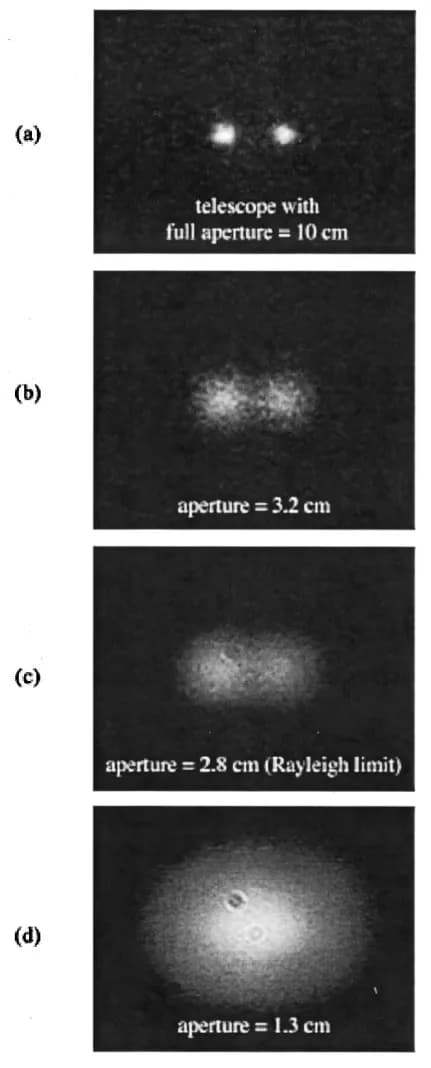
In case (c) of the image, the two objects start to appear conjoined, meaning that from the observer's perspective, any objects closer than this distance will appear as one.
The angle between the two objects as observed is called the resolution.
Therefore, the smaller the resolution, the clearer the object can be seen, and a smaller resolution indicates better performance.
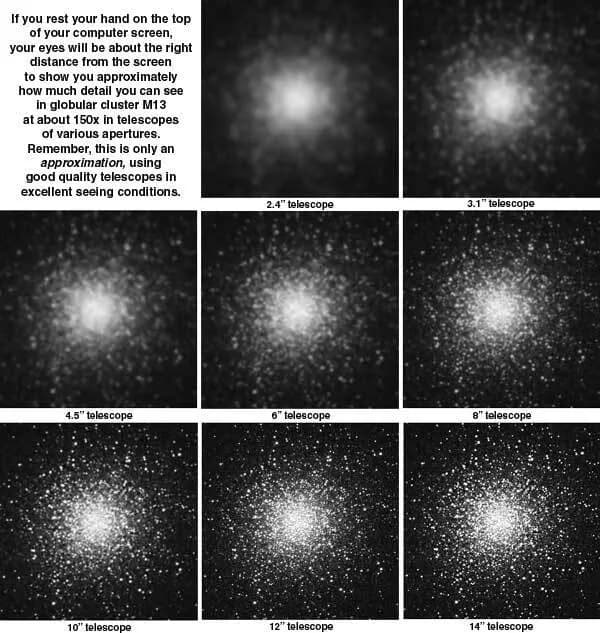
The image above shows the globular cluster M13 with varying telescope apertures.
The larger the aperture, the clearer the image appears. If the aperture is small, no matter how good the magnification is, the image will only appear blurry, making it impossible to observe objects accurately.
3. Resolution is Inversely Proportional to Aperture.
This is why the resolution formula of a telescope and that of a single slit are similar.
Diffraction at the front of the telescope blurs the object's image.
Therefore, the larger the telescope's aperture and the shorter the wavelength, the smaller the resolution value, allowing the observer to obtain a better image.
That's why a larger aperture is always better for telescopes.
It's impossible to understand the various formulas seen in Earth Science by only studying Earth Science alone.
Studying physics and chemistry along with Earth Science can greatly help in understanding these formulas.



댓글을 불러오는 중...