In astronomy, to represent a planet or celestial body moving in an elliptical orbit on a coordinate system, the method known as the true anomaly is used.
However, before reading this article, it is recommended to know the basic concepts regarding the geometric properties of ellipses, Kepler's laws, and the description of circular motion.
1. True Anomaly
The true anomaly refers to the angular distance (angle) from the periapsis of the celestial body's orbit.
The true anomaly is measured counterclockwise from the periapsis.
But why define the true anomaly despite having the ellipse equation?
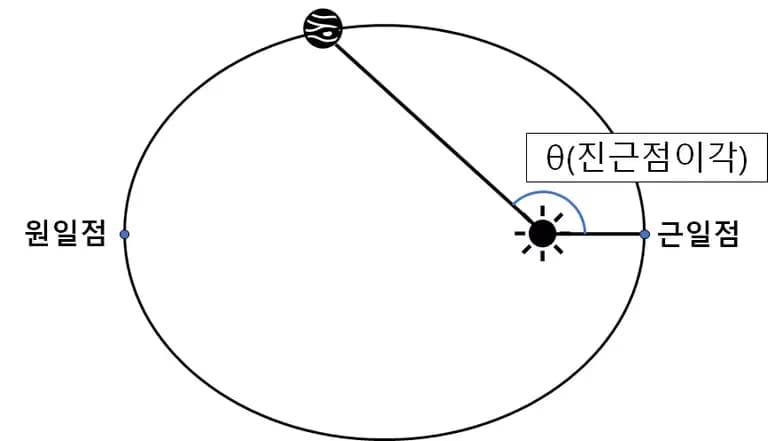
Let's assume there's Jupiter orbiting the Sun as shown above.
Since the Sun, the most crucial factor influencing Jupiter's orbital movement, is at one focus of the ellipse, moving the coordinate system's axis to this focus makes it easier to express various elements.
For example, using the true anomaly, semi-major axis (a), and eccentricity (e), it is easier to express Jupiter's orbital speed on the coordinate system.
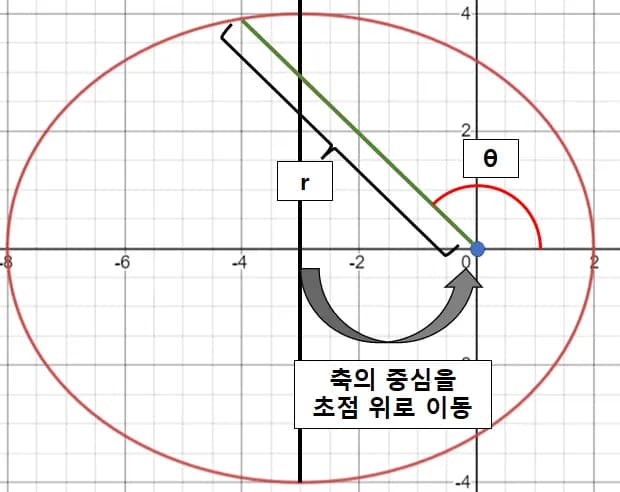
2. Three Elements of an Elliptical Orbit for True Anomaly
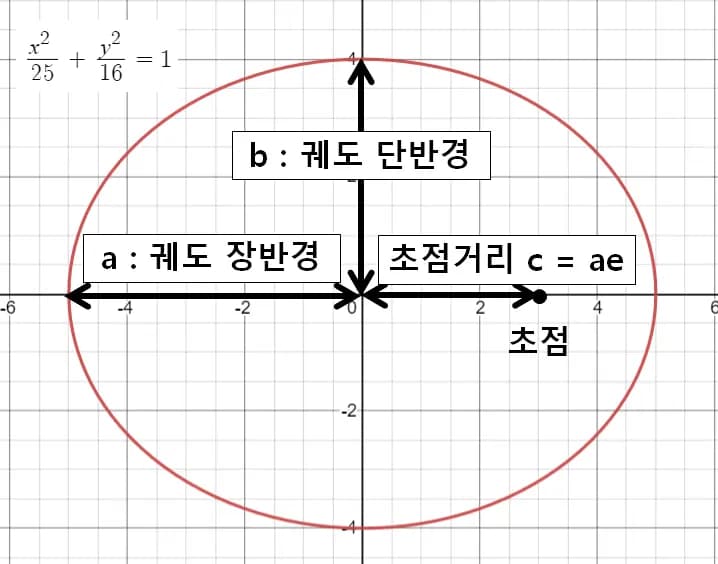
In the true anomaly, all elements are expressed with the semi-major axis (a), semi-minor axis (b), and eccentricity (e).
Those familiar with the ellipse equation know the semi-major and semi-minor axes, but the concept of eccentricity (e) might be unfamiliar.
Eccentricity refers to the value obtained by dividing the distance between the foci of the orbit by the semi-major axis and represents the degree of flattening.
Eccentricity holds a value between 0 (a perfect circle) and 1 (a straight line).
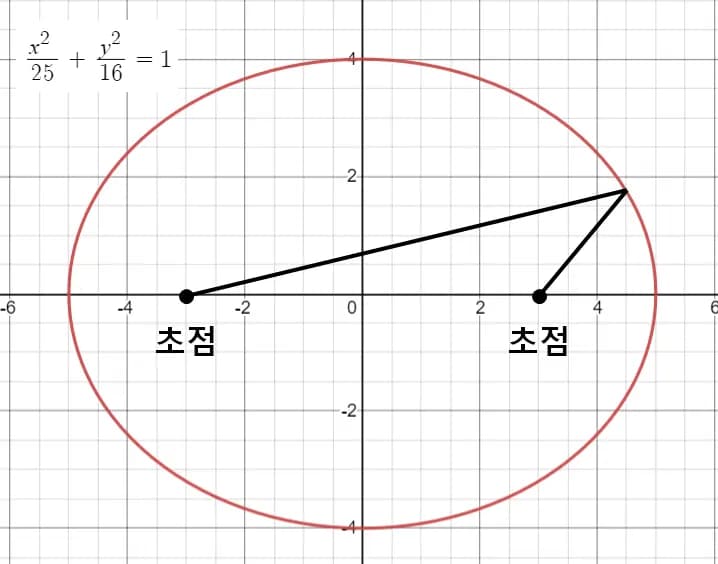
3. Expressing the Sun-Planet Distance Using True Anomaly
This time, we’ll try to express the distance (r) from the Sun to a planet using the true anomaly (θ).
Assume that the Sun is at the right focus of two foci, and the planet is at a position with a true anomaly (θ) from the periapsis, as shown below.
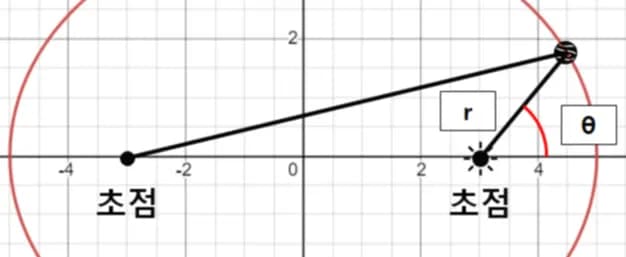
In this scenario, one can assume a right triangle as shown below.
Here, you can use Pythagorean theorem.
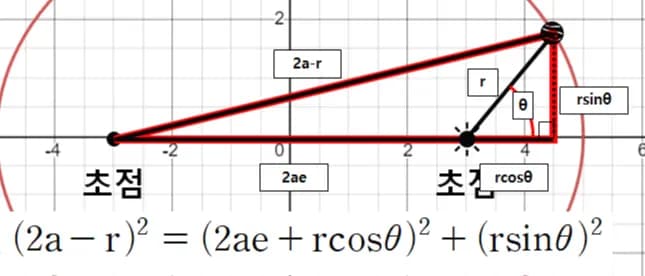
Let's solve this equation step by step.

Here, since sin²θ + cos²θ = 1, we can eliminate r² on both sides.
Then let's divide both sides by 4 and simplify.
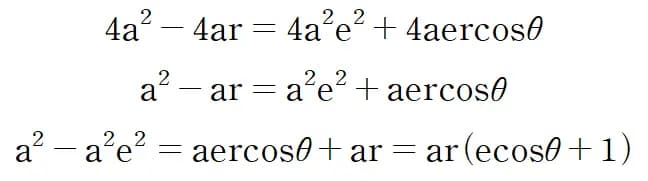
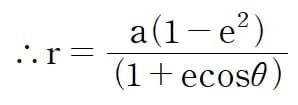
Now, by solving for r, we obtain the following equation.
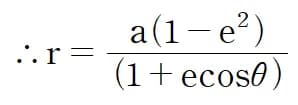
Using this equation, you can calculate the distance between the Sun and a planet using the true anomaly, semi-major axis, and eccentricity.
4. What is True Anomaly?
It refers to the angular distance from the periapsis of the planet.
The reason for using the true anomaly is to better express the position and speed of the planet.
The distance between the Sun and a planet can be expressed as follows.
5. Conclusion
Today, we learned about the true anomaly, which is fundamental for studying solar system mechanics.
Remember that this formula can be applied not just to the solar system but to all celestial bodies.
Next time, I'll write about calculating a planet's speed and mechanical energy using true anomaly.




댓글을 불러오는 중...