I found that Seoul National University opened a training course for teachers titled Educational Research and Statistical Analysis.
Since I’m thinking of writing a thesis next year, I decided to take it.
Today is Day 1.
It’s about reading quantitative research.
1. Non-experimental research
Non-experimental research is research in which the researcher does not directly conduct an experiment, but explains relationships by observing phenomena that already exist.
The training begins by reading the paper below.
In this post, I’ll say in advance that the source of the tables and figures is the paper below.
Yang Min-seok, Jeong Dong-uk. (2015). An analysis of the effect of breakfast on academic achievement. The Journal of Educational Administration, 2015, 33(2), 27-54According to the introduction of the paper, one of the reasons for implementing a 9 a.m. school start at the time was to make sure students could eat breakfast, and the authors wanted to find out whether such a policy was meaningfully correlated with improved grades.
Since the researchers could not obtain the data themselves, they conducted the study using 1–2 year data from elementary, middle, and general high school students in the Gyeonggi Education Longitudinal Study.
The actual data can be obtained from the Gyeonggi Institute of Education website below.
Conducting research based on such data involves several issues.
To give a simple example, the reason a student doesn’t eat breakfast may be that their parents are indifferent, or that they don’t have parents.
In other words, differences in grades may be due not to breakfast itself, but to other factors.
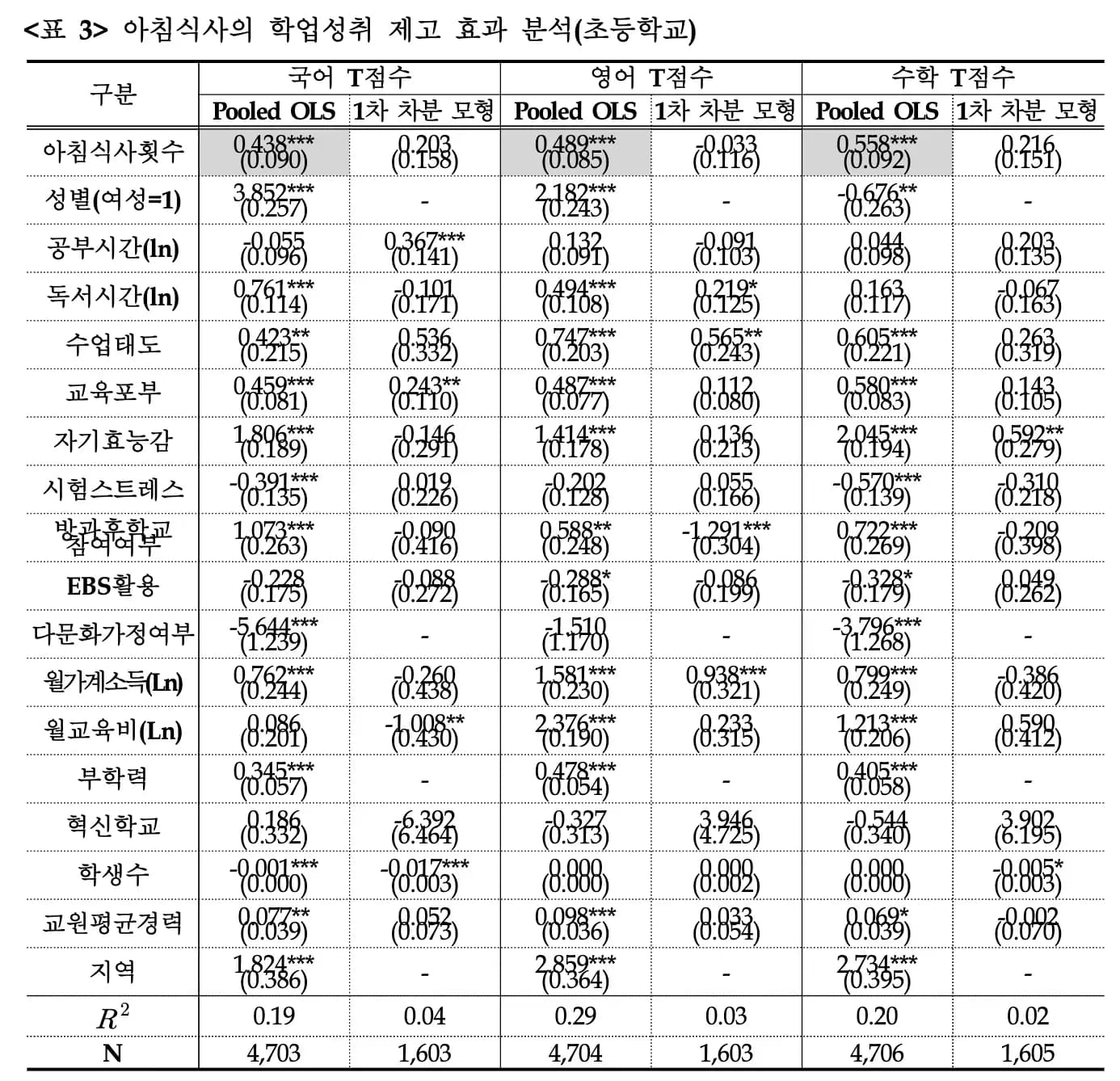
Because the data were collected without any intervention, intention, or refinement by the experimenter, the correlation between cause and effect is not clear.
Accordingly, a third party cannot know these pre-existing differences from the data alone.
Therefore, the variables must be adjusted, and various variables other than breakfast are statistically analyzed.
2. Results in the paper
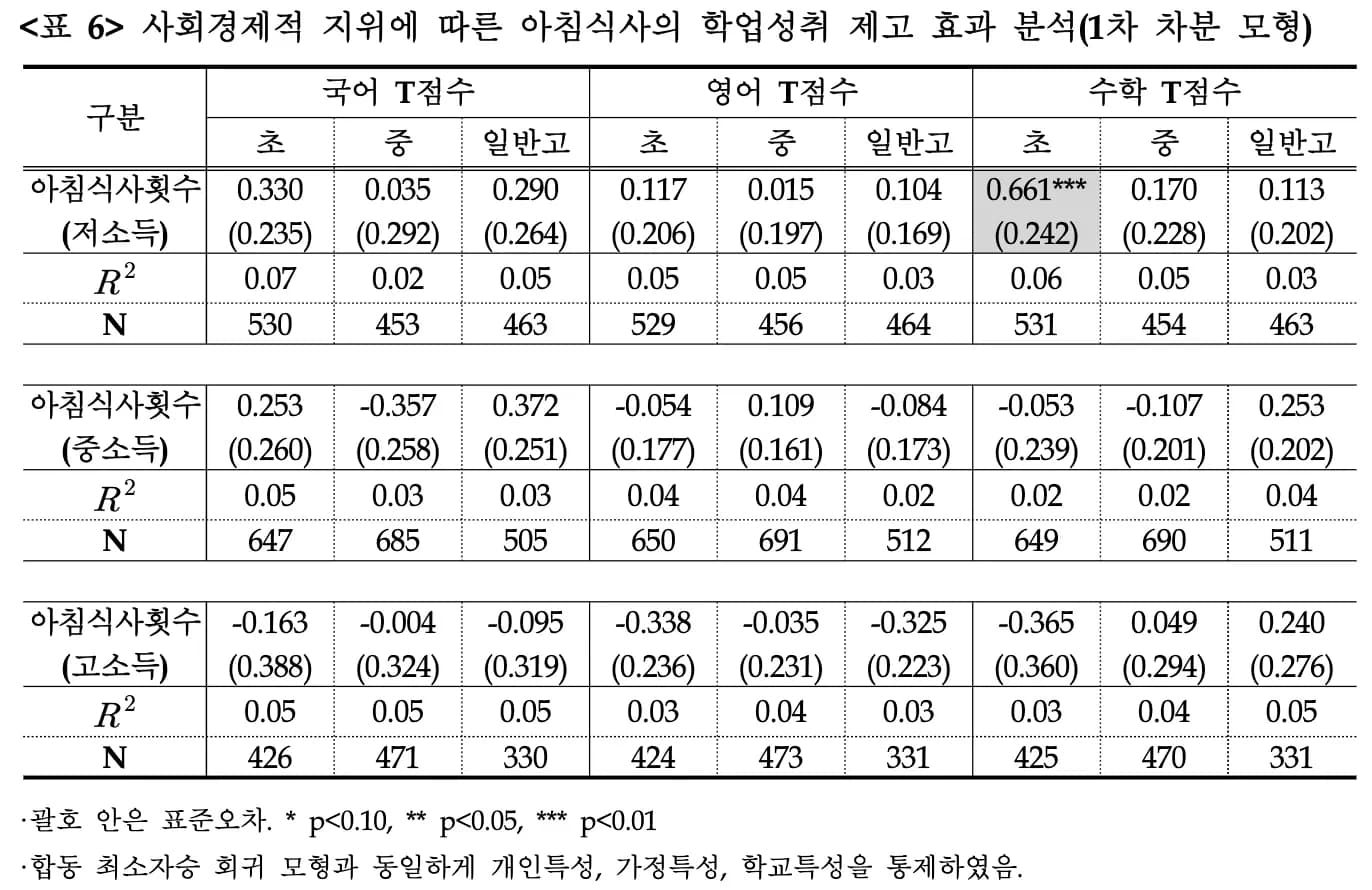
The author judged that, among the analytical methods, the first-difference model was more reliable.
When the data were analyzed using a first-difference model, the conclusion was that only the math scores of low-income elementary school students showed a significant correlation.
Since the correlation between breakfast and grades, which was a common social belief, is not significant, the author argues that breakfast should be carefully considered as grounds for policy implementation, and that policy interventions related to breakfast are needed for low-income students.
3. Response in the media
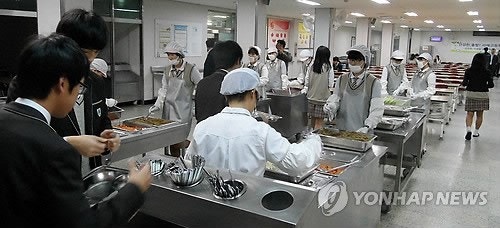
Judging from the headline of the media report, it seems to have been reported with a title somewhat at odds with the findings of the study.
Looking at the content, it is the same as the results of the paper, but I get the impression that, given the nature of news that must attract public attention, they chose a title that fits social common sense.
4. Large-scale non-experimental data in the Korean education field
National-level data | Regional-level data |
|---|---|
Korean Education Longitudinal Study (Korean Educational Development Institute 🔗) | Seoul Education Longitudinal Study (Seoul Metropolitan Office of Education Research & Information Institute 🔗) |
Korean Education & Employment Panel Survey (Korea Research Institute for Vocational Education & Training 🔗) | Gyeonggi Education Longitudinal Study (Gyeonggi Institute of Education 🔗) |
Korean Children and Youth Panel Survey (National Youth Policy Institute 🔗) | Daegu Education Longitudinal Study (Daegu Future Education Research Institute 🔗) |
The above are examples of national-level and regional-level data presented in the training.
They are said to be representative, as sophisticated methods such as sampling design are used when collecting the data.
5. Reflections
When I looked up the actual paper, I found that, in addition to what was covered in the training, a great many elements were set as variables.
Non-experimental research makes data easy to obtain, but it seems you have to spend much more time eliminating variables that affect the object of study.
If I ever write a thesis, I feel that instead of this kind of non-experimental research, it might actually be easier to do experimental research by conducting a few lessons in my own classroom and administering surveys.
And learning by reading papers like this is fun, so the 100,000 won fee doesn’t feel like a waste at all.


댓글을 불러오는 중...